If you ask ChatGPT or Claude which streaming service to subscribe to, one name comes up almost every time, and it probably won’t surprise you. What I wanted to find out was everything around it: how often AI talks about each brand, which ones it actually recommends when someone asks for advice, and why a brand can be mentioned a lot without ever being put forward.
Streaming makes a good test case for that, because everyone knows the market and the four big services are easy to compare. I had already looked at netflix.com’s SEO with Semrush MCP (that test is in my guide to setting up Semrush MCP in ChatGPT and Claude), so this time I wanted to see the other side, what AI says about Netflix and its rivals. I looked up Netflix, Disney+, HBO Max and Prime Video in Semrush’s AI Visibility Toolkit, then asked ChatGPT and Claude the questions a normal subscriber would ask. The method is simple enough that you can run the same AI visibility audit on your own brand afterwards, and if you want a wider view of the tools available, I’ve also put together a selection of the best AI visibility tools.
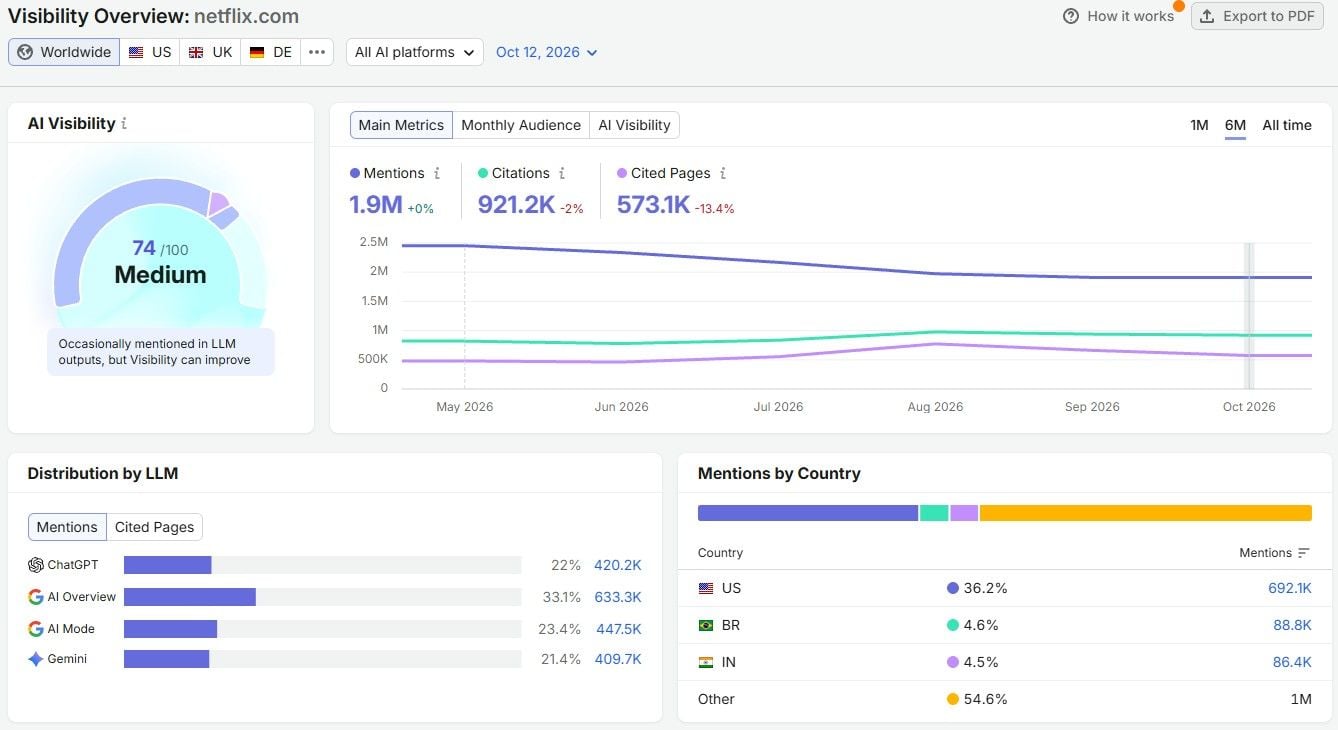
- Netflix has the highest AI Visibility score in Semrush (74/100), ahead of Prime Video and Disney+ (60) and HBO Max (52).
- In my open prompts, Netflix was named in every answer and came first in all of them.
- Prime Video gets 1.2M AI mentions, twice as many as Disney+, but ChatGPT didn’t name it once when I asked which service to pick.
- Cited pages fell by 9.5% to 13.4% over six months for all four brands, including HBO Max and Prime Video, whose mentions actually grew.
How I ran this AI visibility audit
I kept the method simple on purpose, so that anyone can repeat it. It has two steps:
- Measure at scale. I looked up netflix.com, disneyplus.com, hbomax.com and primevideo.com in the Visibility Overview report of the AI Visibility Toolkit, with these settings: worldwide, all AI platforms, data as of October 12, 2026, and a six-month view.
- See what a user sees. On October 13, 2026, I ran four prompts in ChatGPT and in Claude, each in a fresh chat with no history and no connected tools. Two of them were open questions with no brand named, and the other two were head-to-head comparisons.
The first step tells you how often AI talks about each brand across millions of answers, and the second tells you whether AI actually recommends it when someone asks for advice. I ran each prompt only once, so I’d treat the second step as an illustration of what a user might see, and leave the measuring to the first.
What Semrush’s AI Visibility Toolkit shows
| Metric (worldwide, Oct 2026) | Netflix | Prime Video | Disney+ | HBO Max |
|---|---|---|---|---|
| AI Visibility score | 74/100 | 60/100 | 60/100 | 52/100 |
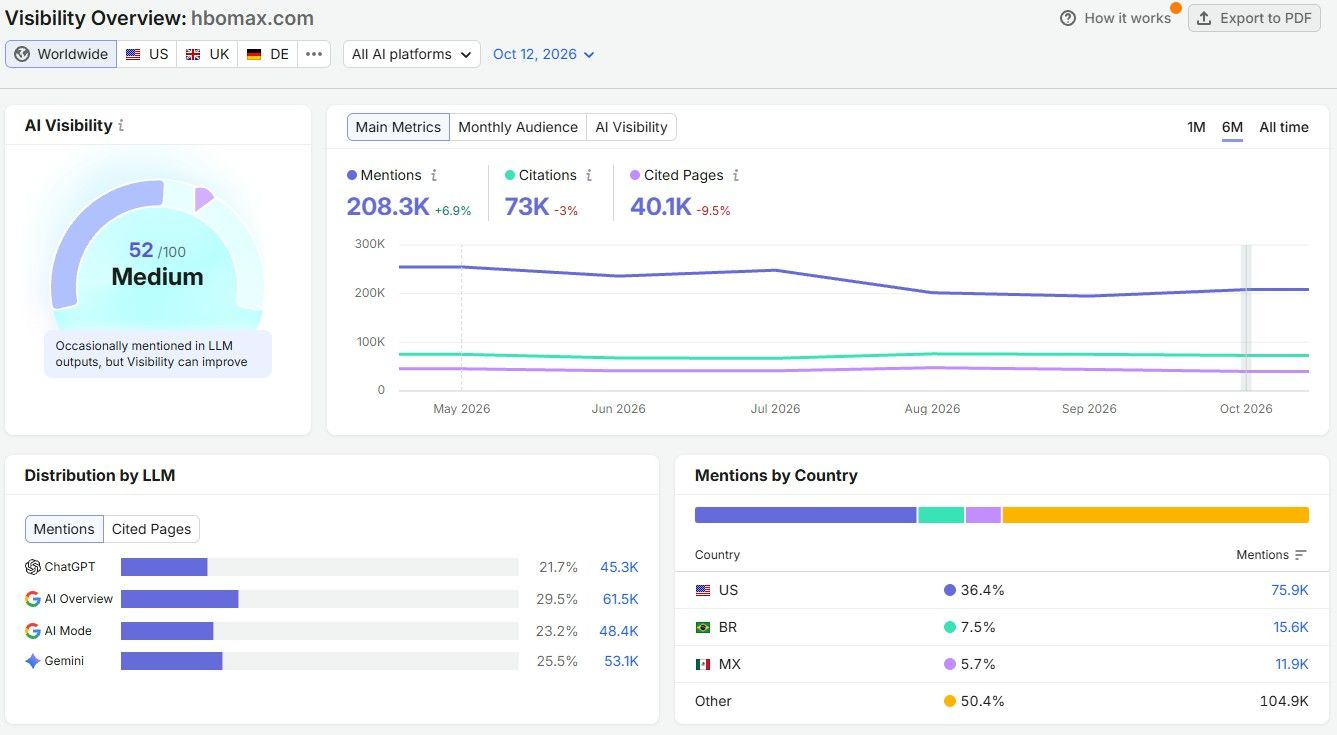
| Mentions | 1.9M | 1.2M | 588.4K | 208.3K |
| Citations | 921.2K | 629.5K | 255.5K | 73K |
| Cited pages | 573.1K | 562.2K | 145.2K | 40.1K |
| Cited pages, 6-month change | -13.4% | -11.4% | -10% | -9.5% |
| Share of mentions from the US | 36.2% | 36.1% | 28.9% | 36.4% |
All four brands land in the “Medium” band, which Semrush describes as brands that are occasionally mentioned in LLM outputs and still have room to improve. I was a bit surprised to see that even Netflix, with the best score of the four, doesn’t make it into the top band.
Netflix leads, but its mentions are shrinking
On Netflix’s six-month chart, mentions slide from about 2.4M in May to 1.9M in October, a drop of roughly 20%, before leveling off. Its cited pages also fell the most of the four brands (-13.4%).
A drop in cited pages doesn’t necessarily mean Netflix is losing links, though: it can also mean that AI answers now rely on a smaller set of Netflix URLs, which is a different problem.
Prime Video: the biggest challenger on paper
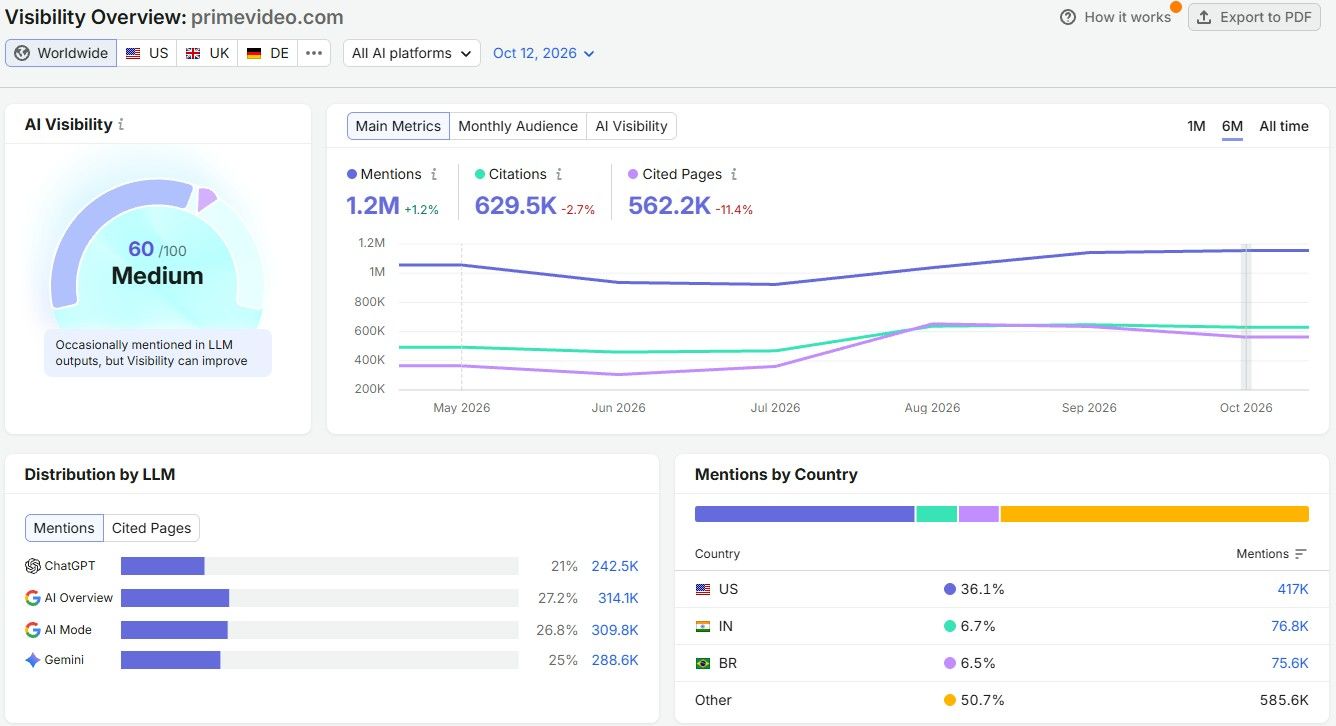
Prime Video has twice as many AI mentions as Disney+ and almost as many cited pages as Netflix, and its mentions have been growing since July. Looking at these numbers alone, I’d have bet on it as Netflix’s closest rival in AI answers, but the prompt tests further down show something quite different.
Disney+ and HBO Max: smaller, but steady
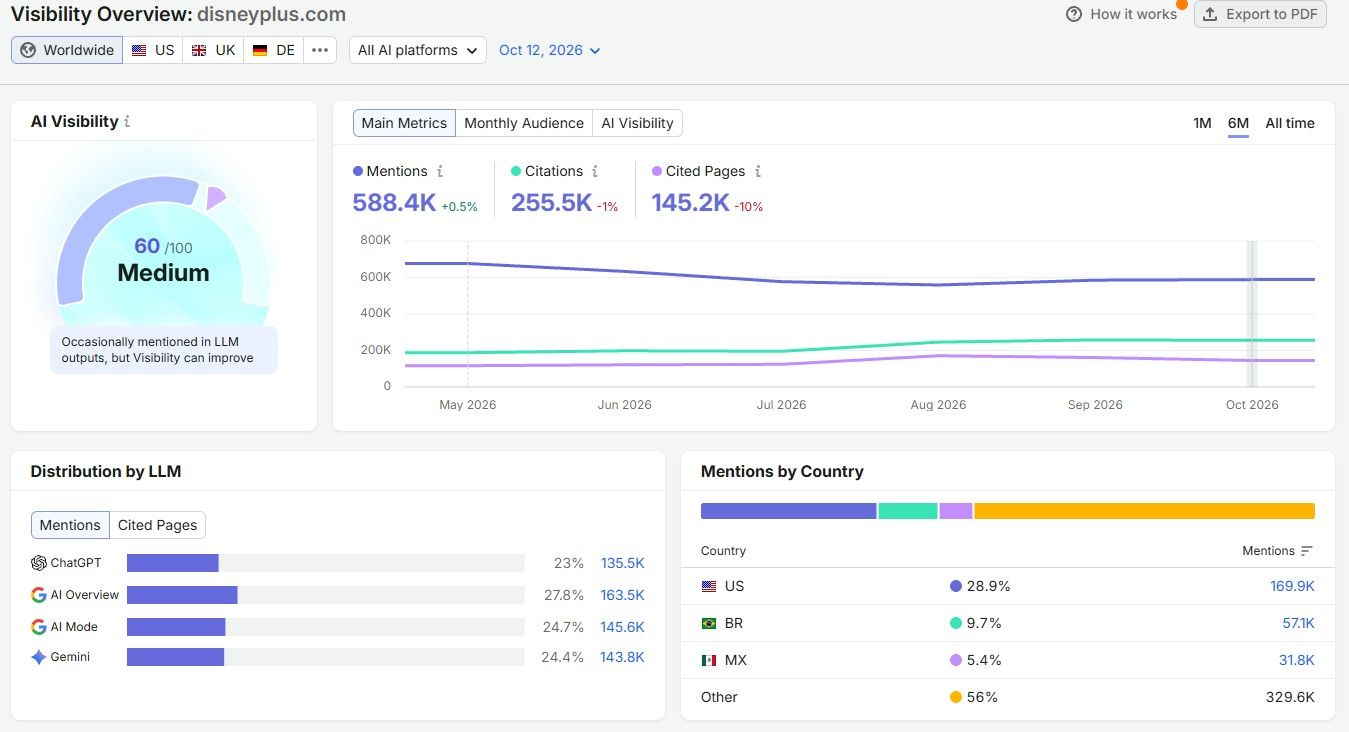
Disney+ scores 60/100 with 588.4K mentions, and it’s the only one of the four with a noticeably lower share of mentions coming from the US (28.9%, against about 36% for the others). HBO Max has the lowest score (52/100), but also the best momentum, with mentions up 6.9% over six months.
Google AI Overviews is the biggest channel for everyone
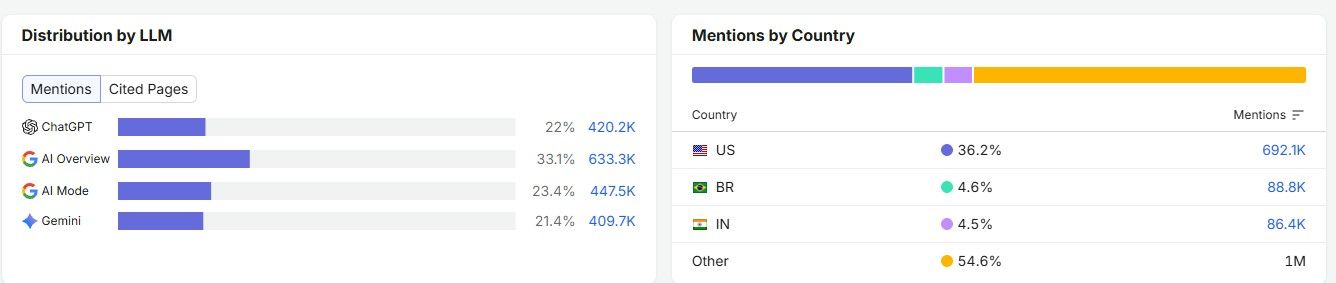
The “Distribution by LLM” panel gives the same ranking for all four brands: Google AI Overviews brings the largest share of mentions (27% to 33%), ahead of AI Mode, Gemini and ChatGPT. For Netflix, AI Overviews alone accounts for 633.3K mentions.
That’s worth keeping in mind for the next part, because by testing ChatGPT and Claude by hand, I’m only covering part of the places where these brands actually show up.
Check your AI Visibility score in Semrush
What ChatGPT and Claude recommend
Semrush counts how often AI talks about a brand. With these four prompts, I wanted to check something else: which brand AI puts forward when a user simply asks for advice.
Prompt 1: the open question
What is the best streaming service in 2026?
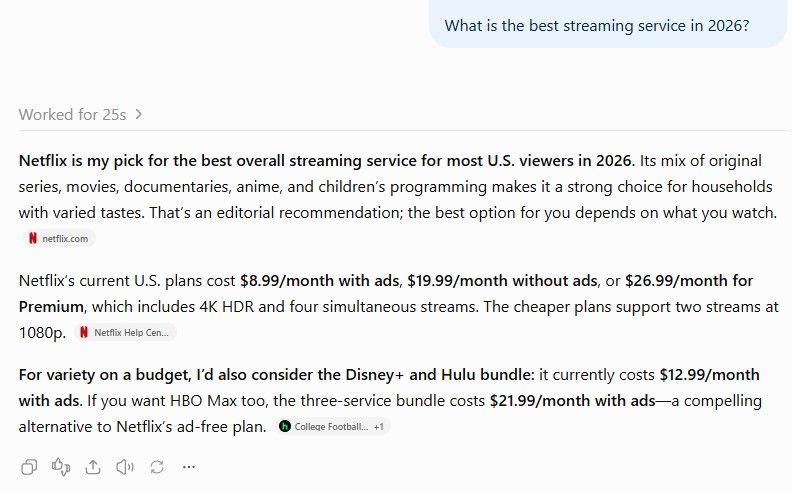
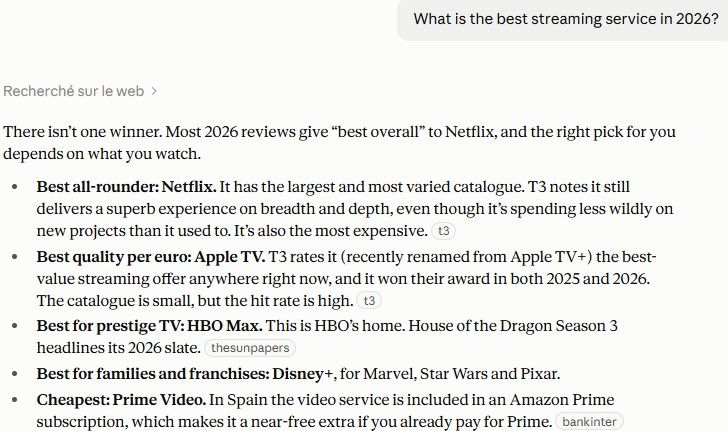
ChatGPT didn’t hesitate: Netflix is its pick for most US viewers, with current plan prices ($8.99 with ads, $19.99 without, $26.99 for Premium), and the Disney+ and Hulu bundle as the budget alternative. Claude also called Netflix the best all-rounder, but then handed out awards by category, with Apple TV for value, HBO Max for prestige TV, Disney+ for families and franchises, and Prime Video as the cheapest option.
One detail I noticed straight away: Claude’s answer leaned on European sources and quoted prices in euros, most likely because of where my session ran. AI answers are localized, so a manual audit like this one only ever reflects one market at a time.
Prompt 2: the forced choice
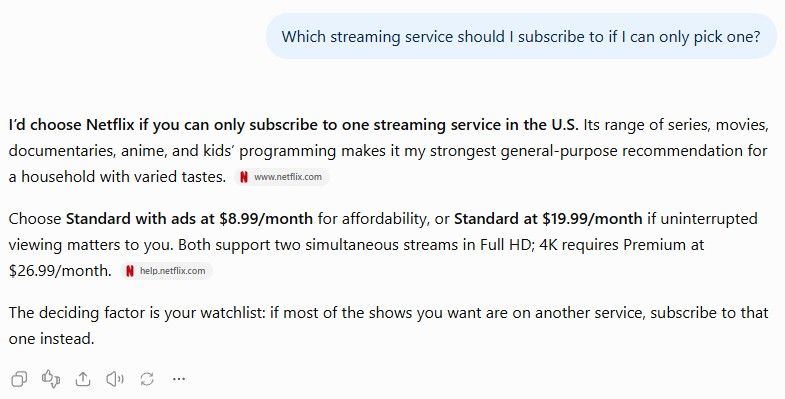
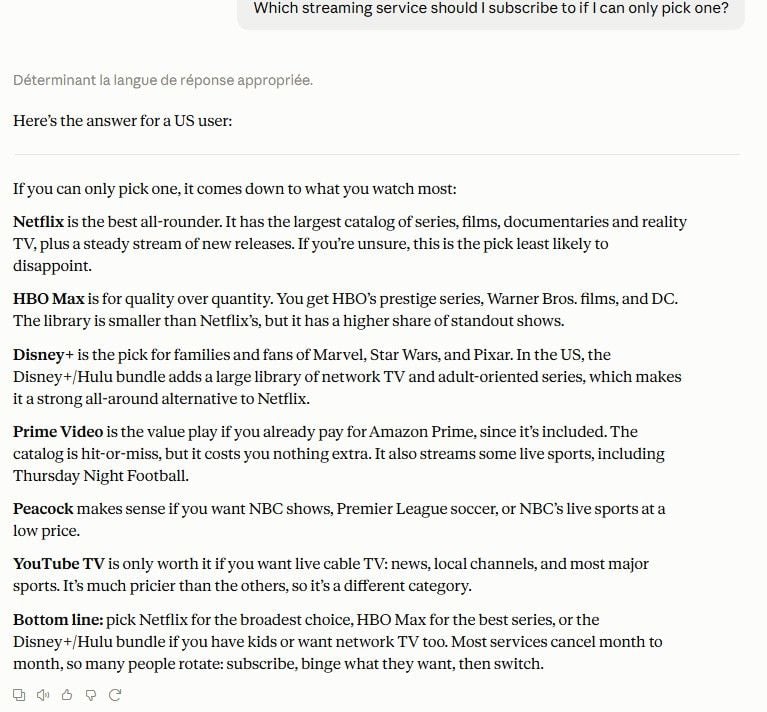
Which streaming service should I subscribe to if I can only pick one?
ChatGPT answered Netflix again, and only Netflix, with a single caveat: if most of your watchlist is on another service, you should subscribe to that one instead.
Claude also put Netflix first, as the pick “least likely to disappoint”, and then went through six alternatives (HBO Max, Disney+, Hulu, Prime Video, Peacock and YouTube TV). It finished with a tip I rarely see in streaming guides, which is that a lot of people rotate their subscriptions from one month to the next.
Prompt 3: Netflix vs Disney+
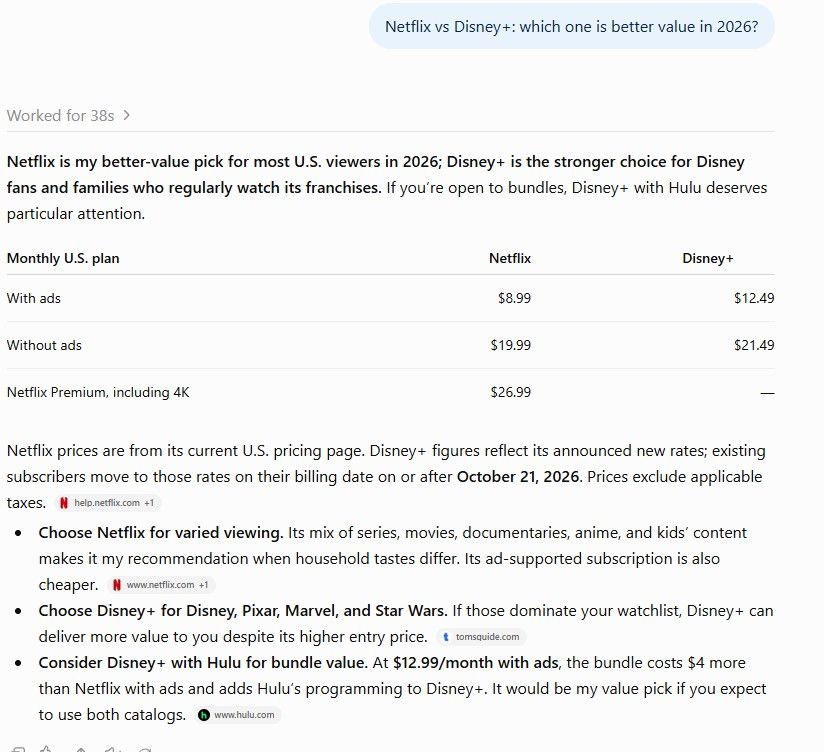
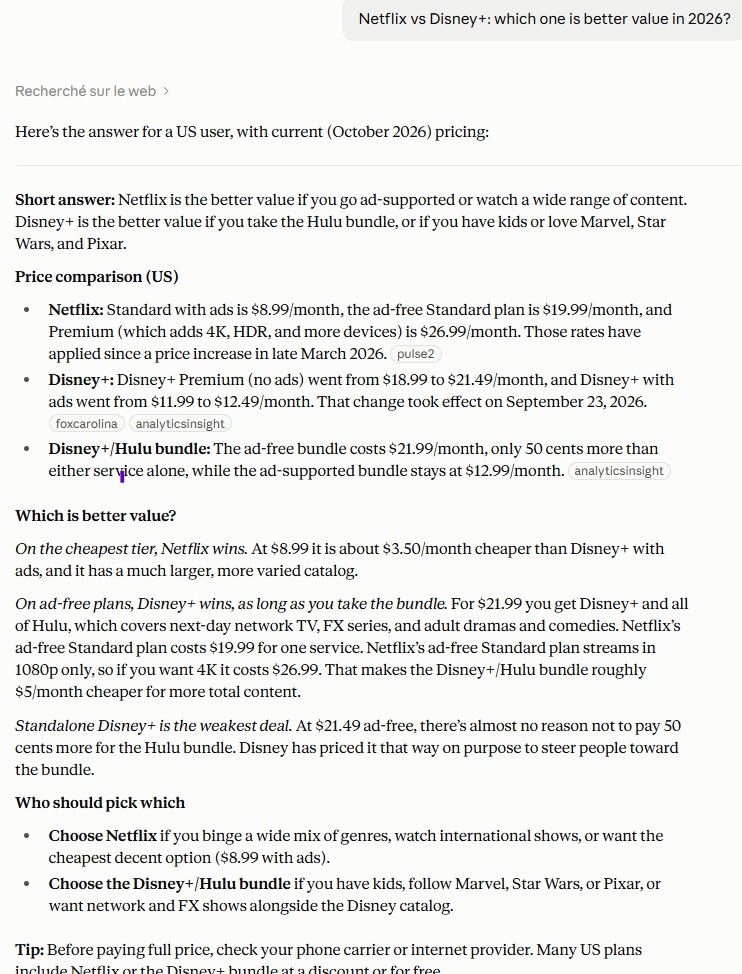
Netflix vs Disney+: which one is better value in 2026?
Both assistants reached the same verdict: Netflix is the better value for most viewers, especially on the ad-supported tier, while Disney+ wins for families and fans of Marvel, Star Wars and Pixar, and becomes the better deal once you add the Hulu bundle.
Where it got interesting was the pricing. Both quoted the new Disney+ prices ($12.49 with ads, $21.49 without), but each one only gave half of the timeline: ChatGPT dated the change to October 21, 2026, and Claude to September 23, 2026. They’re actually both right, since the new prices applied to new subscribers from September 23, and existing subscribers move to them from their first billing cycle on or after October 21.
Neither assistant made that split clear, though, and from the brand’s side it’s a real issue: when AI only tells half of your pricing story, users end up with a confusing answer, which makes it a generative engine optimization problem for Disney.
Prompt 4: HBO Max vs Netflix
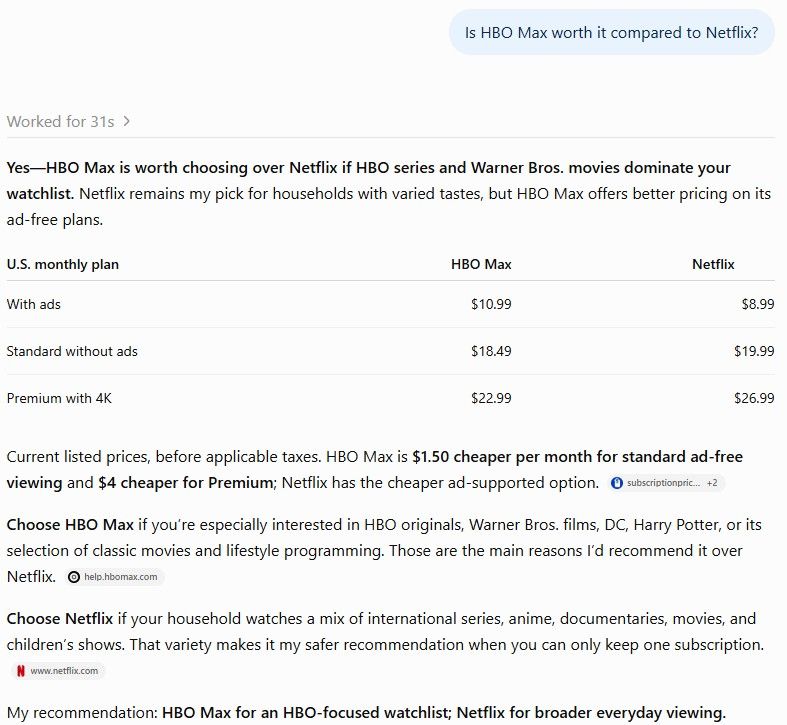
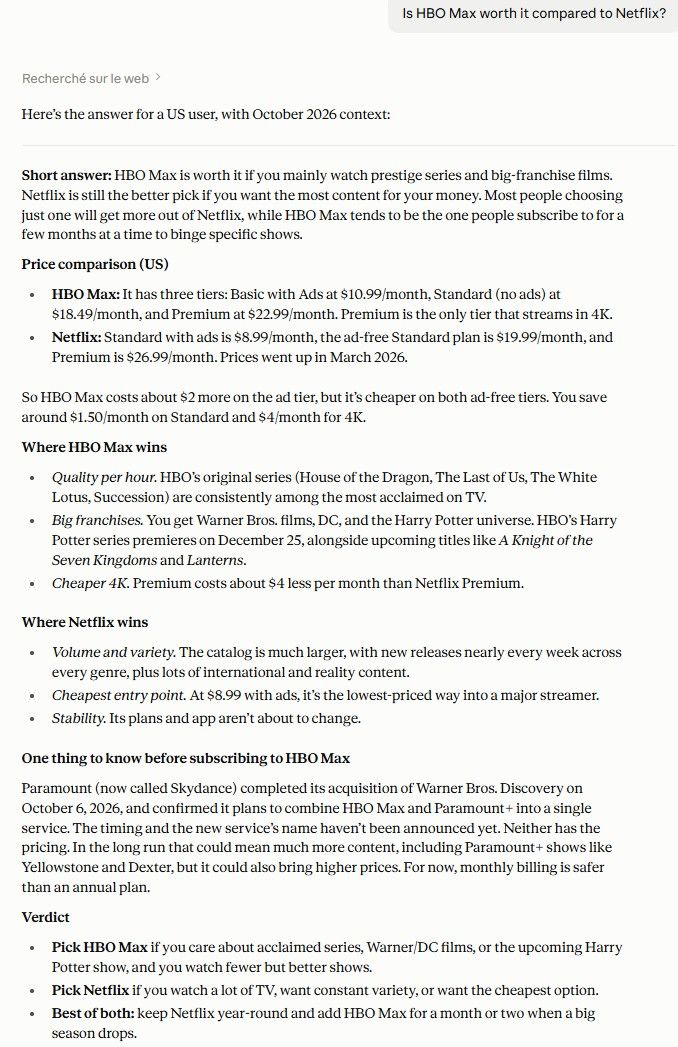
Is HBO Max worth it compared to Netflix?
The pattern was much the same here. HBO Max is worth it if HBO series and Warner Bros. films make up most of your watchlist, and Netflix stays the safer pick if you can only keep one service. Both assistants also pointed out that HBO Max is cheaper on the ad-free plans ($18.49 against $19.99 for Standard, and $22.99 against $26.99 for Premium).
Claude went further, with upcoming titles and, according to its answer, reported plans to merge HBO Max with Paramount+ after an acquisition, which led it to recommend monthly billing over an annual plan. I haven’t checked that claim myself, and that’s exactly the point: a news-driven statement like this one changes the recommendation a user gets, so it’s the kind of thing a brand needs to keep an eye on.
Mentioned vs recommended: the brand visibility scorecard
Prompts 3 and 4 already name the brands, so they don’t tell you much about visibility. The open prompts 1 and 2 are the real test, because there the assistant decides on its own which brands deserve a mention, and with two assistants that gives me four answers to compare.
| Brand | Mentioned (out of 4) | Ranked first | Named by ChatGPT | Named by Claude |
|---|---|---|---|---|
| Netflix | 4 | 4 | Yes | Yes |
| Disney+ | 3 | 0 | Yes | Yes |
| HBO Max | 3 | 0 | Yes (in a bundle) | Yes |
| Hulu | 2 | 0 | Yes (in a bundle) | Yes |
| Prime Video | 2 | 0 | No | Yes |
| Apple TV, Peacock, YouTube TV | 1 each | 0 | No | Yes |
The Prime Video gap
This is the result that surprised me the most. Semrush has Prime Video as the second most-mentioned brand in AI answers, with 1.2M mentions, yet ChatGPT never named it in the open prompts, and Claude only presented it as something that comes with Amazon Prime.
My guess is that a large share of those mentions comes from “where to watch” questions about individual titles, where Prime Video naturally shows up, rather than from people asking which service to pick. Being mentioned and being recommended turn out to be two very different things, and the total number of mentions hides that difference completely, which is why it’s worth taking the time to track brand mentions by context.
ChatGPT concentrates, Claude spreads
In my test, ChatGPT pushed one clear winner and only brought up other brands as alternatives or as part of a bundle, while Claude named five to seven services in each open answer. If that pattern holds over time, a challenger brand has a much harder job in ChatGPT, where there’s basically one seat to win.
The sources were different
ChatGPT mostly cited the brands’ own pages, such as Netflix’s help center, hulu.com and HBO Max’s help pages, while Claude leaned on third-party media and tech sites. On a sample this small I wouldn’t draw firm conclusions, but it does suggest that owned pages carry more weight with ChatGPT, and press coverage more with Claude.
I should repeat that each prompt was run once, and AI answers change from one chat to the next, so only repeated tracking can tell you whether these patterns are real.
AI visibility gaps and fixes, brand by brand
If I were working on the AI search visibility of each of these brands, here’s where I would start.
For Netflix, mentions are down about 20% and cited pages 13.4%. Both assistants relied on its help center for pricing, so the first lever is to keep the plan and pricing pages clear, up to date and easy to quote.
For Disney+, each assistant gave only one of the two price-change dates. A single pricing page that lays out the timelines for new and existing subscribers side by side would give AI the full answer in one place.
HBO Max has the lowest score of the four, and news about its ownership and a possible merger is already shaping what AI says about it. Clear content on its own site about what changes and what stays the same would give AI something official to cite.
Prime Video’s problem is positioning: it has a huge volume of mentions but very little presence in “which service should I pick” answers. What it’s missing is content that makes the case for Prime Video as a standalone choice, instead of an extra that comes with a Prime subscription.
How to run the same AI visibility audit on your brand
- Open the Visibility Overview report in Semrush’s AI Visibility Toolkit for your domain and two or three competitors, and note the score, mentions, cited pages and the split by AI platform.
- Write 4 to 10 prompts your customers would actually ask, mixing open questions (“best X for Y”) and head-to-head comparisons.
- Run them in fresh chats in ChatGPT and Claude, and write down which market you’re in. For each answer, log which brands appear, in what order, and which sources get cited.
- Compare mentions with recommendations. A brand with a high volume of mentions but no place in “which should I pick” answers has a positioning gap.
- Move your prompts into Prompt Tracking. One manual run is only a snapshot, and tracking the same prompts over time, across AI platforms, is what shows you whether a result is stable and whether your fixes are moving it. I explain how to set that up in my guide on how to track AI visibility with Semrush.
In this short video, Semrush shows how to find and track brand mentions across ChatGPT and AI search in the AI Visibility Toolkit.
Audit your AI visibility with Semrush One
FAQ
What is AI visibility?
AI visibility measures how often, and in what way, a brand shows up in the answers of AI assistants and AI search features such as ChatGPT, Gemini, Google AI Overviews and AI Mode. It covers mentions, citations of the brand’s pages and the context in which the brand appears.
How do you run an AI visibility audit?
I’d start with your AI visibility data in a tool such as Semrush’s AI Visibility Toolkit (score, mentions, citations and platforms), then test a handful of customer prompts in ChatGPT and Claude to see whether AI actually recommends you when someone asks for advice. After that, track the same prompts over time to confirm what you found.
What is a good AI Visibility score in Semrush?
Scores run from 0 to 100. In my audit, all four streaming brands scored between 52 and 74, which Semrush classes as “Medium”, so even a market leader like Netflix still has room to improve.
Do ChatGPT and Claude give the same answer to everyone?
No. In my tests, the wording, the number of brands named and the sources cited all varied between the two assistants, and Claude adapted its first answer to the location of my session. Answers can also change from one chat to the next.
Is testing prompts by hand enough?
It shows you what one user sees, in one market, on one day. It misses Google AI Overviews and AI Mode, which bring the largest share of mentions, and it can’t tell a one-off answer from a pattern. Semrush covers both sides, with the overall data on one hand and prompt tracking over time on the other.
Try Semrush One free for 14 days
This article is sponsored by Semrush and contains affiliate links. We may earn a commission if you make a purchase through these links, at no extra cost to you.
