If you’ve ever asked ChatGPT or Claude for SEO numbers on a website, you’ve probably run into the same problem I did: the answer sounds confident, but the figures come from the model’s memory (or are simply guessed), and there’s no way to check where they came from. Semrush MCP solves that by plugging both assistants straight into your Semrush account, so when you ask about a domain’s traffic, keywords or backlinks, the answer comes from live Semrush data, with a link back to the report it used.
I use it every day to follow the SEO of our group’s websites. In this guide, I’ll show you how to set it up in ChatGPT and in Claude, step by step, and then go through eight prompts I ran on netflix.com, with my screenshots and what each assistant answered. You can copy every prompt and run it on your own domain.
The main thing I took away from it: both assistants pulled exactly the same numbers from Semrush, but the more precise my prompt was, the more useful the answer turned out to be, and the vague ones left a lot of room for interpretation.
What is Semrush MCP?
Semrush MCP is the official MCP server from Semrush, and what it does is fairly simple to explain: it lets an AI assistant such as Claude or ChatGPT query your Semrush account while you chat with it. MCP stands for Model Context Protocol, an open standard for connecting AI models to outside tools and data sources.
In practice, you type a question in plain English, the assistant calls Semrush, reads the report and answers with live SEO data instead of figures it remembers from its training. Semrush hosts the server itself, so there is nothing to install on your computer, which I liked, because I didn’t have to touch a config file once.
One thing to be clear about: MCP brings SEO data into the chat, but it won’t tell you how ChatGPT or Claude describe your brand in their own answers. For that part, I wrote a separate guide on how to track AI visibility with Semrush.
Semrush MCP capabilities: which reports can it query?
During my tests, Claude and ChatGPT pulled data from five groups of Semrush reports:
- Domain Overview, for organic traffic, ranking keywords, Semrush Rank and the 12-month history
- Organic Research, for top keywords, top pages and organic competitors
- Keyword Gap, for the keywords your competitors rank for and you don’t
- Backlink Analytics, for Authority Score, backlinks, referring domains and the follow/nofollow split
- Keyword research, for question keywords, search volume, keyword difficulty and search intent
Every answer linked back to the Semrush report it came from, and I ended up using that more than I expected: whenever a number looked odd, I could open the full report in one click and check it myself.
Semrush MCP pricing: is it included in your plan?
Good news on this one, you don’t pay anything extra: Semrush MCP is included in every Semrush One and SEO Toolkit plan, and each eligible user gets 50,000 MCP API units. They work like the regular Semrush API, so every request the assistant sends to Semrush uses a few of them.
My eight test prompts barely made a dent in that allowance. If you ask for large exports with hundreds of keyword rows, though, the count goes up much faster, which is why I’d always give the assistant a fixed number of results.
Semrush MCP also works during the Semrush One free trial, so my advice would be to run the setup below while you’re still on the trial, and see for yourself before paying anything.
Start your Semrush One free trial
How to connect Semrush MCP: setup checklist
Before you start, make sure you have:
- an active Semrush One or SEO Toolkit plan, or a Semrush One trial
- a Claude or ChatGPT account that supports connectors or apps
- your Semrush login (both assistants connect through OAuth, so there’s no API key to copy and paste anywhere)
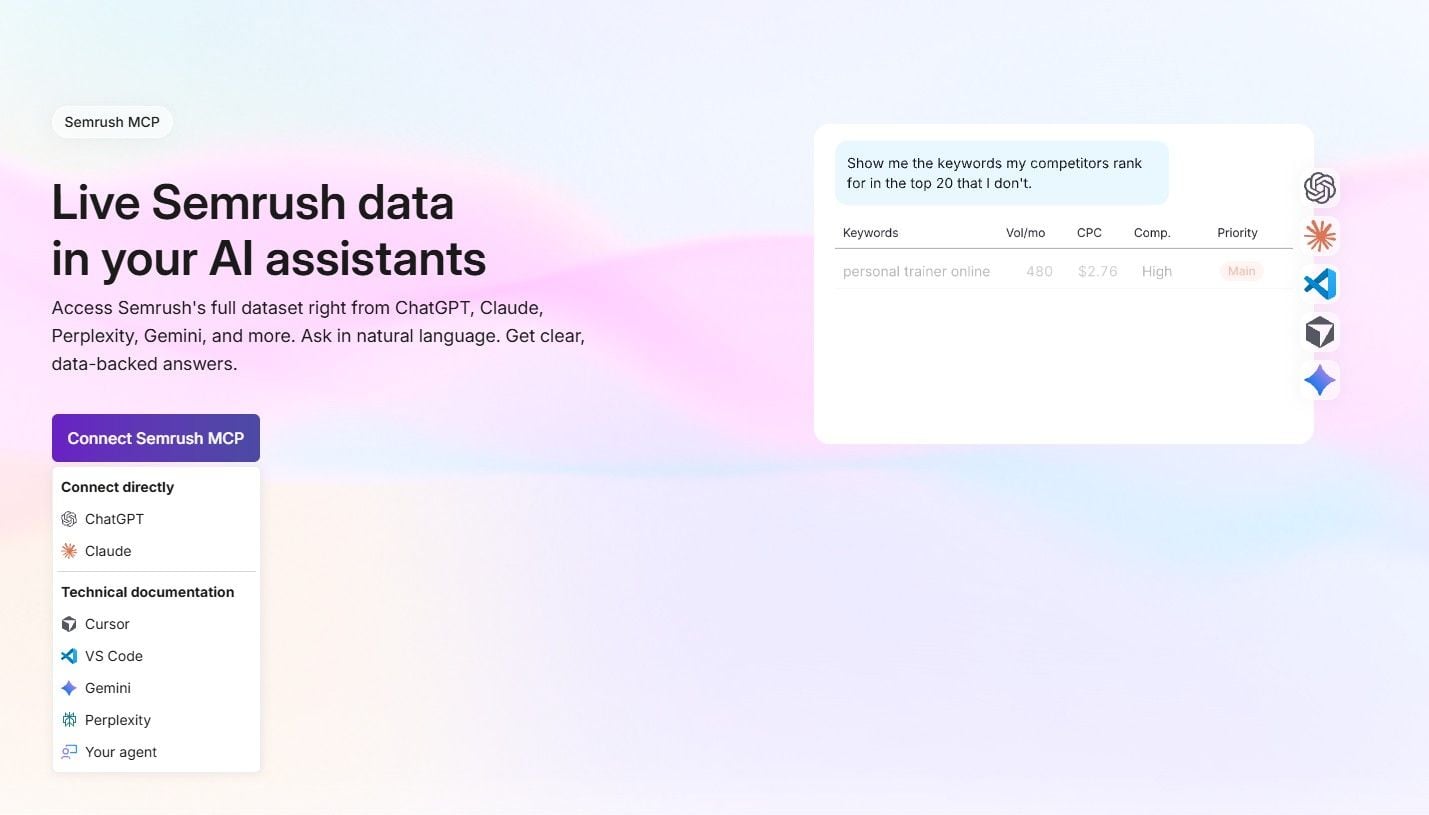
The setup itself is quick, and everything starts from the official Semrush MCP page. Its “Connect Semrush MCP” menu covers ChatGPT and Claude directly, and there is documentation for Cursor, VS Code, Gemini, Perplexity and custom agents if you work with those.
How to connect Semrush MCP to Claude
- On the Semrush MCP page, click Connect Semrush MCP.
- Under “Connect directly”, choose Claude.
- Claude adds Semrush as a connector and sends you over to Semrush, where you log in and approve access.
- Open a new chat and check that the Semrush connector is switched on.
The first time Claude calls Semrush, it asks for your permission, and you can allow it either once or for the whole chat (I went with the whole chat, otherwise you end up clicking on every prompt).
How to connect Semrush MCP to ChatGPT
- On the Semrush MCP page, click Connect Semrush MCP and choose ChatGPT.
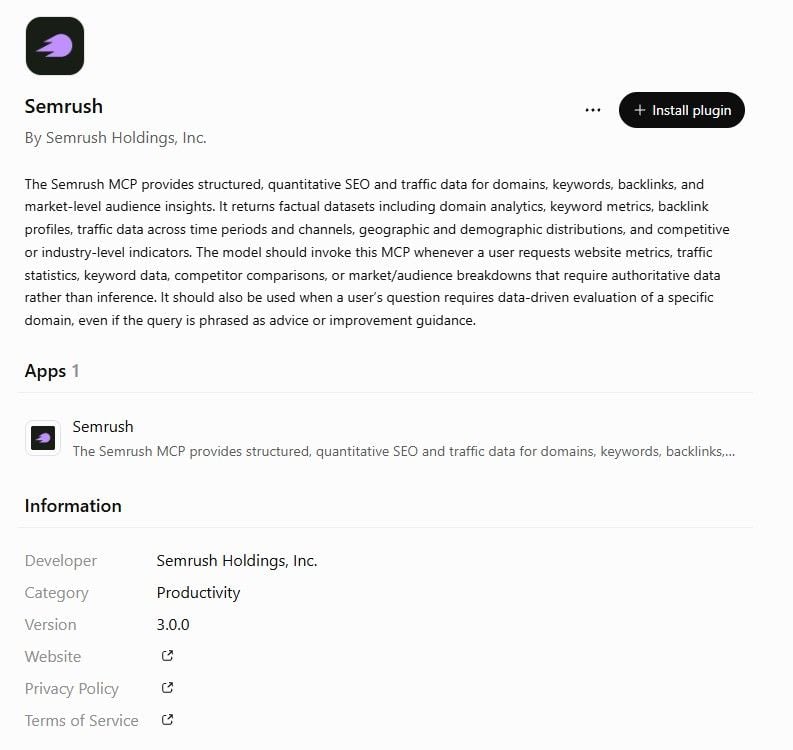
- ChatGPT opens the official app, published by Semrush Holdings, Inc.
- Click Install.
- Log in to Semrush and approve access.
- In a new chat, pick Semrush from the tools menu or just name it in your prompt, and a Semrush tag shows up in your message.
How I tested Semrush MCP
I use this MCP every day to follow the SEO of our group’s websites, but those prompts and analyses stay in-house, so I’m not going to publish them here. For this article I needed a domain that everyone knows, and netflix.com is one example among many, but a really interesting one to look at.
First, it’s huge (5.69M ranking keywords), so every report comes back full of data. Its traffic also depends on two very different things, brand searches on one side and millions of searches for individual titles on the other, and it has obvious rivals in Disney+ and HBO Max, which made the comparison prompts easy to set up. And, as it turned out, its organic traffic had dropped a lot over the past year, which gave the assistants something real to explain.
For the comparison prompts, I added disneyplus.com and max.com. Here is how the test was set up:
- Date: October 13, 2026
- Database: Semrush US
- Assistants: Claude and ChatGPT, each with the official Semrush connection
- Method: the same eight prompts, word for word, in a fresh chat on each assistant
All the figures below come from the assistants’ answers. Keep in mind they are Semrush estimates, not Netflix’s own analytics. You can copy any of the prompts, swap in your own domain and run it as is.
8 Semrush MCP prompts tested on netflix.com
1. Domain overview with a 12-month trend
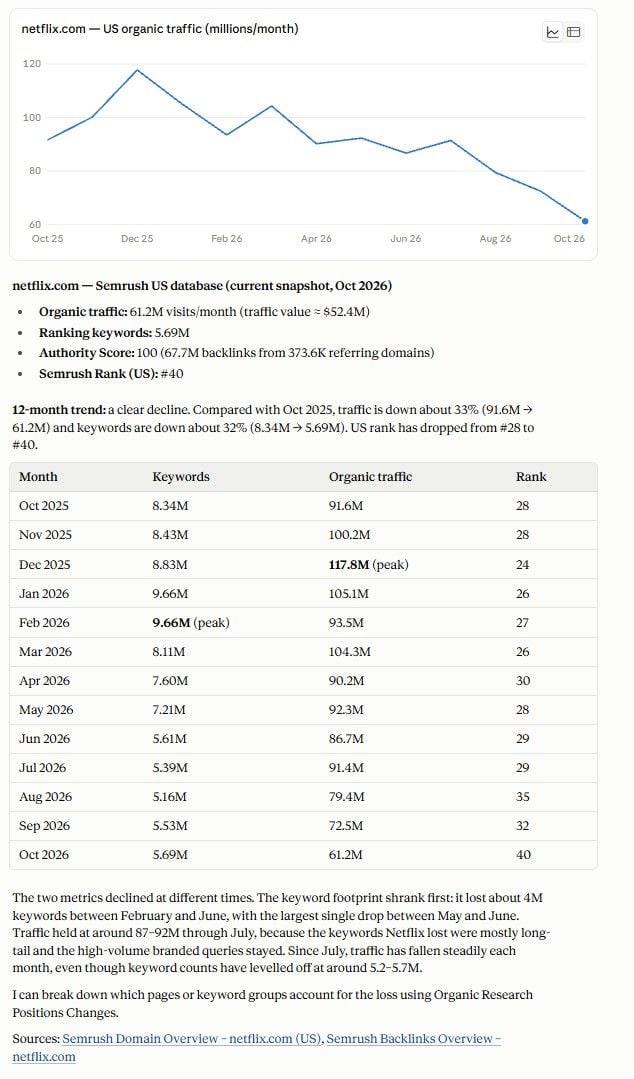
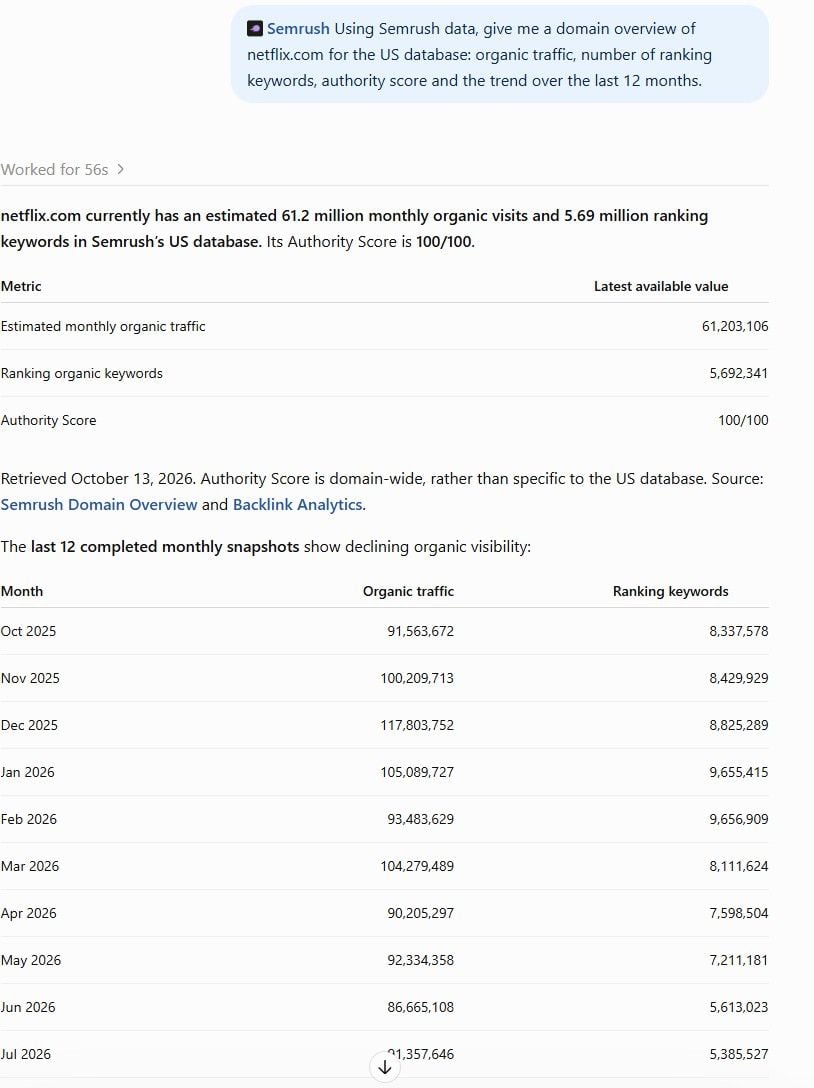
Using Semrush data, give me a domain overview of netflix.com for the US database: organic traffic, number of ranking keywords, authority score and the trend over the last 12 months.
Both assistants came back with the same core figures, which was reassuring: 61.2M monthly organic traffic, 5.69M ranking keywords and an Authority Score of 100. The trend, though, is going the wrong way. Organic traffic dropped about 33% in a year, from 91.6M in October 2025 to 61.2M in October 2026, and Netflix slid from #28 to #40 in Semrush’s US ranking.
What I didn’t expect was Claude pointing out a timing gap that I would probably have missed on my own: Netflix lost around 4 million keywords between February and June, but its traffic only started falling in July. Its explanation (which makes sense once you think about it) is that most of those keywords were long-tail terms with little traffic behind them, while the big branded searches held up, so the drop took a few months to show.
2. Top organic keywords, branded vs non-branded
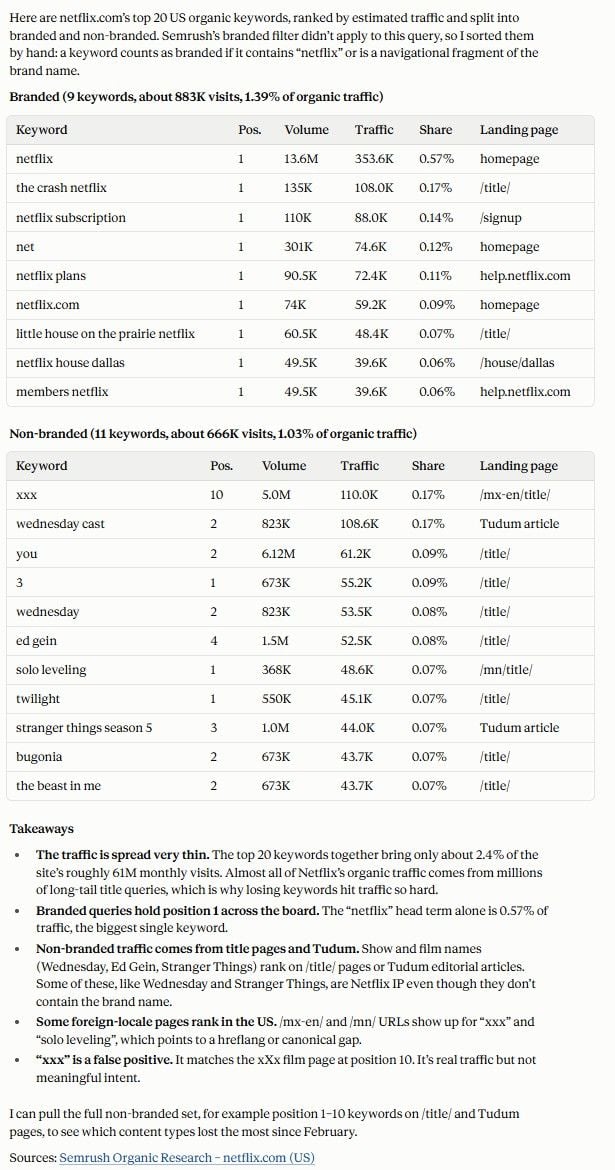
Using Semrush, list the top 20 organic keywords driving traffic to netflix.com in the US, with search volume, position and traffic share. Separate branded and non-branded keywords.
Netflix ranks #1 for every branded keyword in the list, and “netflix” on its own has 13.6M monthly searches, which bring in about 353.6K visits. What struck me more was how spread out the traffic is: the top 20 keywords account for only about 2.4% of organic visits, and the rest comes from millions of searches for individual titles, so no single keyword carries much weight on its own.
Claude also caught two problems in the data that I might well have quoted without thinking twice: Semrush had matched one film title as an adult query, and some Mexican and Mongolian locale pages show up in the US rankings.
3. Top pages by organic traffic
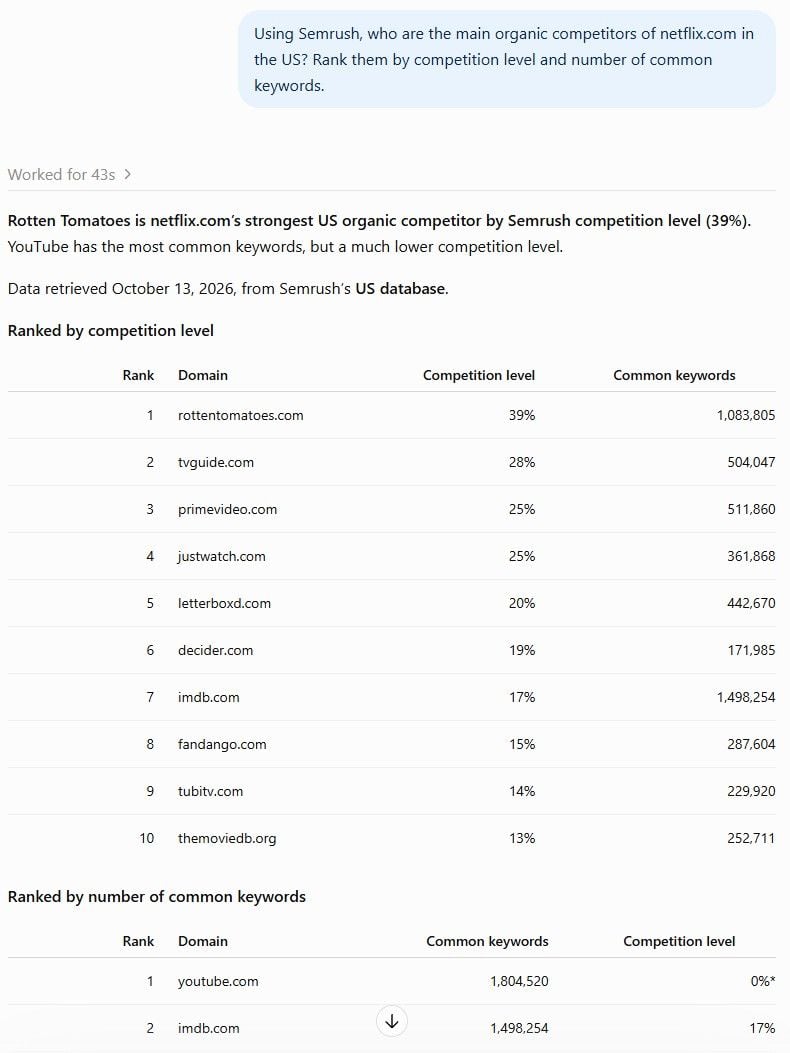
Using Semrush data, which pages on netflix.com get the most organic traffic in the US? Show the top 10 URLs and the main keyword for each.
The homepage comes first with 4.51M monthly visits (about 7.4% of organic traffic), but four of the top 10 URLs are on Tudum, Netflix’s editorial hub, including the Top 10 lists and the Stranger Things release-date page. So on non-branded searches, Netflix grows through editorial content much more than through its title pages, which I found to be a useful lesson in itself.
There were two oddities in this one. A login URL with tracking parameters is credited with 209K visits from just 555 keywords, and Claude read it as either a parameter-handling leak or an estimation error on Semrush’s side; I’d check that kind of row in the report before quoting it anywhere. Then there’s “netflix new releases”, which ranks #1 for a query with 165K searches but gets only about 4.3K clicks, probably because SERP features take most of them.
4. Organic competitors
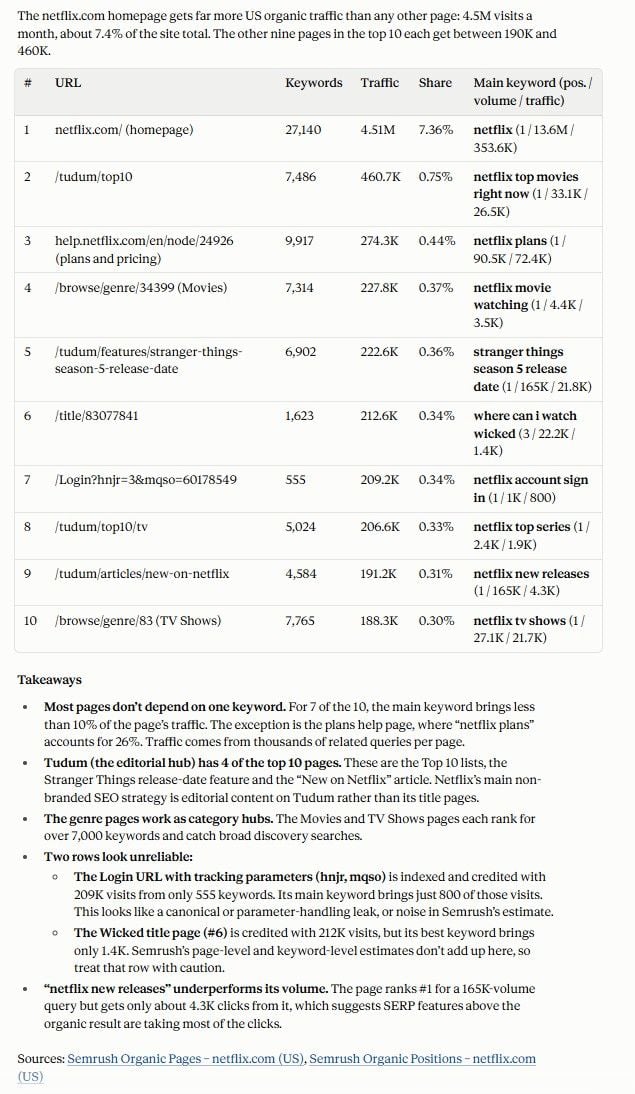
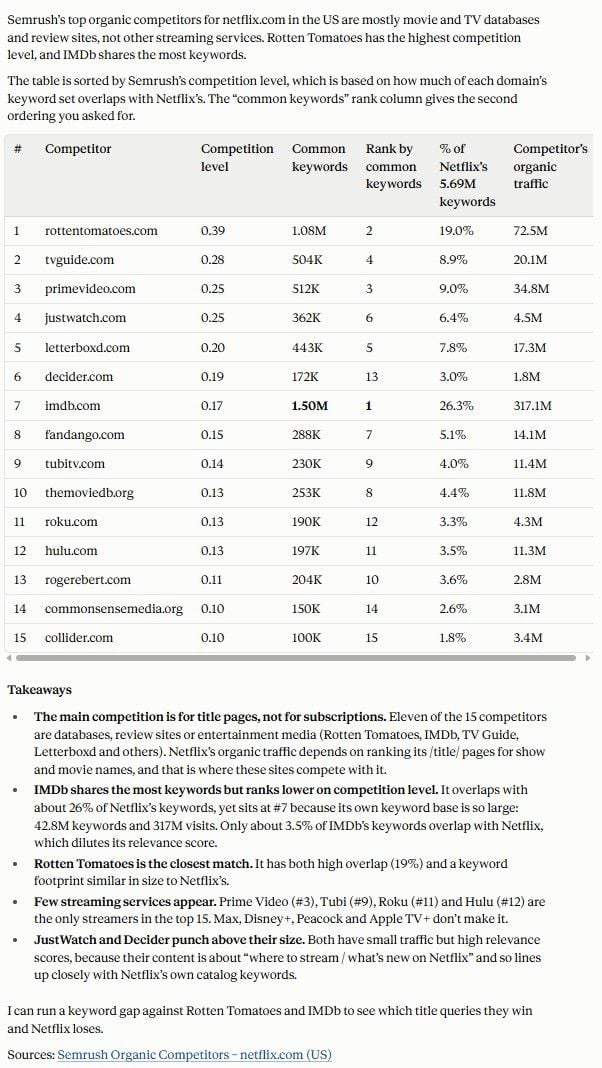
Using Semrush, who are the main organic competitors of netflix.com in the US? Rank them by competition level and number of common keywords.
Rotten Tomatoes comes out as the top organic competitor, with a 39% competition level and about 1.08M common keywords, followed by TV Guide, Prime Video and JustWatch. IMDb actually shares the most keywords with Netflix (about 1.5M), but it ranks lower on competition level because its own keyword base is so much larger.
Only four streaming services made the top 15: Prime Video, Tubi, Roku and Hulu. I found that one interesting, because it shows that on Google, Netflix mostly competes with movie databases and review sites over title searches, and the other streamers come further down the list.
5. Keyword gap against Disney+ and HBO Max
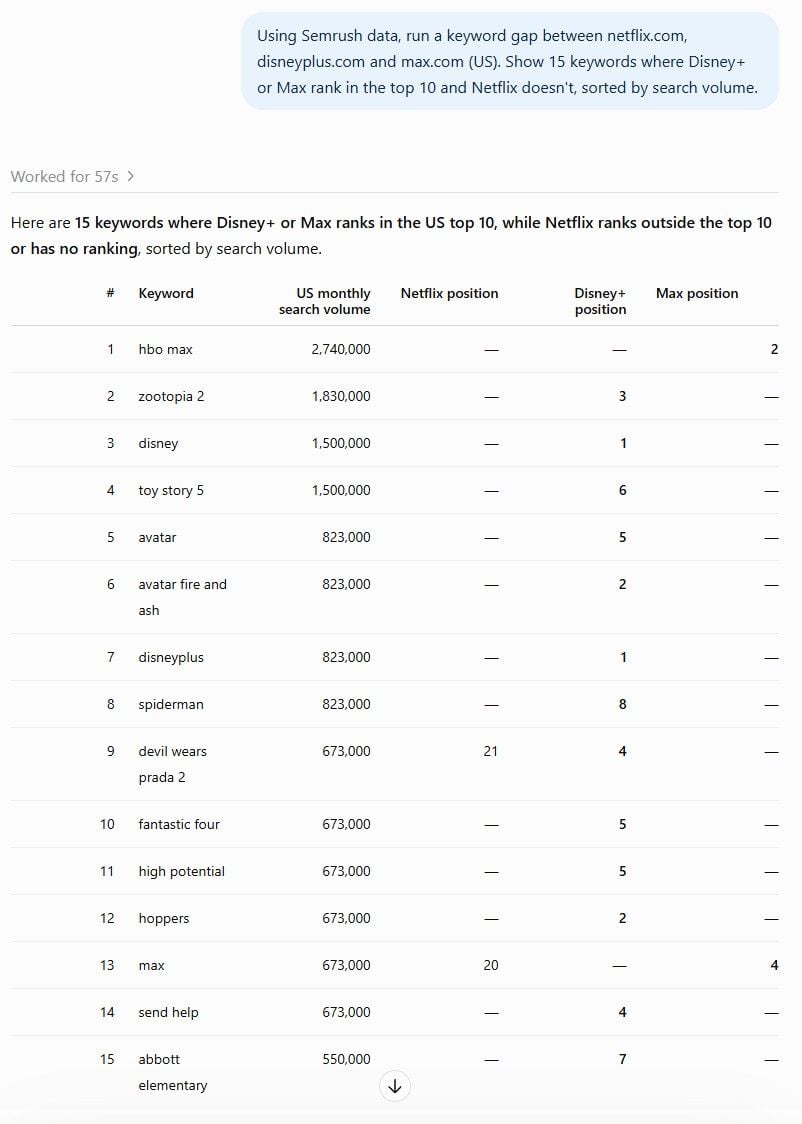
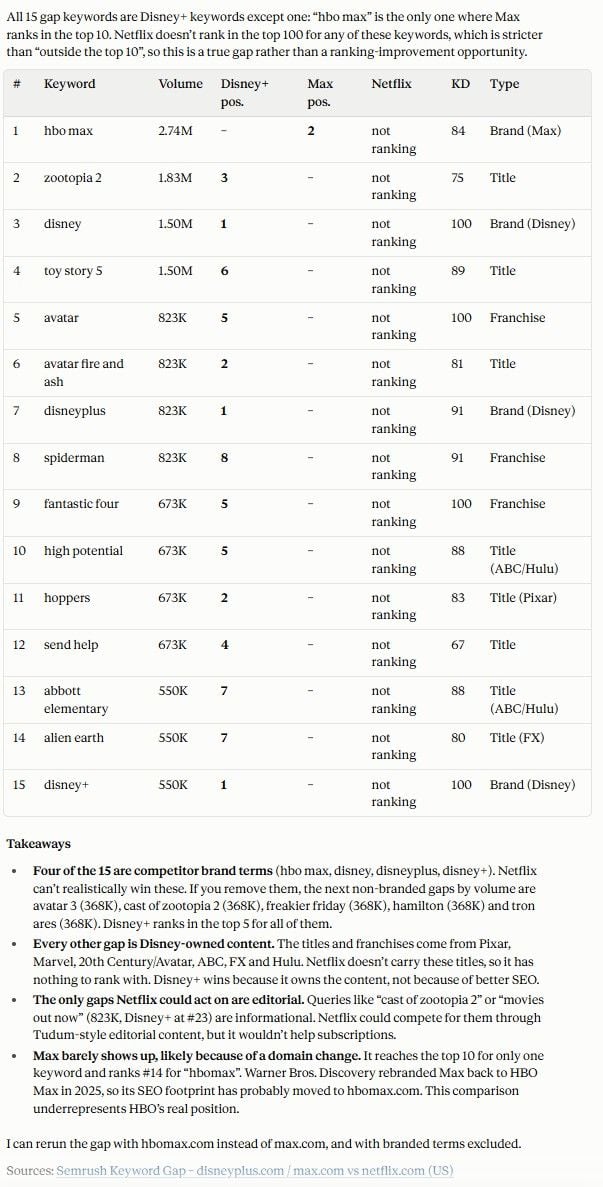
Using Semrush data, run a keyword gap between netflix.com, disneyplus.com and max.com (US). Show 15 keywords where Disney+ or Max rank in the top 10 and Netflix doesn’t, sorted by search volume.
The biggest keyword gap is “hbo max” (2.74M searches, with Max at #2), followed by “zootopia 2” and “disney”. Almost everything else on the list is a Disney title or franchise, such as Toy Story 5, Avatar or Fantastic Four. Claude’s reading is that Disney+ ranks for these because it owns the films, so Netflix can’t do much about most of them, apart from editorial angles like cast pages or “what’s out now” queries.
It also noticed that max.com barely shows up at all: the service went back to the HBO Max name, and most of its search visibility moved to hbomax.com. That’s worth keeping in mind before you run a competitor report on any brand that has changed domains recently.
6. Backlink profile overview
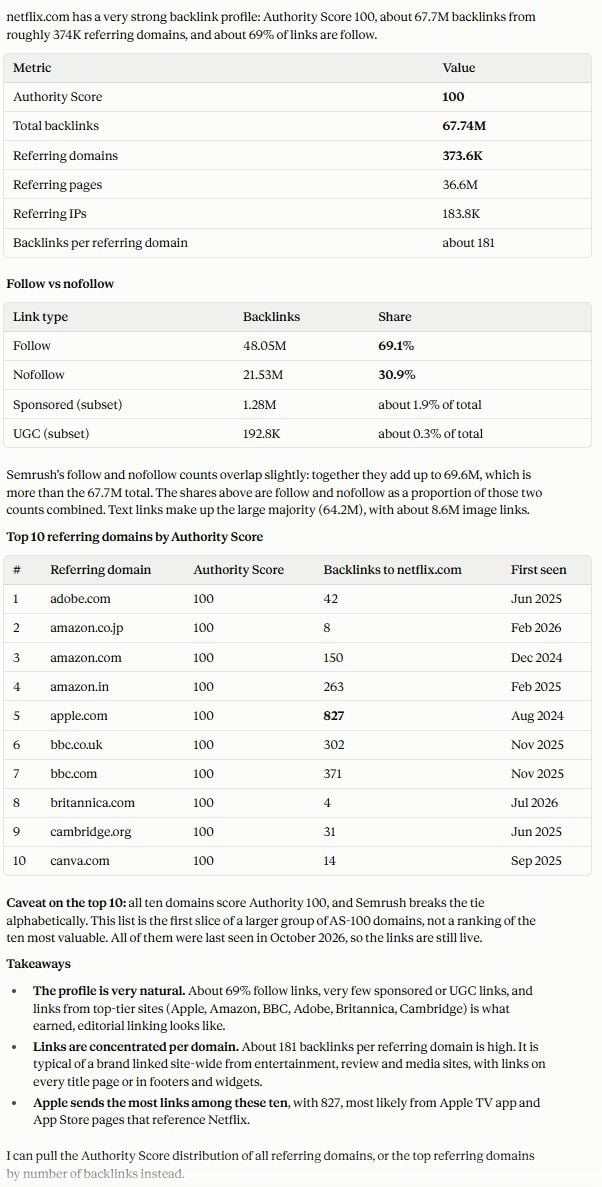
Using Semrush, give me a backlink overview of netflix.com: total backlinks, referring domains, top 10 referring domains by authority, and the share of follow vs nofollow links.
Netflix’s backlink profile has about 67.7M backlinks from 373.6K referring domains, and around 69% of them are follow links, with sponsored and UGC links barely registering. Among the top referring domains you’ll find apple.com, amazon.com, bbc.com and britannica.com, and Apple sends the most links of the group (827), probably from Apple TV and App Store pages.
Claude added a caveat here that I appreciated: all ten domains have an Authority Score of 100, so Semrush simply sorts them alphabetically. In other words, the list is a sample of AS-100 sites, and it says nothing about which one is worth the most to Netflix.
Backlinks only cover the pages that actually link to you, though, and unlinked mentions of a brand count too. If you want to find those, I explain how in our guide on how to track brand mentions.
7. Question keywords grouped by search intent
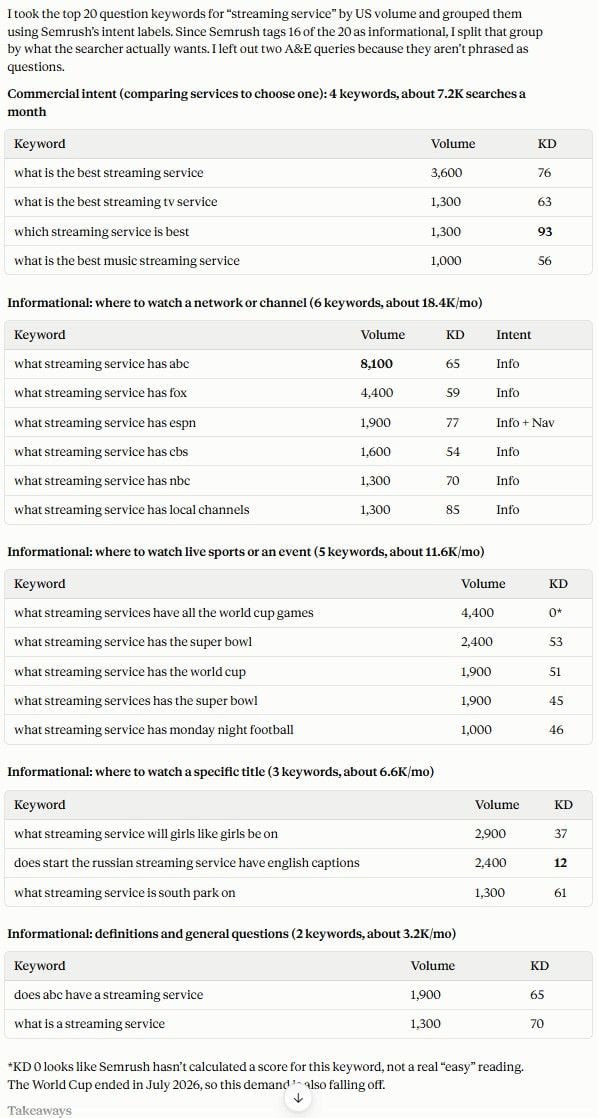
Using Semrush keyword data, find 20 question-based keywords around “streaming service” with US search volume and keyword difficulty, then group them by search intent.
Of the eight, this is the prompt I’d reuse the most for content planning. The top question was “what streaming service has abc” (8,100 searches), followed by “what is the best streaming service” with 3,600 searches and a keyword difficulty of 76.
Semrush tags 16 of the 20 questions as informational, but Claude went a step further and grouped them by what the person searching actually wants to do:
- find where to watch a channel
- find where to watch live sports
- find where to watch a specific title
- get a general definition
It also warned me that a KD of 0 usually means Semrush hasn’t scored the keyword yet, which is very different from the keyword being easy (and I’ll admit that’s a mistake I could easily have made).
8. Side-by-side competitor comparison
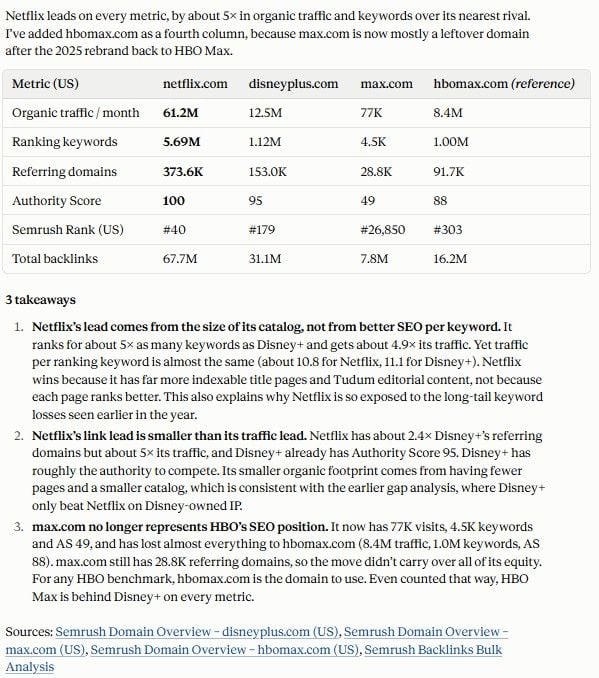
Using Semrush data, compare netflix.com, disneyplus.com and max.com side by side (US): organic traffic, ranking keywords, referring domains and authority score. Format it as a table and give me 3 takeaways.
| Metric (US) | netflix.com | disneyplus.com | max.com | hbomax.com |
|---|---|---|---|---|
| Organic traffic / month | 61.2M | 12.5M | 77K | 8.4M |
| Ranking keywords | 5.69M | 1.12M | 4.5K | 1.00M |
| Referring domains | 373.6K | 153.0K | 28.8K | 91.7K |
| Authority Score | 100 | 95 | 49 | 88 |
Netflix gets about five times as much organic traffic as Disney+, yet both sites earn roughly 11 visits per ranking keyword, so the gap between them comes from the size of the catalog more than from better rankings.
I never asked for hbomax.com, by the way: Claude added that column itself after noticing that max.com now gets very little traffic, which turned out to be the most useful column in the table.
Run these prompts with Semrush One
Semrush MCP in Claude vs ChatGPT
On the raw numbers there was no difference at all, which makes sense since both assistants read the same Semrush data. Where they differed was in how they read my prompts.
Claude tended to go further than I asked: it drew charts, added a keyword difficulty column, flagged rows that looked wrong and, on the last prompt, even added hbomax.com to the comparison on its own. ChatGPT stayed closer to the literal request, with clean tables and less commentary, which some people will actually prefer.
The keyword gap is where the difference showed most. ChatGPT kept keywords where Netflix ranks outside the top 10, while Claude only kept the ones where Netflix doesn’t appear in the top 100 at all, so I got two fairly different lists from the same sentence. Speed, on the other hand, was about the same: 45 to 60 seconds per prompt on both, with several Semrush calls behind each answer.
Since the data is identical, I’d simply use whichever assistant you already work with every day.
Semrush MCP limits to know before you rely on it
Semrush MCP makes SEO analysis a lot faster, but it inherits the limits of Semrush itself. Traffic figures are estimates, not analytics, so for your own site you’ll want to compare them with Google Search Console, which is what I do for our group’s sites.
The keyword gap test also showed me that two assistants can read the same prompt in two different ways, and the only real fix is to write more precise prompts. Odd rows slip through as well, like the login URL in prompt 3 or the KD of 0 in prompt 7, so before quoting an outlier I open the linked Semrush report and check it there. And large exports eat a lot more API units than short, targeted requests.
Tips for better Semrush MCP prompts
Here’s what worked best for me, after a fair amount of trial and error:
- Name the database (“US”, “UK”), otherwise you can get default or mixed results.
- Start your prompt with “Using Semrush data”, which pushes the assistant to call the connector instead of answering from memory.
- Set a number, like “top 20” or “15 keywords”, so the answer stays readable and you save units.
- Ask for a table and a few takeaways, and you get both the data and a first reading of it in one answer.
- Follow up in the same chat with things like “now exclude branded terms” or “rerun with hbomax.com”, so the assistant reuses the context it already has.
Semrush MCP FAQ
Does Semrush have an MCP server?
Yes, Semrush runs an official, hosted MCP server that you connect from the Semrush MCP page. It works with Claude, ChatGPT, Gemini, Perplexity, Cursor, VS Code and custom AI agents.
Is Semrush MCP free?
It doesn’t cost anything extra, since it’s part of the Semrush One and SEO Toolkit plans, with 50,000 MCP API units per eligible user. It also works during the Semrush One free trial.
Do I need a Semrush API key?
No. Claude and ChatGPT connect through your Semrush login with OAuth, so you never have to handle a key.
Is Semrush MCP the same as the Semrush API?
It draws on the same data and uses the same unit system. The difference is that you ask your question in plain English, and the assistant builds the API requests for you.
Is Semrush MCP the best MCP server for SEO?
That depends on which SEO tool you already pay for. If your team works in Semrush, its MCP server gives your AI assistant the same data you see in the dashboard, and that’s how we use it. If you’re still choosing a platform, our comparison of the best AI visibility tools puts Semrush next to its alternatives.
Can I use Semrush MCP on my own website?
Yes, just replace netflix.com with your own domain in any of the prompts above.
Try Semrush One free for 14 days
This article is sponsored by Semrush and contains affiliate links. We may earn a commission if you make a purchase through these links, at no extra cost to you.