
AI assistants now recommend brands by name, and most companies have no idea what is being said. Here is how to check, manually or with Semrush, and what to do with the answer.
What are AI brand mentions?
An AI brand mention is any time ChatGPT, Gemini, Perplexity, Google AI Overviews or AI Mode names your brand inside a generated answer. Ask Perplexity for “a good password manager for a family” and it will list three or four products. Each of those is a mention.
Mentions are not the same as citations. A citation is a link to a source the AI used to build the answer. Your brand can be mentioned without any of your pages being cited (the model learned about you from a review site), and a page of yours can be cited in an answer that recommends a competitor. Both matter. Mentions drive the recommendation; citations tell you which content the models trust.
Because the same prompt can produce a different answer on Tuesday than on Monday, tracking brand mentions in AI is a question of frequency, not a single yes or no. What you want to know is: across 20 runs of a prompt, how many times am I named, in what position, and described how?
Why you should monitor brand mentions in AI search results
Three reasons, in order of urgency. The traffic has moved. Around 60% of Google searches end without a click, and AI answers are absorbing the research stage of most purchases. When someone asks ChatGPT which CRM to buy, the shortlist is decided before any website is visited. Semrush’s research puts the value of those visitors at 4.4 times the conversion rate of traditional organic traffic.
Competitors may already be winning. In our own testing across several product categories, the brands mentioned most in AI answers were not always the ones ranking highest on Google. Some mid-sized brands with strong review coverage appeared far more often than the market leader.
Misdescription is common. Models pick up stale pricing, discontinued features and old controversies. One of the brands we track was consistently described as “expensive” in Gemini answers six months after a price cut. Nobody on the marketing team had seen it because nobody was looking.
Is it possible to track brand mentions in AI answers?
Yes, with two caveats. AI answers are non-deterministic (the same prompt gives different outputs), and they are increasingly personalised by location, account history and device. That rules out checking once and calling it done.
There are two workable approaches. A manual check gives you a rough picture in an hour and costs nothing. A dedicated tool such as Semrush’s AI Visibility Toolkit runs the same checks daily, across platforms, against competitors, with sentiment attached. Most teams start with the first and move to the second once they see the numbers. We compared the main options in our roundup of the best AI visibility tools.
How to check brand mentions in ChatGPT manually
Open an incognito window and log out of ChatGPT so personalisation does not skew the results. Do the same in Gemini and Perplexity.
Write 10 to 15 prompts that a real buyer would type at the point of choosing: “best [category] for [use case]”, “[competitor] alternatives”, “is [your brand] worth it”, “[your brand] vs [competitor]”. Run each prompt three times on each platform and record the answer.
Measuring brand mentions in ChatGPT responses: what to record
A spreadsheet with six columns is enough: prompt, platform, whether you were mentioned, your position in the list, which competitors appeared, and how the answer described you (positive, neutral, negative, plus the exact phrase). Add a column for cited sources if the platform shows them, which Perplexity always does and ChatGPT does in search mode.
After 45 runs per platform you will have a first read on ChatGPT brand mentions and how they compare with brand mentions in Gemini and Perplexity. The limits are obvious: it took an afternoon, it covers one moment in time, and you will not repeat it every week.
How to track your brand’s mentions across AI with Semrush
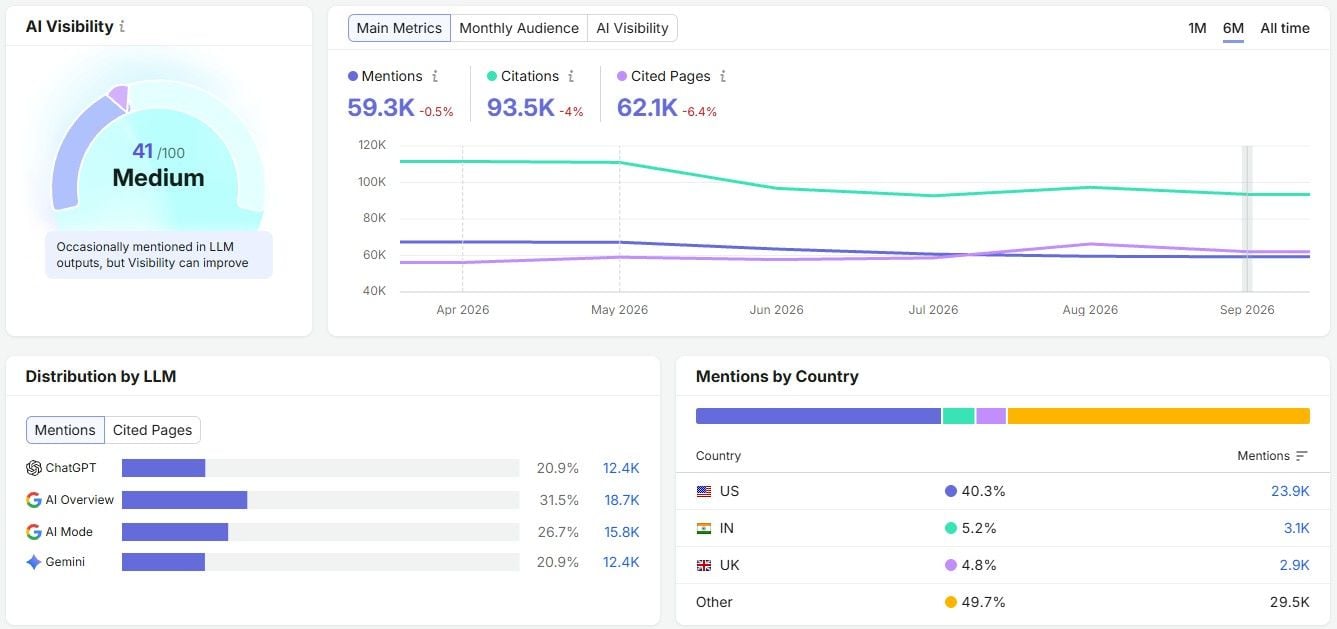
Semrush’s AI Visibility Toolkit, included in Semrush One, automates everything in the manual method and adds the parts you cannot do by hand: historical trends, competitor share of voice, sentiment scoring and daily monitoring. It draws on a database of more than 261 million AI prompts.
Here is the workflow we use. For the full toolkit walkthrough, including Prompt Research and reporting, see our guide on how to track AI visibility with Semrush.
1. Benchmark with Visibility Overview
In the left menu, open AI, then Visibility Overview, and enter your domain. You get an AI Visibility Score from 0 to 100, trend lines for mentions, cited pages and citations, and a Distribution by LLM chart that shows which platforms mention you most. This single screen replaces the manual spreadsheet and adds history you did not have.
Check your AI Visibility Score with Semrush One
2. Brand mentions in Gemini and Perplexity: Brand Performance
The Brand Performance reports are where Gemini and Perplexity join ChatGPT and Google’s AI surfaces. Set up your brand with its name variations and pick up to nine competitors.
The main dashboard plots share of voice against sentiment for every brand at once. The Perception report tracks how positively each platform describes you over time. Narrative Drivers lists the domains the models cite most when talking about your category, which is your outreach list. The Questions report shows the exact prompts where you and your competitors are named.
This is the part that answers the question most teams actually have, which is not “are we mentioned” but “what does AI say about us compared with them”.
3. Monitoring ChatGPT brand mentions daily with Prompt Tracking
Prompt Tracking lives inside Position Tracking. Create a campaign, choose ChatGPT, Google AI Mode or Gemini as the search engine, and paste the prompts from your manual test. From the next day you get a Visibility figure and an Average Position for every prompt, refreshed daily, with competitors tracked on the same prompts.
Semrush One Starter includes 50 tracked prompts, which is enough for a single brand with a handful of products. Around 10 well-chosen prompts per product is the number Semrush’s own team recommends.
4. Brand mentions in AI Overviews
Google’s AI Overviews are tracked in two places. Position Tracking flags AI Overview as a SERP feature on your keywords, so you can see which searches trigger one. The AI Visibility reports then tell you whether you are cited inside it. A keyword where you rank third but the Overview cites two competitors is the clearest gap you will find.
5. Check that AI crawlers can reach you
Run a Site Audit and open the AI Search Health widget. It flags robots.txt rules blocking OAI-SearchBot, PerplexityBot, Google-Extended or Claude-SearchBot, plus missing llms.txt files. A blocked crawler is the most common reason a brand is absent from AI answers, and the cheapest to fix. We detail the AI Search Health checks in step 6 of our Semrush AI visibility tutorial.
Best tools to track ChatGPT brand mentions: how Semrush compares
Several tools to track company mentions in AI-generated answers have launched since 2025. The main difference between them is whether the AI data connects to anything else.
| Tool | Platforms covered | SEO tools included | Starting price |
|---|---|---|---|
| Semrush (Semrush One) | ChatGPT, Gemini, Perplexity, AI Overviews, AI Mode | Yes, full toolkit | $199/mo, 14-day trial |
| Ahrefs Brand Radar | ChatGPT, Gemini, Perplexity, AI Overviews | No, sold as add-on | $179/mo on top of subscription |
| Profound | ChatGPT on entry tier, more on higher plans | No | $99/mo |
| Otterly AI | ChatGPT, Perplexity, AI Overviews, Copilot | No | $29/mo |
Otterly is the right choice for a quick diagnostic on a tight budget. Profound goes deep on the AI layer alone. Semrush is the option where a gap found in ChatGPT becomes a content brief, a technical fix and a tracked keyword in the same project, because the AI brand tracking sits next to your rankings and backlinks rather than in a separate product.
Ahrefs has the closest equivalent, but Brand Radar costs $179 a month on top of an existing plan and includes no SEO tools. Semrush One bundles both from $199.
Try Semrush One free for 14 days
Best ways to monitor brand mentions in AI search: five habits
Whichever tool you use, these practices separate teams that improve their numbers from teams that just collect them.
- Track prompts with buying intent first. “Best X for Y” and “X vs Y” prompts decide revenue. Definitional prompts do not.
- Treat competitors’ mentions as your roadmap. Where they are named and you are not is where the next piece of content goes.
- Read the sentiment, not just the count. A rising mention count with falling sentiment is a reputation problem dressed as a win.
- Work the cited domains. The publishers AI models already trust are the ones worth pitching. Narrative Drivers gives you the list.
- Review monthly, not daily. Daily data is for catching sudden drops. Strategy decisions need a month of trend.
FAQ: tracking brand mentions in AI
How can you track brand mentions in ChatGPT for free?
Manually: incognito window, a fixed prompt list, three runs per prompt, results in a spreadsheet. Semrush also offers a free AI Visibility Checker for a one-off snapshot. Daily tracking with competitors and sentiment requires a paid tool.
What is the difference between a brand mention and a brand citation in AI responses?
A mention is your brand named in the answer. A citation is a link to one of your pages as a source. You can have either without the other, and a full picture tracks both.
Does Semrush track brand mentions in Gemini and Perplexity?
Yes. Both are covered in Visibility Overview and Brand Performance. Daily Prompt Tracking currently supports ChatGPT, Google AI Mode and Gemini.
How often should I check AI brand mentions?
With a tool, daily monitoring runs on its own and a monthly review is enough for decisions. Manually, once a quarter is realistic, which is one reason most teams move to software to track brand mentions in AI responses after their first audit.