Rankings hold, traffic drops, and ChatGPT recommends a competitor. We tested 11 AI visibility tools and AI marketing tools to find out which ones actually fix that in 2026, and what each costs.
Why AI visibility is the marketing problem of 2026
Something odd is happening in marketing dashboards this year. Impressions keep climbing. Clicks keep sliding. Rankings hold steady while traffic drops anyway.
The reason is simple. Roughly 60% of Google searches now end without a click, and AI Overviews, ChatGPT and Perplexity are answering questions that used to send people to your site. In a Semrush survey from September 2025, 59% of marketers reported traffic declines. Gartner expects traditional search volume to fall by 25% by the end of 2026.
Search has not died. It has split in two. Your brand now needs to rank on Google and be cited in AI-generated answers, and most marketing stacks were built for only one of those. That is why the first thing many teams are shopping for is an AI visibility tool, and why we put that category at the top of this list.
The 01net editorial team spent the past several weeks using these tools on our own properties. Below, 11 tools that earned a place, sorted by what they are good at, with pricing, strengths and the limitations we ran into.
How we chose the best AI visibility tools and AI marketing tools
Every tool below was set up on a real domain and used for actual work, not a demo account. We looked at four things.
- Does it solve a problem marketers have in 2026, or does it just add “AI” to a feature that already existed?
- Is the output usable without heavy rework?
- Does the price line up with what you actually get on the entry tier?
- Does it fit into a workflow, or does it sit in isolation?
For the AI visibility tracking tools specifically, we also checked which platforms each one covers (ChatGPT, Gemini, Perplexity, Google AI Overviews, AI Mode), how often the data refreshes, and whether it connects to any SEO data at all.
AI visibility tools and AI marketing tools: comparison table
| Tool | Category | AI visibility tracking | Starting price |
|---|---|---|---|
| Semrush | Search visibility platform (SEO + AI) | Yes, ChatGPT, Gemini, Perplexity, AI Overviews, AI Mode | Semrush One from $199/mo, 14-day free trial |
| Ahrefs | SEO platform | Yes, via Brand Radar add-on ($179/mo extra) | From $129/mo |
| Profound | LLM visibility tool | Yes (ChatGPT only on entry tier) | From $99/mo |
| Otterly AI | AI brand visibility tracker | Yes, basic | From $29/mo |
| Claude | AI assistant / writing | No | Free, paid from $17/mo |
| Koala AI | Long-form content generation | No | From $9/mo |
| Grammarly | Writing assistant | No | Free, paid from $12/mo |
| Canva AI | Design and video | No | Free, Pro from $12/mo |
| Photoroom | Image editing and product visuals | No | Free, paid from $12.99/mo |
| Gumloop | AI workflow automation | No | Free, paid from $37/mo |
| beehiiv | Newsletter and email | No | Free, paid from $39/mo |
AI visibility tools and search visibility platforms
This is the category that changed the most since last year. Two years ago, “SEO tool” meant keywords, backlinks and rank tracking. Now the question is whether ChatGPT mentions your brand at all, and which competitor it recommends instead.
Four tools made the cut. One is a full search visibility tool that covers Google and AI answers together. One is a classic SEO suite with AI tracking sold separately. Two are standalone AI search visibility tools with no SEO layer. If you want to see the first one in action before reading on, we walk through the full setup in our guide to tracking AI visibility with Semrush.
1. Semrush: AI visibility platform and SEO suite in one
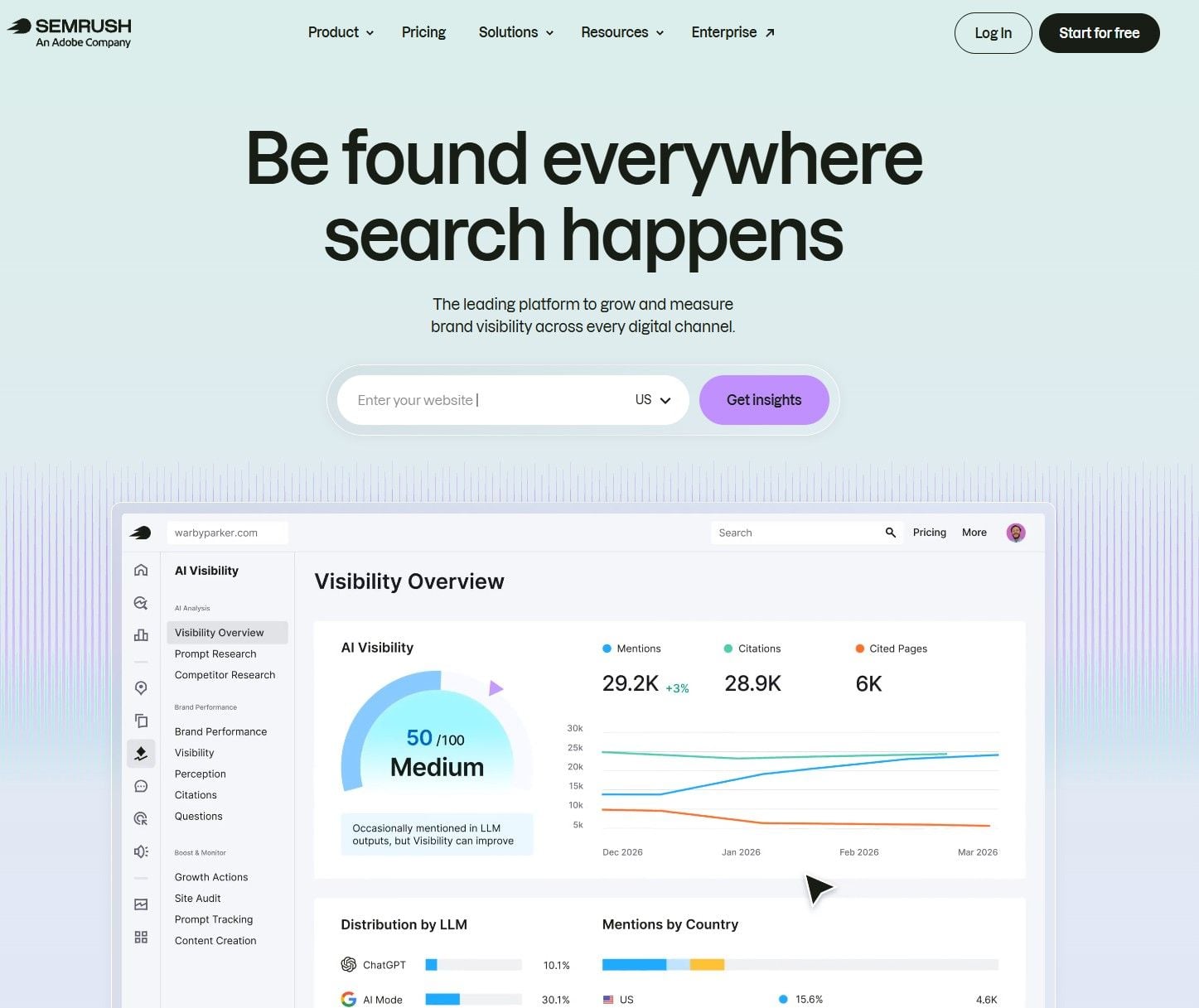
Semrush is the one platform on this list that treats Google rankings and AI-generated answers as a single problem. Its AI Visibility Toolkit sits next to the classic SEO tools inside the same interface, so the team that tracks rankings is also the team that tracks brand mentions in ChatGPT.
Best for: in-house marketing teams and agencies that need SEO and AI search data in one workflow, on one subscription.
Why Semrush is the best AI visibility platform on this list
The Semrush One plan bundles the SEO Toolkit and the AI Visibility Toolkit. In practice that means you research a keyword, check whether Google shows an AI Overview for it, see which sources that Overview cites, and then track the equivalent prompt in ChatGPT, all without switching tabs.
The underlying data is the largest we have worked with. Semrush reports a 43 trillion backlink index, 3.7 billion US keywords across 142 geographic databases, and a prompt database of more than 261 million AI search prompts. Historical data goes back to 2012, which matters when you are trying to explain a traffic drop to a client.
AI visibility tracking: what the AI visibility tracker shows you
This is the part we spent the most time on, because it is the part nobody else does at this depth.
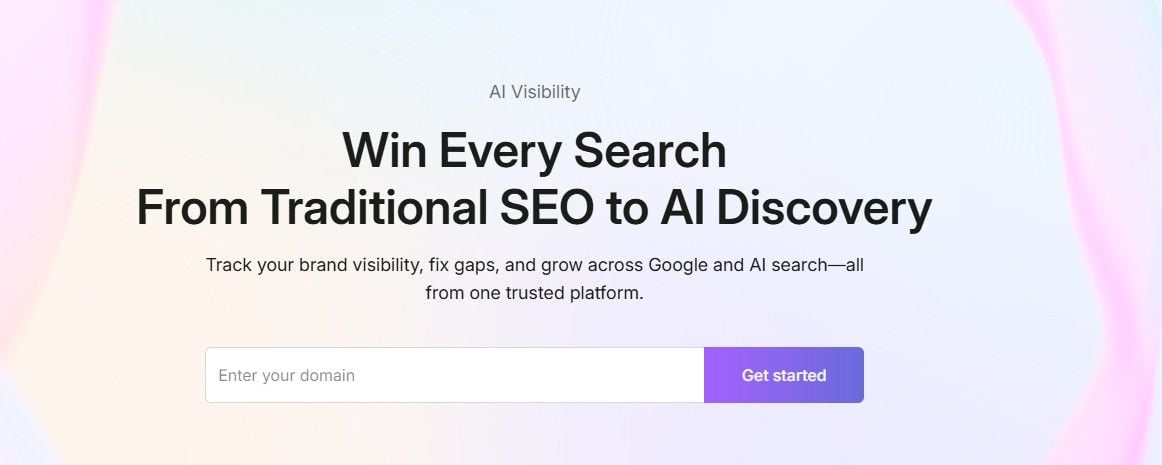
The AI Visibility Score (0 to 100) tells you how often your brand appears in AI answers for the prompts you track, and where it is missing. Coverage includes Google AI Overviews, Google AI Mode, ChatGPT, Gemini and Perplexity. Not every report covers every platform yet: Prompt Tracking currently works on AI Overviews, AI Mode and ChatGPT, while the Brand Performance reports add Gemini and Perplexity. Semrush documents the exact split in its knowledge base.
Prompt tracking works like rank tracking, but for conversational queries. You add the prompts your customers are likely to type, and Semrush checks daily whether you show up, in what position, and with what sentiment (we explain how to build that prompt list in our article on how to track brand mentions in ChatGPT, Gemini and Perplexity). We found the sentiment layer useful in a way we did not expect: one of our test brands was being described as “expensive” in Gemini answers, and nobody on the team knew.
Share of voice benchmarks you against up to nine competitors inside AI responses. Citation tracking then shows which pages and domains the AI platforms credit. That list doubles as an outreach target list, since those are the sources you want to appear on.
The AI site audit is a smaller feature but a practical one. It checks whether your robots.txt blocks OAI-SearchBot, PerplexityBot, Google-Extended or Claude-SearchBot. Two of the five sites we tested were blocking at least one AI crawler without anyone having decided to.
Semrush’s own proof point: using these tools, the company reports moving its share of voice in AI answers from 13% to 32% in one month. Your mileage will differ, but the mechanism is sound.
The SEO visibility tool side has not been neglected
Keyword Magic Tool remains the fastest way to build a topic cluster from a seed keyword, with personalised keyword difficulty scores based on your own domain’s authority. Site Audit crawls for technical issues and now flags AI crawlability alongside the usual Core Web Vitals and indexing problems. Position Tracking covers 50 SERP features, including AI Overviews as a feature.
Larger teams can add Enterprise AIO, which lifts the tracking limits and supports multiple brands and markets in one workspace. For most readers of this article, Semrush One is the right tier.
Limitations
Two honest trade-offs. First, Ahrefs covers more geographic regions (226 vs 142), so if your work is heavily international outside the main markets, check that your countries are covered before you sign up. Second, the AI Visibility Toolkit’s prompt limits on the Starter tier are enough for one brand, but agencies juggling many clients will hit the ceiling and need to move up a plan.
Pricing: Semrush One starts at $199 per month and includes both toolkits, with a 14-day free trial. Current plans and limits are on the Semrush pricing page.
Try Semrush One free for 14 days
2. Ahrefs: SEO platform with AI visibility sold separately
Ahrefs is the closest rival to Semrush on traditional SEO, and on some metrics it wins. Its global keyword database is slightly bigger (28.7 billion vs 28.4 billion), Site Explorer is fast, and the backlink crawler refreshes quickly.
Best for: SEO specialists who live in backlink data and work across many countries.
Where Ahrefs falls behind is AI visibility monitoring. Tracking your brand in ChatGPT or Perplexity requires Brand Radar, a separate product at $179 per month on top of your existing subscription. Brand Radar is a capable tool, but it is AI monitoring only, with no SEO tools bundled. Buying Ahrefs plus Brand Radar costs more than Semrush One and gives you two interfaces instead of one.
Limitations: AI visibility is an expensive add-on rather than a core feature, and Ahrefs has no PPC research tools.
Pricing: from $129 per month for the Lite plan. Brand Radar is priced separately.
3. Profound: LLM visibility tool for brand teams
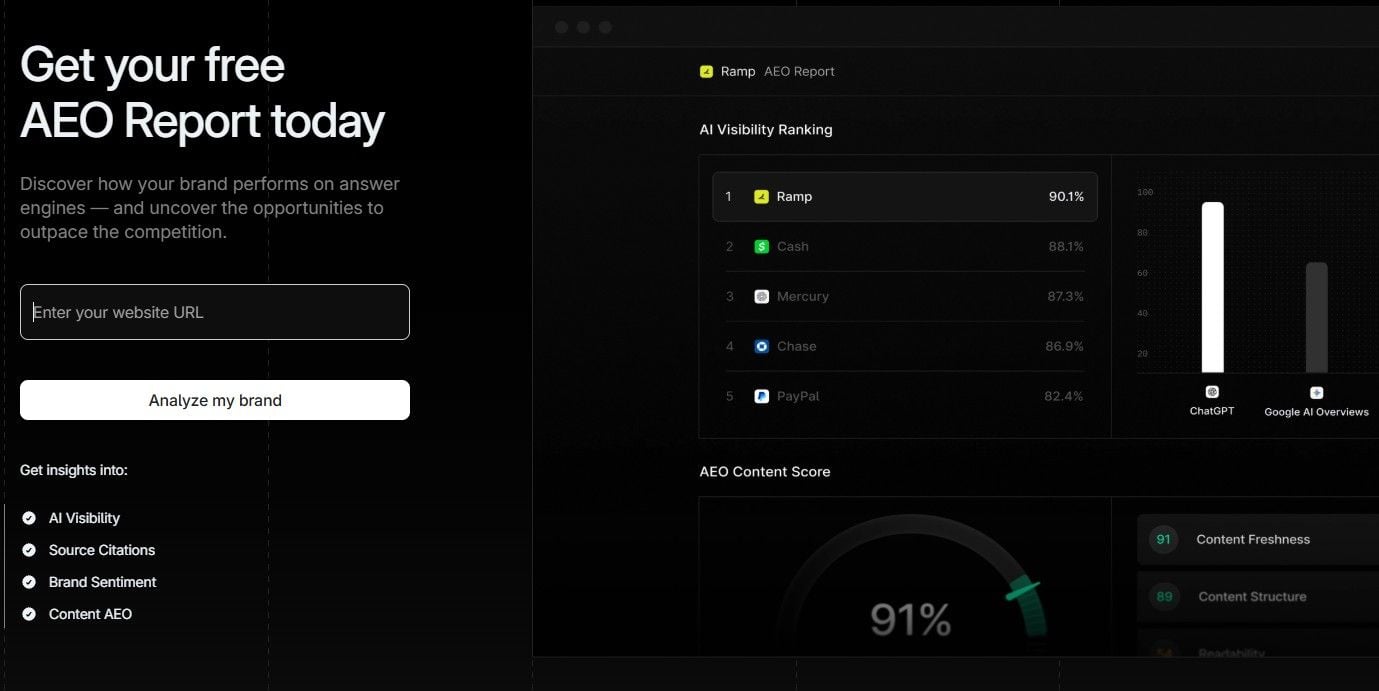
Profound is a pure-play AI visibility platform, built for brands that want to understand how large language models describe them. It does this one thing well, with detailed reporting on citations, sentiment and the sources behind each answer.
Best for: brand and communications teams who already have an SEO tool and only need the AI answer layer.
The catch is scope. The $99 entry tier covers ChatGPT only. Coverage of Perplexity, Gemini and Google AI Overviews requires higher plans, and there is no SEO integration at any tier. Among LLM visibility tools, it is one of the more polished, but you will still need something else for keywords, backlinks and technical audits.
Limitations: single-platform coverage at the entry price, no keyword or backlink data.
Pricing: from $99 per month.
4. Otterly AI: affordable AI brand visibility tracker
Otterly is the affordable way in. For $29 per month you can track one domain across 15 prompts on ChatGPT, Google AI Overviews, Perplexity and Copilot. That is enough to find out whether you have an AI visibility problem before you spend real money fixing it.
Best for: solo marketers and small businesses that want a first read on brand mentions in AI answers.
The reporting is basic, the prompt database is small compared to Semrush’s 261 million, and there is no technical audit or SEO workflow. Of all the tools for AI visibility we tried, it is the simplest to set up and the quickest to outgrow. Treat it as a diagnostic rather than a platform.
Limitations: low prompt limits, no SEO tools, limited history.
Pricing: from $29 per month.
AI content and writing tools
Being visible in AI answers is only half the job. The content itself still has to be worth citing. These three tools handle drafting, long-form production and editing.
5. Claude: AI writing assistant for editors
Claude, from Anthropic, is the assistant our editors reach for when a draft needs to sound like a person wrote it. It handles long documents well, follows style rules closely, and is noticeably better than most rivals at rewriting stiff copy into something readable.
Best for: editors and content marketers who want an AI writing assistant for research, restructuring and tone work rather than bulk generation.
Projects let you store standing instructions (brand voice, banned phrases, house style), so you stop re-explaining the brief every session. We use one to turn published articles into social posts and newsletter blurbs in a consistent voice.
Limitations: no native SEO data. It does not know your rankings or search volumes unless you connect it to a data source such as the Semrush MCP server, which Semrush One customers can do.
Pricing: free plan available. Paid plans from $17 per month with annual billing.
6. Koala AI: long-form content generator
Koala AI is a purpose-built AI content generator for blog posts. You give it a keyword, tweak the outline and tone, and it produces a full article in one of 97 languages. It can pull in real-time data and add an FAQ section automatically.
Best for: publishers and affiliate sites that need volume and are prepared to edit.
The output is a usable first draft, not a finished article. Facts need checking, and the prose needs a human pass before publication if you want it to hold up in a competitive SERP.
Limitations: generic phrasing out of the box, and no visibility tracking to tell you whether the content performed.
Pricing: from $9 per month for 15,000 words. One free article to test.
7. Grammarly: editing assistant that works everywhere
Grammarly has grown from a spell-checker into a full editing assistant, and it still earns its place because it works everywhere: in WordPress, in Gmail, in LinkedIn. It catches the errors that slip through when you are publishing ten pieces a day.
Best for: teams that publish a lot and need consistent quality control across every channel.
The browser extension also flags plagiarism and gives an AI-detection score. The detector is easy to fool and should not be treated as proof of anything, but as a quick readability sanity check it is handy.
Limitations: the tone suggestions can flatten distinctive writing if you accept them blindly.
Pricing: free plan. Premium from $12 per month.
AI design and visual tools
8. Canva AI: social visuals without a designer
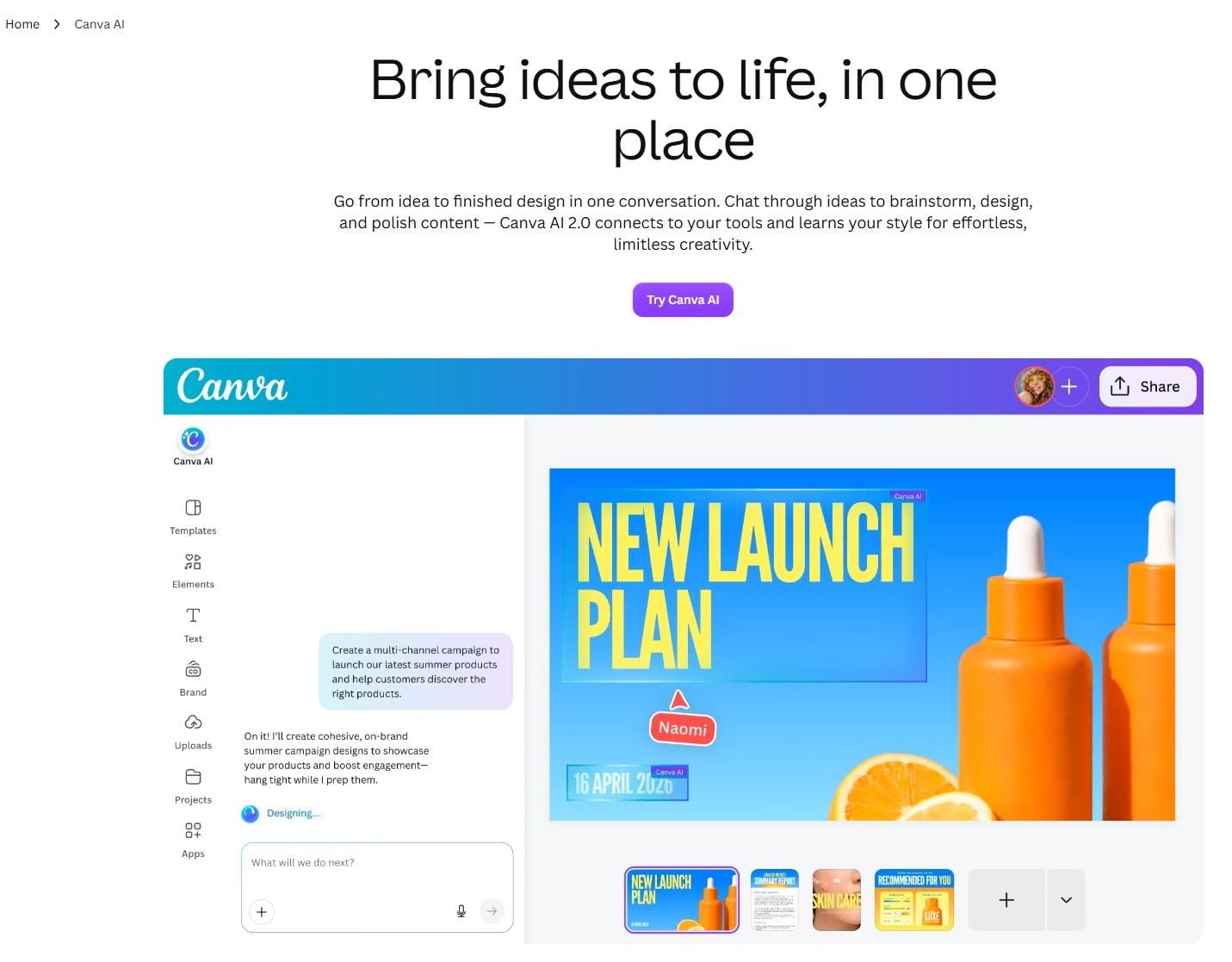
Canva’s AI features turn a rough brief into social visuals, carousels, short video and presentation slides without a designer in the loop. The Magic tools inside the editor handle background changes, resizing across formats and text-to-image generation.
Best for: small marketing teams producing daily social content.
We used it for featured images and Instagram carousels across several test brands. The Brand Kit keeps colours and fonts consistent, which is the feature that saves the most time over a month.
Limitations: the AI does not always follow layout instructions, and the best templates need a Pro plan.
Pricing: free plan. Canva Pro from $12 per month billed annually.
9. Photoroom: product imagery in one click
Photoroom is narrower than Canva and better at its narrow job: product and brand imagery. Background removal is one click and pixel-accurate, and Product Staging drops a product shot into a lifestyle scene that looks photographed rather than pasted.
Best for: e-commerce marketers and anyone who needs clean product visuals fast.
The AI logo generator is better than it has any right to be at this price, and the resize tool reformats one image for every platform in a single pass.
Limitations: weak for layouts, text-heavy graphics or anything that is not image-centric.
Pricing: free plan. Paid from $12.99 per month.
AI automation and email
10. Gumloop: no-code AI marketing automation
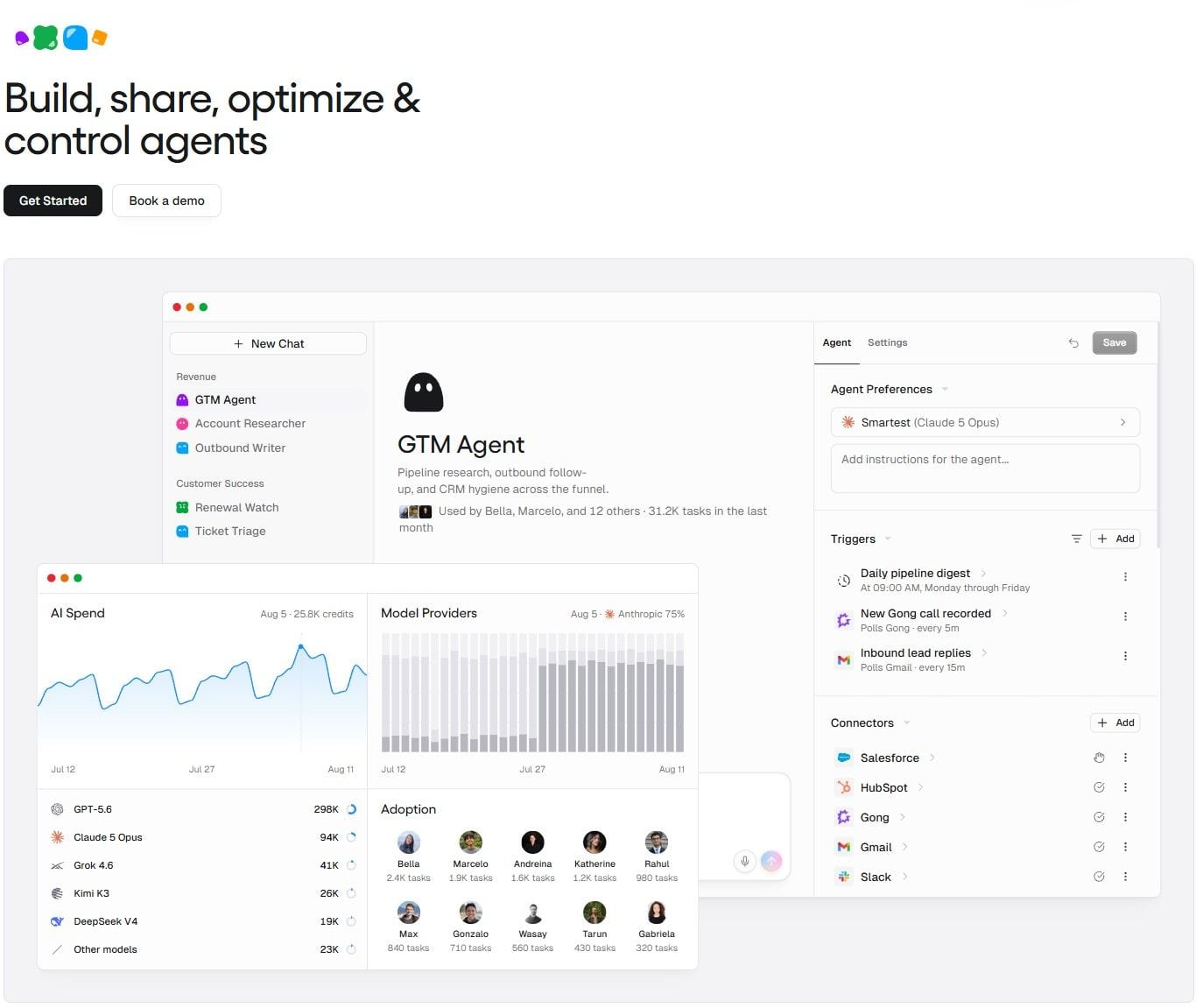
Gumloop is a visual builder for AI marketing automation. You connect steps (scrape a page, run a prompt, write to a sheet, post to Slack) and the platform runs the workflow on a schedule or trigger. More than 100 integrations are available.
Best for: marketers who want to automate reporting, content repurposing or lead research without writing code.
We built a content decay monitor that flags articles losing more than 25% of clicks month over month and groups them by severity. It took an afternoon and now runs itself.
Limitations: credits burn quickly on complex workflows, and debugging a failed run takes patience.
Pricing: free plan with 5,000 credits per month. Paid from $37 per month.
11. beehiiv: newsletters with built-in growth tools
beehiiv is a newsletter platform with AI baked into the writing, subject-line and growth tools. Newsletters can be published as SEO-friendly web pages, which makes it a quiet contributor to search visibility as well as email.
Best for: creators and media brands that want to grow and monetise an email list on one platform.
Referral programmes, paid subscriptions and an ad network are built in. The analytics are clear enough to see which subject lines and send times are actually working.
Limitations: the free tier caps at 2,500 subscribers, and the more useful growth features sit on paid plans.
Pricing: free up to 2,500 subscribers. Paid from $39 per month.
What makes Semrush different from a standalone AI brand visibility tool?
Most tools in this article do one job. Semrush is the only one where traditional SEO and AI visibility optimization share the same data, projects and reports.
That matters because the two are converging. Semrush’s own research finds that visitors arriving from AI search convert at 4.4 times the rate of traditional organic visitors. They arrive later in the decision, with the comparison already done. Being the brand the AI recommends is worth more per click than being the brand that ranks third on Google.
Ahrefs asks you to pay $179 extra for AI tracking with no SEO tools attached. Profound and Otterly give you AI tracking with no SEO at all. Semrush One gives you both for $199. For a team that needs to explain where the traffic went and what to do about it, that is the shortest path.
Try Semrush One free for 14 days
Our verdict: the best AI visibility tool and marketing stack for 2026
If you buy one tool from this list, buy Semrush and use the AI Visibility Toolkit from day one. Pair it with Claude for writing and Canva for visuals, and you have covered the three jobs that most marketing teams struggle with in 2026: knowing where you appear, producing content worth citing, and packaging it.
If budget is tight, Otterly plus Claude will tell you whether you have an AI visibility problem for under $50 a month. You will outgrow it, but it is a sensible place to start.
FAQ: AI visibility tools and AI search
What is AI visibility?
AI visibility measures how often, and how favourably, your brand appears in answers generated by tools such as ChatGPT, Gemini, Perplexity and Google AI Overviews. It is the AI-search equivalent of a keyword ranking, and AI visibility software exists to measure it the way rank trackers measure Google positions.
What is the best AI visibility tool in 2026?
For most marketing teams, Semrush, because its AI Visibility Toolkit ships inside the same platform as the SEO tools. If you only need the AI layer, Profound is the most detailed standalone option and Otterly the cheapest.
How do I track brand mentions in ChatGPT with an LLM visibility tracker?
You need a tool that runs prompts against ChatGPT on a schedule and records whether your brand is named, in what position and with what sentiment. Semrush does this daily for Google AI Overviews, AI Mode and ChatGPT, with Gemini and Perplexity covered in the Brand Performance reports. Otterly and Profound offer narrower versions. For a manual method that costs nothing, see our step-by-step guide to tracking brand mentions in AI answers.
What are the best tools for monitoring AI Overviews?
Semrush tracks AI Overviews both as a SERP feature in Position Tracking and as a platform in the AI Visibility Toolkit, so you can see which keywords trigger an Overview and whether you are cited in it. Otterly also covers AI Overviews on its entry plan. Ahrefs requires the Brand Radar add-on.
Is AI visibility optimization replacing SEO?
No. Google still drives the majority of referral traffic, and AI platforms draw heavily on pages that already rank well. The brands winning in 2026 are doing both, which is why a unified platform makes more sense than two separate AI tracking tools.
Which AI visibility tracking tools are best for small businesses?
Otterly is the cheapest way to check your AI visibility before committing to anything larger. Once you know there is a gap worth closing, Semrush One is the most complete option, and Canva’s free plan plus Claude’s free tier cover content and visuals in the meantime.