Surfshark can work in China, but only with the right protocol, and not on every attempt. A contributor who tested it in Shanghai in March 2026 connected on the first try in about 17 of roughly 25 attempts. Our November tests from Europe showed what the working setup costs: OpenVPN (TCP) cut speeds to about 11 Mbps, while OpenVPN (UDP) kept Singapore and Tokyo above 115 Mbps.
How to Use Surfshark in China: November 2026 Setup
- Subscribe to Surfshark before you travel. Its website is blocked in China.
- Install the app on every device you’re taking and sign in.
- Open Settings, then VPN Settings, and set the protocol to OpenVPN (UDP). Camouflage Mode then runs automatically.
- Enable NoBorders and the kill switch in the same menu.
- Connect to a server in Singapore or Japan, and switch to OpenVPN (TCP) if UDP won’t connect.
- Download a manual WireGuard configuration from your Surfshark account as a backup.
Does Surfshark Work in China?
Yes, but not reliably, and the result depends on how the app is set up. China blocks Google, YouTube, Instagram, WhatsApp, and the international TikTok app, and it detects most VPN traffic that isn’t disguised. WhatsApp remains blocked in China, unlike in Iran, which lifted its WhatsApp ban in December 2024. Our contributor in Shanghai tested Surfshark for ten days in March 2026 on a residential connection, with NoBorders enabled. About 17 of roughly 25 attempts connected on the first try.
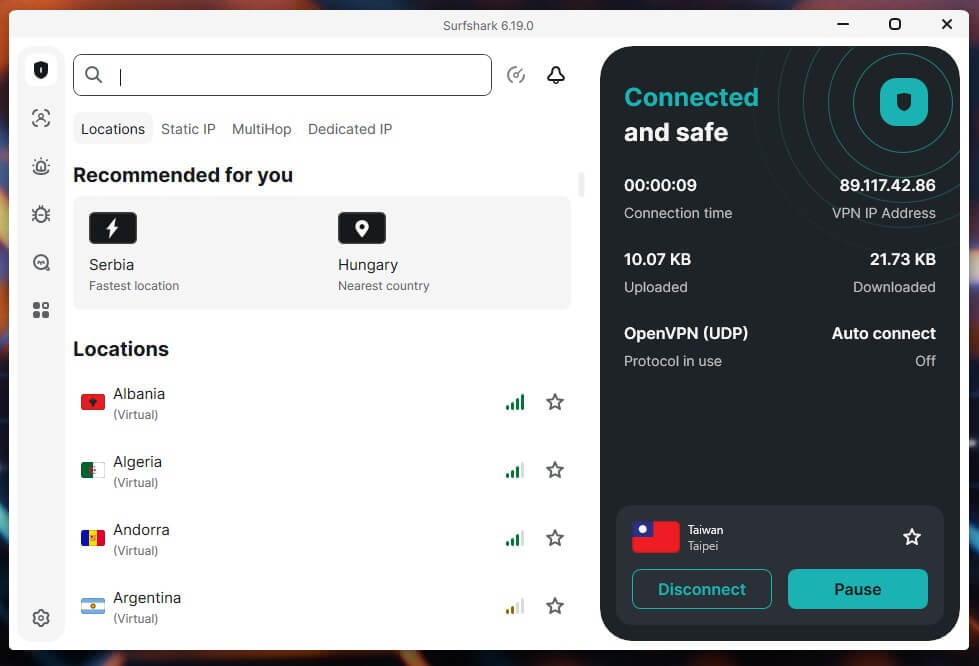
The rest needed a second or third attempt, sometimes on another server. Once connected, speeds ran from 15 to 22 Mbps, Netflix US loaded on four of five attempts, and YouTube, BBC iPlayer, and WhatsApp calls worked in every session. The issue was connecting: once a session was up, it was stable. Those results predate China’s April 2026 crackdown, when Beijing ordered network providers to block VPN services, and reports since then describe stable VPN connections as harder to find.
Surfshark’s support article on connecting from China, updated in May 2026, tells users to switch to a manual WireGuard connection when the app can’t connect, and the company says it can’t guarantee access at all times.
NoBorders and Camouflage Mode Do Different Jobs
- NoBorders detects a restricted network and shows the servers most likely to work on it. It’s a toggle under VPN Settings, and it doesn’t disguise your traffic.
- Camouflage Mode is Surfshark’s obfuscation, which makes VPN traffic look like ordinary encrypted traffic. It has no toggle. Surfshark applies it automatically whenever the app uses OpenVPN, over UDP or TCP. WireGuard and IKEv2 connections have no Camouflage, so a protocol left on WireGuard or Automatic is the most common reason Surfshark fails in China.
What the China Setup Costs in Speed
We tested the three nearest uncensored locations on each protocol in November, using Surfshark 6.19.0 on a Windows 11 PC in Europe with a 190.36 Mbps connection. Download speeds, in Mbps:
| Server | WireGuard | OpenVPN (UDP) | OpenVPN (TCP) |
|---|---|---|---|
| Singapore | 133.19 | 138.22 | 10.07 |
| Tokyo | 123.91 | 117.30 | 12.11 |
| Taipei | 116.54 | 26.88 | 10.60 |
OpenVPN (UDP) kept up with WireGuard in Singapore and Tokyo, so Camouflage costs little speed on UDP. Taipei was the exception, at 26.88 Mbps. OpenVPN (TCP) was very slow on every server, between 10 and 12 Mbps, and each OpenVPN connection took 5 to 6 seconds to establish.
The TCP figures exaggerate the drop a user in China would see. TCP throughput falls as latency increases, and Tokyo and Taipei are far closer to Shanghai than to Europe. Start with UDP, and keep TCP for networks where UDP won’t connect.
Setting Up Surfshark Before You Travel
Install Surfshark on every device you plan to take and sign in at home. One subscription covers unlimited devices. Open Settings, then VPN Settings. The protocol selector, the NoBorders toggle, and the kill switch are in that menu.
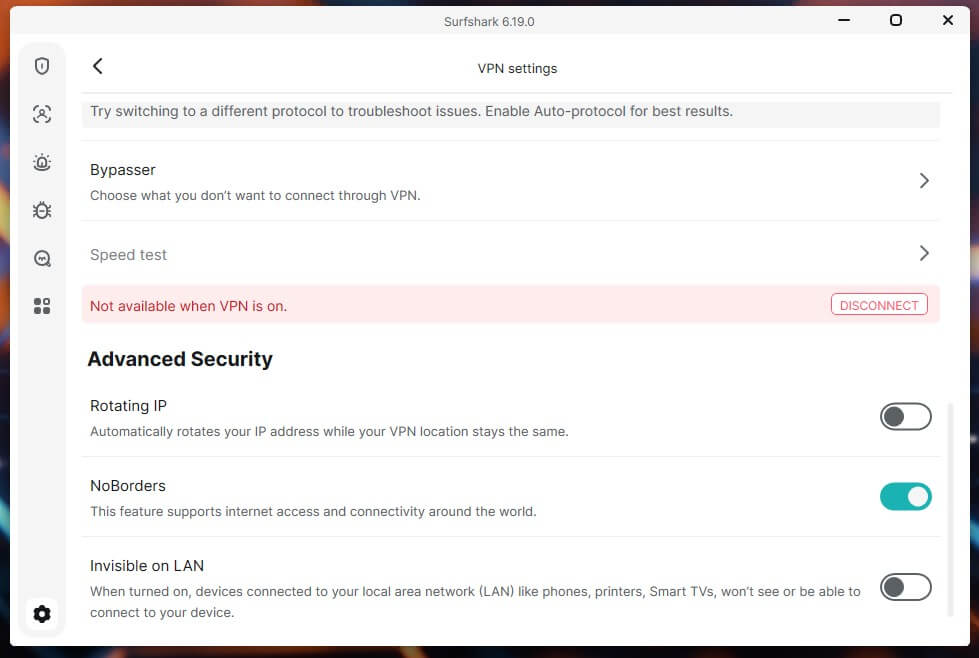
Set the protocol to OpenVPN (UDP), then enable NoBorders and the kill switch, which blocks your traffic if the VPN connection drops. Connect to Singapore or Tokyo first. If nearby servers are blocked, more distant locations are worth a try, and a server in Australia also provides an Australian IP address for local streaming.
Surfshark’s Manual WireGuard Setup
Prepare this before the trip, because it requires logging in to your Surfshark account.
- Log in at surfshark.com and open VPN, then Manual setup.
- Choose Desktop or mobile, then WireGuard.
- Generate a key pair under Credentials, or enter your own public key.
- Download configuration files under Locations for Singapore, Japan, and Taiwan.
- Install the official WireGuard app, import a file, and connect.
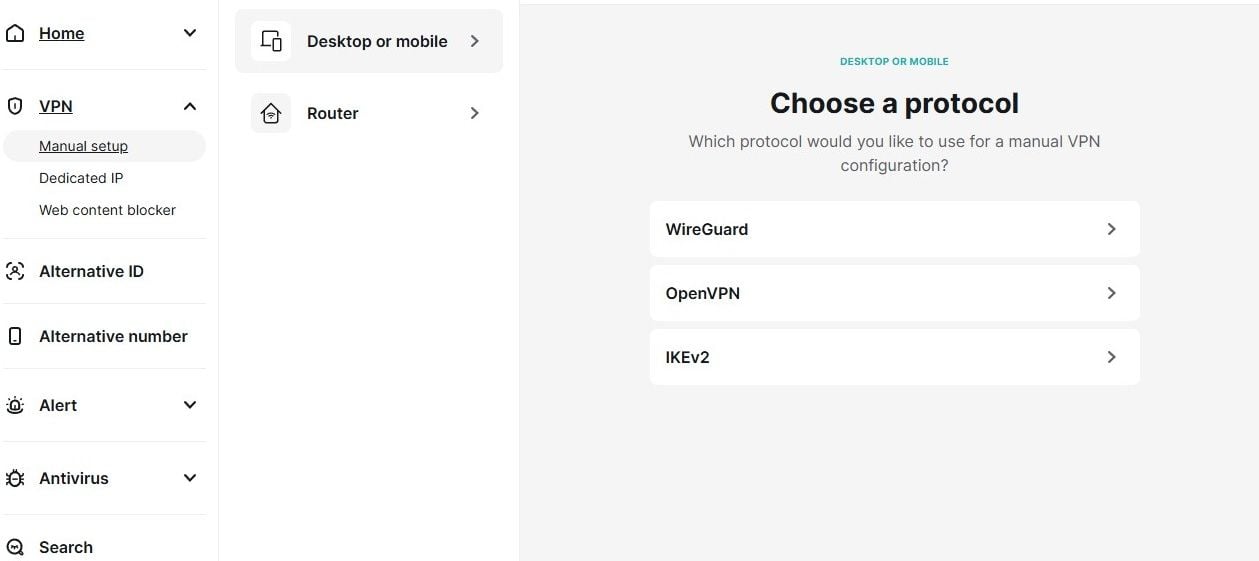
The setup was easy, and connection times and speeds matched the Surfshark app within the margin of error. Download files for several locations, because individual servers get blocked. Each file contains your private key, so keep it off shared drives and generate a new key pair if it leaks.
Surfshark Not Working in China?
- Check the protocol. WireGuard and Automatic run without Camouflage Mode. Select OpenVPN explicitly.
- Try TCP after UDP. TCP is much slower, but it can connect where UDP doesn’t.
- Switch servers. Rotate between Singapore, Tokyo, and Taipei, because single servers get blocked or slow down.
- Use a manual WireGuard file when the app won’t connect.
- Update the app before you travel. Downloading updates in China can fail.
- Contact support. Surfshark’s live chat runs 24/7 and can point you to servers that are working.
- Keep a second VPN. NordVPN’s obfuscated servers and ExpressVPN’s automatic obfuscation are the usual alternatives, compared in our NordVPN vs ExpressVPN guide and our test of ExpressVPN in China.
Is It Legal to Use Surfshark in China?
Not strictly. Since 2017, China has permitted only government-approved VPNs, and Surfshark isn’t one of them. Enforcement has mostly targeted people selling VPN access, some of whom have received prison sentences, though individual users have occasionally been fined. Visitors checking email or messages are rarely pursued. Our overview of where VPNs are legal covers other countries. We’re not lawyers, and this isn’t legal advice.
Getting Surfshark When You’re Already in China
Surfshark’s website is blocked in China, and China’s App Store has had no VPN apps since 2017. In Hong Kong, which is outside the Great Firewall, the website and app stores work normally. On an iPhone, an Apple ID registered in another country can also download the app.
Conclusion
Surfshark connects through the Great Firewall often enough to be useful on a trip, if the protocol is set correctly and a manual WireGuard file is ready as a backup. Retries are part of using it there. For short trips or as a backup, it’s a low-cost choice at under $2.50 a month on the Starter plan’s 27-month term, and the 30-day refund works like a free trial of Surfshark before you go. Our Surfshark review covers its performance elsewhere, and our best VPN rankings list the alternatives.
Frequently Asked Questions
Does Surfshark work in China?
Yes, but not reliably. Surfshark connects in China when set to OpenVPN with NoBorders enabled, or through a manual WireGuard configuration, though connections often require more than one attempt.
Is Surfshark's NoBorders mode enough for China?
No, NoBorders only picks servers suited to restricted networks. The obfuscation comes from Camouflage Mode, which Surfshark applies automatically on the OpenVPN protocol, over UDP or TCP.
Which Surfshark protocol works best in China?
OpenVPN (UDP) is the first protocol to try in the app, because Camouflage Mode only runs on OpenVPN. TCP is the slower fallback, and a manual WireGuard configuration is Surfshark's own recommendation.
Is it legal to use Surfshark in China?
No, not strictly. China permits only government-approved VPNs, and Surfshark isn't one. Enforcement has mostly targeted people selling VPN access, though some individual users have been fined.
Can Surfshark be downloaded in China?
No, not easily. Surfshark's website is blocked in China and VPN apps are missing from China's App Store, so the app and any configuration files have to be set up before arrival.
Why is Surfshark not connecting in China?
A protocol left on WireGuard or Automatic is the usual cause, since neither uses Camouflage Mode. Switching to OpenVPN, or to a manual WireGuard configuration, is the first fix to try.
