Kape Technologies is one of the most powerful companies in the VPN industry. With the acquisition of ExpressVPN in 2021, the company managed to merge some of the greatest providers together, including CyberGhost and PIA. Yes, PIA and ExpressVPN are sister companies as of 2021, and they share some similarities.
However, keep in mind that we’re talking about some of the oldest providers on the market, and with a very long experience in this field, both have proven to have insane value. We’ll be honest, one provider is better than the other, and in this ExpressVPN vs PIA test and comparison for 2026, that was ExpressVPN.
Still, we’ll test each provider and basically do a mini-review of both of them in this article. Therefore, you can expect speed tests, streaming tests, and comparisons in terms of torrenting, device compatibility, customer support, and, of course, pricing, where we’ll see major differences between the two VPNs.
If you wonder which provider you should buy for safeguarding your online privacy, streaming, and security features, this ExpressVPN vs Private Internet Access comparison will be quite helpful. And now, let us begin – imagine a gong ringing in your room as a sign of a start.
PIA VPN vs ExpressVPN: Key Features Compared
| Private Internet Access | ExpressVPN | |
| 💰 Starting price | $2.19 monthly | $3.49 monthly |
| 💸 Money-back guarantee | 30 days | 30 days |
| 🆓 Free version | No ❌ | No ❌ |
| 📺 Working with Netflix | Yes ✅ | Yes ✅ |
| 🔽 Torrenting allowance | Yes ✅ | Yes ✅ |
| 🔟 10 Gbps servers | Yes ✅ | Yes ✅ |
| 🥸 No-logging policy | Yes ✅ | Yes ✅ |
| 🌐 Jurisdiction | United States | British Virgin Islands |
| 📱 Simultaneous connections | Unlimited | 10 to 14 |
| 🛜 Protocols | WireGuard, IKEv2, OpenVPN | OpenVPN, Lightway Turbo |
| 💾 Servers | 30,000+ in 90+ countries | 3,000+ in 105+ countries |
| 💯 Best for | Unlimited device protection and advanced security | Ease of use, streaming, and connection speeds |
| ☎️ Customer support | 24/7 live chat, email, knowledge base, FAQs | 24/7 live chat, email, knowledge base, FAQs |
PIA vs ExpressVPN: Apps & Ease of Use
This PIA vs ExpressVPN comparison will start with the applications and device compatibility. We can say that both providers do reasonably well in this regard, as both of them support platforms like Windows, iOS, Android, Linux, and macOS.
In other words, they have native clients for these platforms, allowing you to install them without further tweaks and fiddling – even when talking about a Linux VPN app. ExpressVPN, being among the best providers out there, still takes the lead regarding device compatibility for other platforms.
You see, it has a native Fire TV Stick app and its router support is more extensive, making the whole setup much easier on both platforms. PIA doesn’t have a native Fire TV Stick app, so you’ll have to use a workaround to make it work on this streaming device.
On the other hand, we will give Private Internet Access credit – it has unlimited simultaneous connections, whereas ExpressVPN offers “just” 10 to 14. These are excellent numbers, but you simply can’t beat a VPN with unlimited simultaneous connections. It’s a better option for multiple devices.
Private Internet Access
The user experience is going to vary drastically between these providers. You see, PIA VPN is a bit sluggish, and its apps feel like driving a big truck – it’s slow and unresponsive. Mobile apps are a different story, and you can find out more about them in our PIA VPN review.
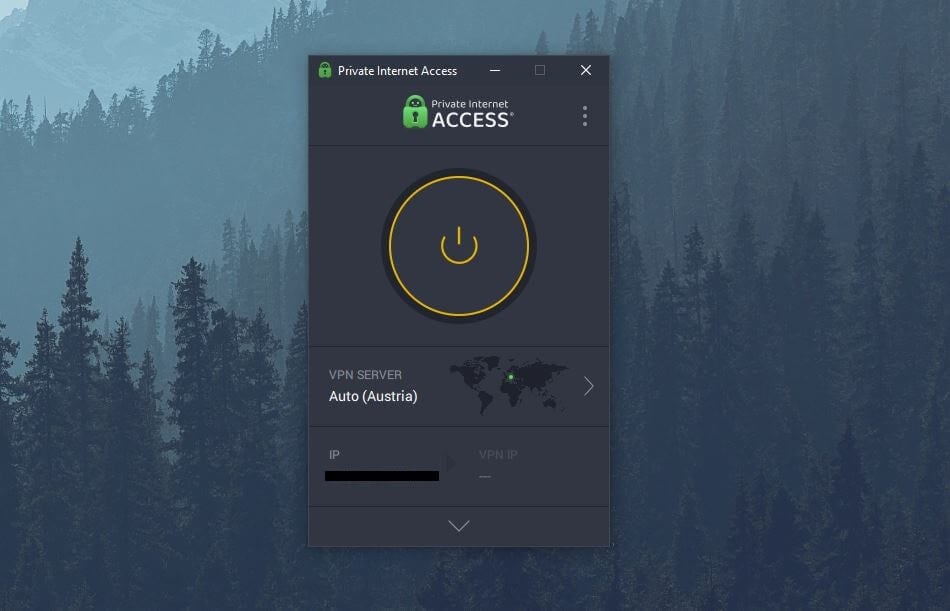
For now, let’s talk about the Windows (desktop) app, which, we think, many of you will use. It looks minimalistic, but opening the server list unwraps it, extending the app window further below. This makes the window extremely large; if you have a low-res screen, it’ll take up some space.
Everything you do here feels slow, from animations to even connecting to servers. Not to mention that the server list isn’t organized from A to Z but according to the ping, from the lowest to the highest, which we found extremely annoying and unintuitive. You can also open the Settings menu when you want to tweak its settings.
Although the Settings menu is well-realized with sub-menus for each advanced feature, we can’t help but think about how outdated and slow its app is overall. On the good side, the app is customizable, and you can change the theme, choose another language, and select the dashboard appearance.
That’s something we always appreciate, especially the presence of a dark theme that makes everything… well, dark – but also more elegant.
ExpressVPN
ExpressVPN is the polar opposite of Private Internet Access. Its app is small, and it feels like driving a Ferrari as opposed to a big, greasy truck. Once you open it up, the app lets you connect to the fastest server in two to three seconds, and scrolling through the server list is blazing fast.

This time, the provider includes an A-Z server list, which is further divided by continents, allowing you to find the location you want swiftly. Mind you, the server list is a separate window, but since both of them are very small, they won’t take up much space on your desktop.
Another thing we like about ExpressVPN is how simplistic its Settings menu is. You have all the important VPN features in two menus where you can find a kill switch, protocol selection, and other relevant functionalities. Plus, ExpressVPN is identical on all platforms!
The simplistic design on the desktop allows the provider to make an identical app for all platforms. This means that, when switching to your phone or even a Smart TV, you’ll get the same interface that functions the same – splendid!
Despite being simple, the apps look modern, and they’re significantly better than those of PIA. If you need to learn how to use a VPN, ExpressVPN’s application is a good place to start, as it’s one of the most beginner-friendly VPNs you can get.
Who Wins?
While PIA offers unlimited simultaneous connections, ExpressVPN is more compatible and easier to get around. PIA’s sluggishness still isn’t fixed, and on desktop, it doesn’t exude that premium feeling. All things considered, both providers have strengths and weaknesses, so we’ll end this round on a TIE.
Security & Privacy: Which One Is Safer to Use?
Moving on with this ExpressVPN vs PIA comparison, it’s time to talk about security and privacy. Being two premium providers of the highest caliber, it’s quite logical to expect the highest level of security. And while it’s true, the point of this test is to compare which one is safer and more secure.
Security Features
All VPNs function pretty much the same, which means you should expect some level of similarity. In the same fashion, ExpressVPN and PIA share some features. They include 256-bit AES encryption, an automatic kill switch, split tunneling, OpenVPN support, and IP/DNS leak protection.
In addition, both providers have something called Private DNS, as they both use proprietary DNS to preserve your privacy. Another similarity lies in the type of servers. ExpressVPN has TrustedServer technology, which is a fancy name for RAM-based servers.
PIA’s servers are RAM-only as well. This means that, upon each restart, all information on the server is wiped, preventing hackers, snoopers, or even the company itself from accessing a single bit of information.
What Are the Differences?
In terms of security features, we can see some main differences in this ExpressVPN vs PIA comparison. ExpressVPN is more of a “plug-and-play type” provider. It doesn’t have many special features that you can tweak, yet it works wonderfully compared to its rivals.
ExpressVPN
Since it has fewer features, let’s start with this provider – how is it different from its rival? Well, there’s one big difference – it has a Lightway Turbo VPN protocol, which is an in-house protocol developed by the company for achieving the best possible performance and security.
Lightway isn’t based on WireGuard, and it’s ExpressVPN’s secret recipe that no one knows so far. Whatever the case, it makes this provider what it is, and that’s a technological marvel in the world of VPNs.
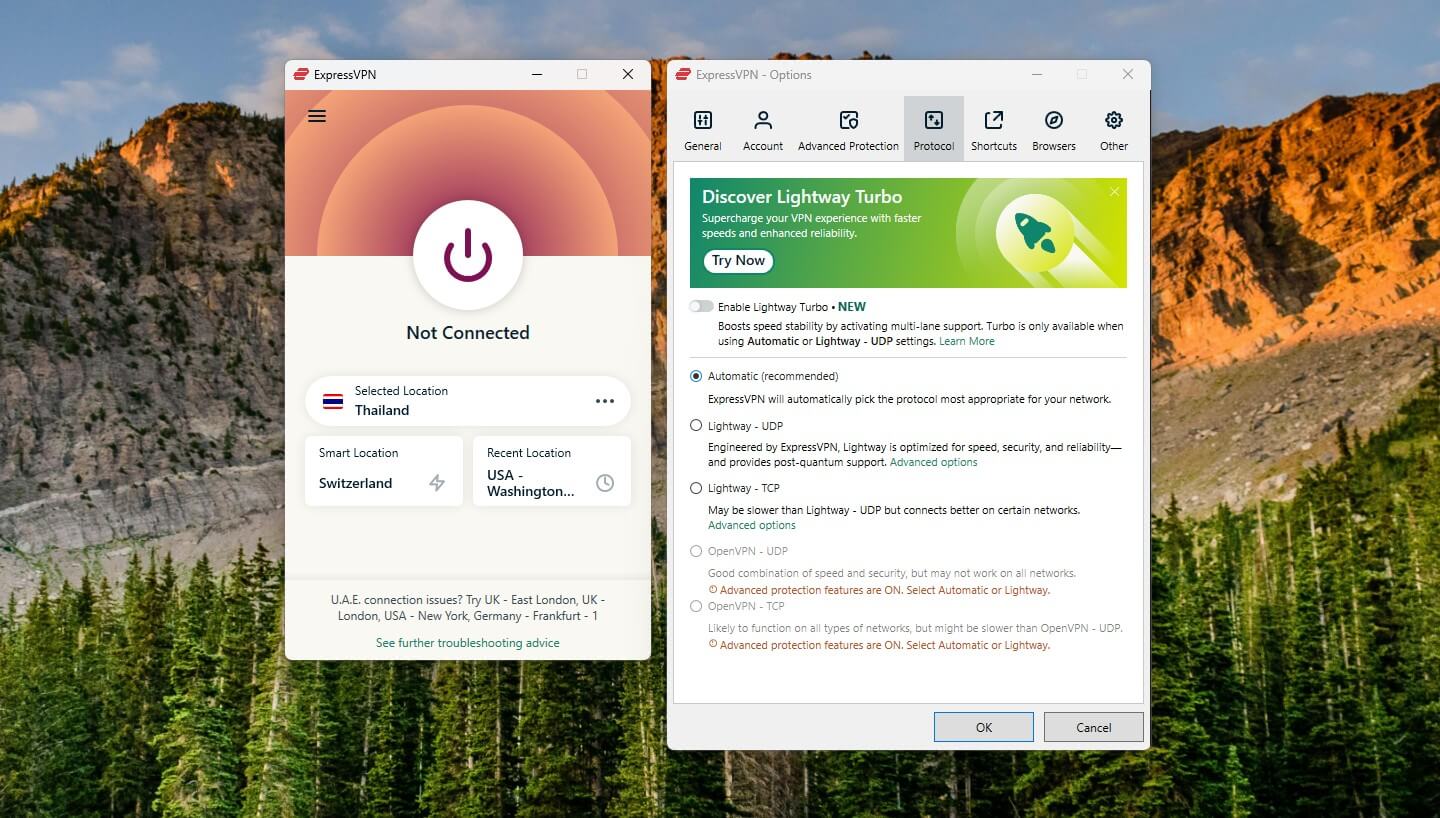
A recent update from ExpressVPN included several new features. We’re talking about an ad blocker that can also block ads and malicious sites. In addition, there’s Parental Control for blocking adult sites, which you’ll find useful if you have small children.
The same feature can be found on iOS/Android platforms and is called Threat Manager. ExpressVPN also offers a free password manager and, in its browser extension, which is far better than PIA, you’ll get WebRTC leak protection, helping with getting over geo-blocks.
We should also address Identity Defender, which includes ID theft protection, credit card monitoring, and a few other services. All are aimed at protecting your identity from snoopers and hackers.
PIA
PIA, on the other hand, offers WireGuard, which brings improvements in terms of connection speeds but isn’t the most secure solution compared to Lightway or OpenVPN. Still, the provider is a lot more customizable and lets you choose from two levels of encryption.
Aside from 256-bit AES, you can enable 128-AES encryption, select packet size, and choose local/remote ports. Unlike ExpressVPN, PIA offers a feature called MACE, which is an ad blocker that blocks not only ads but also malware and trackers.
Furthermore, it has Multi-Hop. This feature routes your traffic through two servers, which doubles your encryption and makes it even harder to be tracked online. Private Internet Access even lets you choose a custom DNS and enable an advanced kill switch that works even when the VPN is turned off.
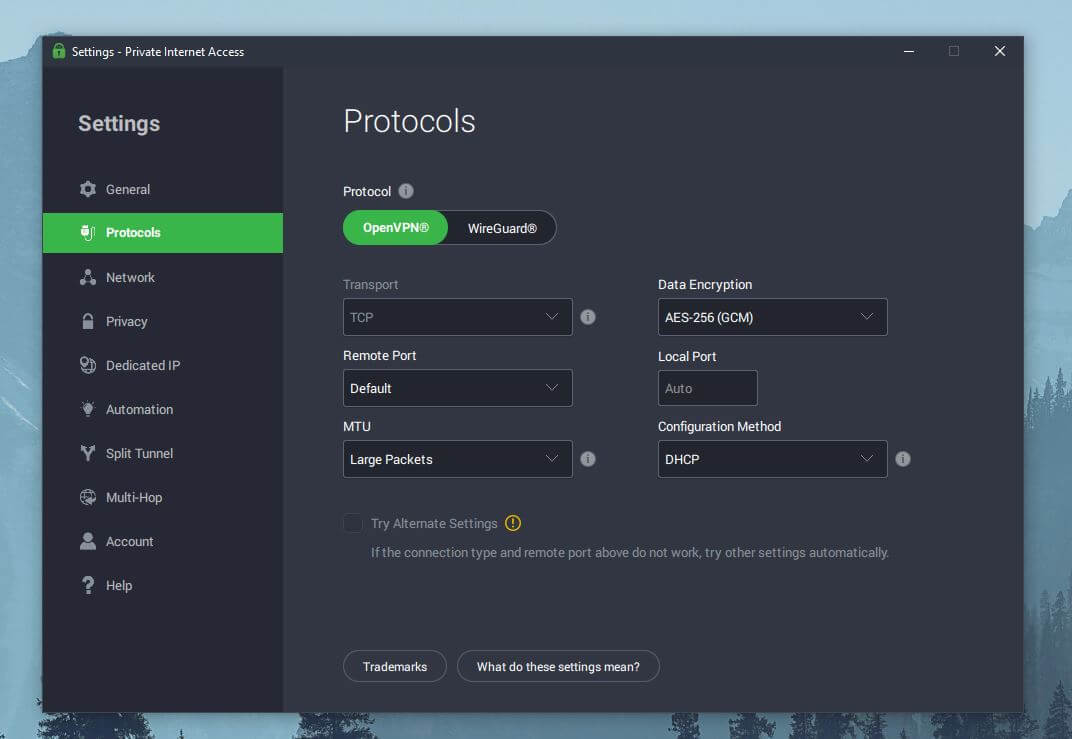
Port forwarding is another great feature that you won’t find in ExpressVPN. Other features include dedicated IP, obfuscation (which isn’t great, you’ll see why soon), SOCKS5 proxy, and split tunneling that lets you block (or allow) even IP addresses from using a VPN tunnel.
Simply put, in this ExpressVPN vs PIA duel, the latter offers more tools to play with if you’re an advanced user. However, if you prefer a plug-and-play experience from ExpressVPN that isn’t by any means inferior, that’s completely okay – once again, it works flawlessly!
Is There a No-Logs Policy?
A no-logs policy is a must-have for every provider, let alone a VPN that charges you for a subscription. Thankfully, that is exactly the case with both VPNs, and much to our happiness, we don’t have to explain to you in-depth how safe and secure these providers are.
ExpressVPN is based in the British Virgin Islands, an offshore location, which immediately grants privacy. It’s far away from the notorious Five Eyes countries, and it actually has a third-party audit from PricewaterhouseCoopers, indicating that its no-logging policy is genuine.

Simply put, it stores no logs of your IP address, DNS queries, geolocation, browsing history, traffic destination, or metadata. ExpressVPN stores a minimal amount of logs, such as the version of your app, choice of VPN server location, used bandwidth, and dates of connection.
This information is needed for troubleshooting and maintaining the service, plus it’s collected in an anonymized form and deleted after a short period. For better or worse, the provider proved its no-logging practices when the assassination of Andrei Karlov happened.
After this event, the Turkish government seized an ExpressVPN-controlled server in the country, only to find no useful information to aid the case-solving process. PIA has an audit from Deloitte, and it’s based in the USA – pretty much the worst jurisdiction for a VPN service.
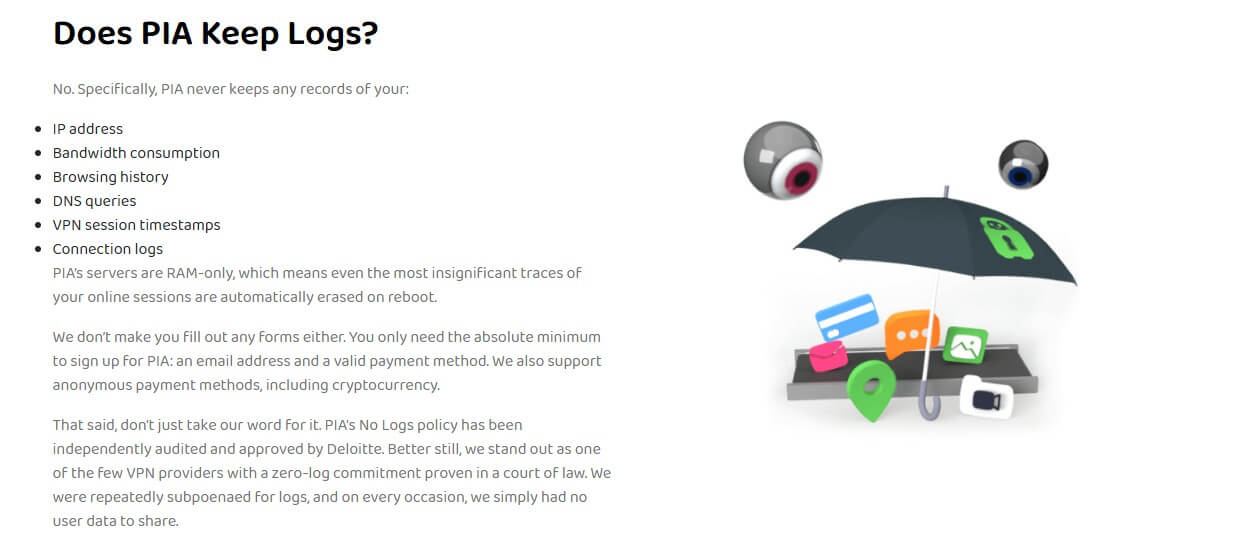
However, it’s surprisingly safe and stores very few logs. Similar to ExpressVPN, this provider was brought to court numerous times, where the authorities tried to extract user-related information from it, only to find nothing useful.
It stores absolutely zero connection logs, timestamps, bandwidth consumption, and other compromising bits of information. With minimal logging practices, a third-party audit, and the US jurisdiction that seemingly does not influence its privacy, Private Internet Access is nothing short of impressive.
Who Wins?
In this ExpressVPN vs PIA duel, it’s very hard to tell who is the winner. Both providers are jam-packed with security features while offering audited no-logging policies with proof of validity. Therefore, this round of comparison is a TIE.
ExpressVPN vs PIA Streaming Test
Streaming is one of ExpressVPN’s highlights, which is surely one of the most powerful providers for this purpose. However, PIA has had a good run so far, rivaling its opponent in security and privacy. Will it be able to do the same in this test? Let’s see.
Netflix Test
The first streaming test will show you how good these providers are in terms of unblocking Netflix. To avoid making the test too long – longer than it needs to be – we’ll focus on the three most popular libraries. These include the libraries from the US, Japan, and Canada.

We’re in Eastern Europe, and we’ll use ExpressVPN and PIA to try and access these libraries in our country. We can’t show you all the screenshots of the results, but ExpressVPN successfully unblocked all three Netflix libraries, while PIA only worked on Netflix Canada.

This part of our ExpressVPN vs PIA comparison makes it easy to see who is the winner.
Other Streaming Platforms
Let’s not draw any conclusions just yet. What about other platforms? Are these providers capable of unblocking, for example, Hotstar and BBC iPlayer?

To find that out, we decided to get a British IP address, as well as an IP address from India, for unblocking Hotstar. We’re happy to report that in both of these instances, ExpressVPN performed really well.
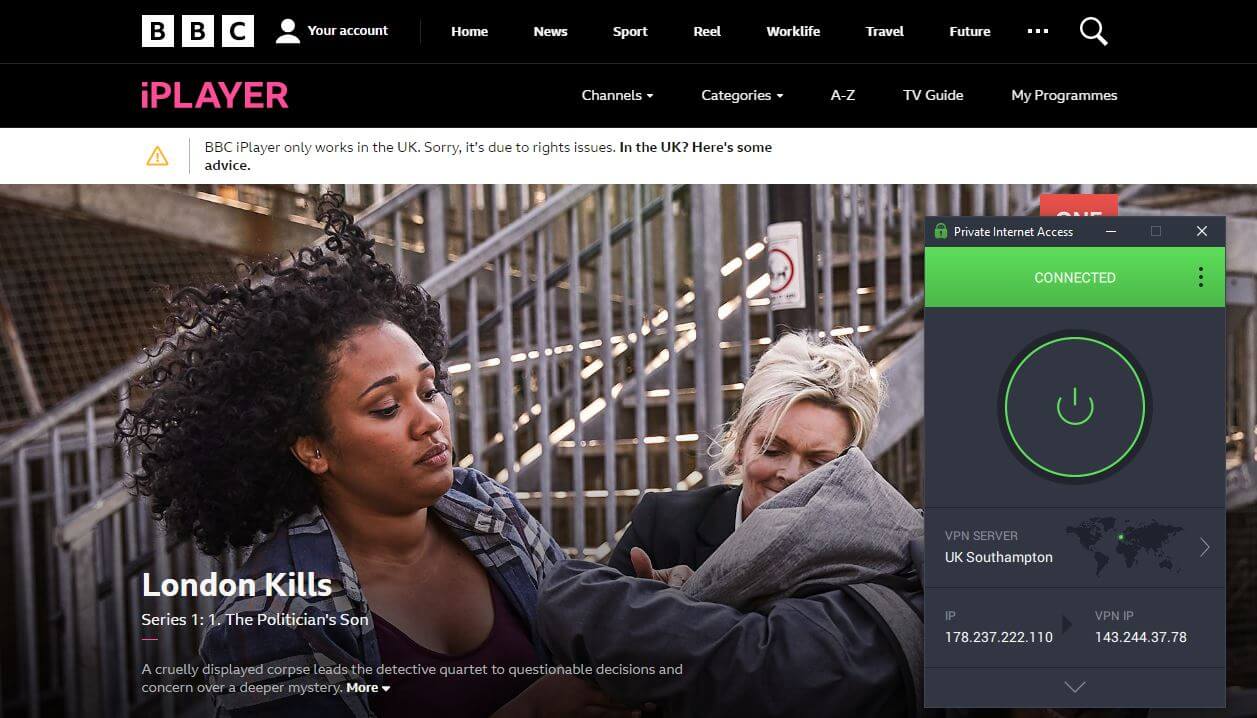
As for Private Internet Access, we can say that this provider performs well on Hotstar, while it’s unable to unblock BBC iPlayer reliably. During our testing, we unblocked it merely a few times, while other attempts were futile and resulted in a well-known error message.
There are better VPNs for BBC iPlayer, and ExpressVPN is surely among them.
Who Wins?
After the streaming tests in this PIA vs ExpressVPN comparison, we can finally draw a simple conclusion. ExpressVPN WINS this round, as it works with more Netflix libraries and unblocks both Hotstar and BBC iPlayer, as opposed to its rival, which didn’t exemplify great performance.
ExpressVPN vs PIA VPN Speed Tests: Which VPN Is Faster?
So far, ExpressVPN has the reins, and now that we mentioned the word “speed”, we think it’s time to see how fast these providers are. First off, we’ll mention that both offer 10 Gbps servers, meaning that users get to enjoy the latest and greatest server infrastructure.
Second, none of the VPNs will limit your bandwidth or performance, which lets you maximize your internet speed and enjoy smooth browsing and streaming. However, to put these claims to the test, we decided to compare these two providers and see which one is closer to its claims.
I tested these providers for three days in a row, three times a day, using four server locations. These include the UK, the US, Australia, and Japan, making for a good combination of servers close to us and those overseas. Mind you, we’re in Eastern Europe, and our native internet speeds are the following:
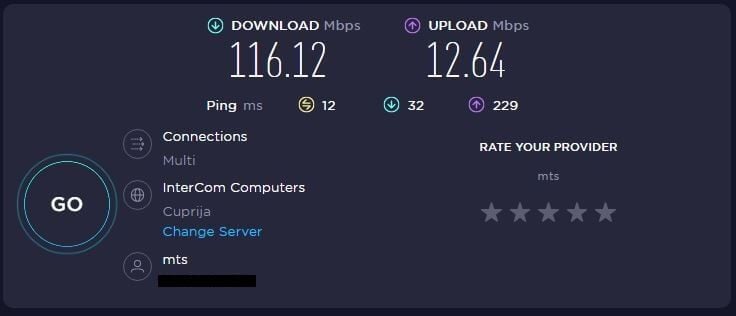
Having these speed test results without using a VPN, it’ll be interesting to see how well these providers will do. That said, here are our results of the ExpressVPN vs PIA VPN speed test.
ExpressVPN
UK:
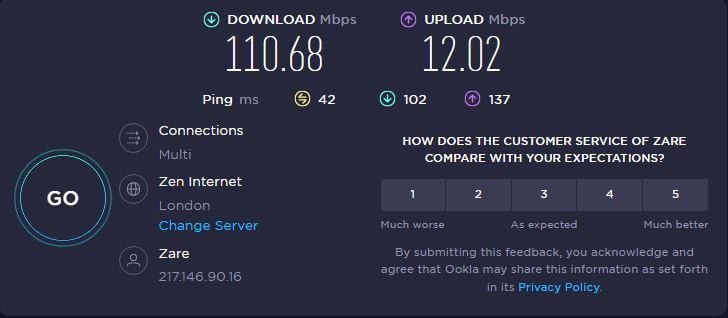
US:
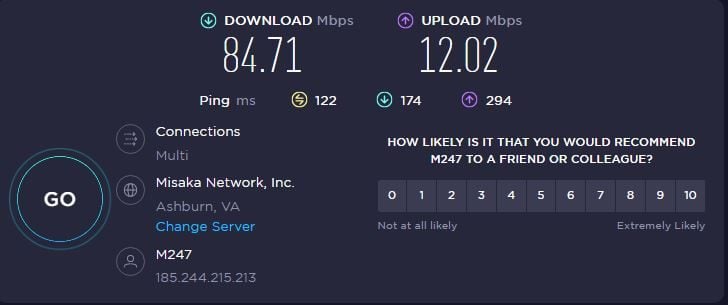
Australia:
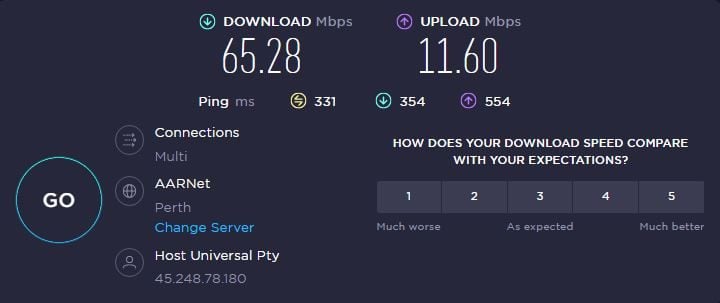
Japan:
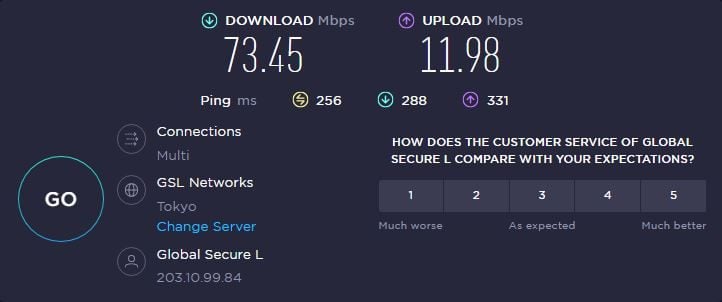
Private Internet Access
UK:
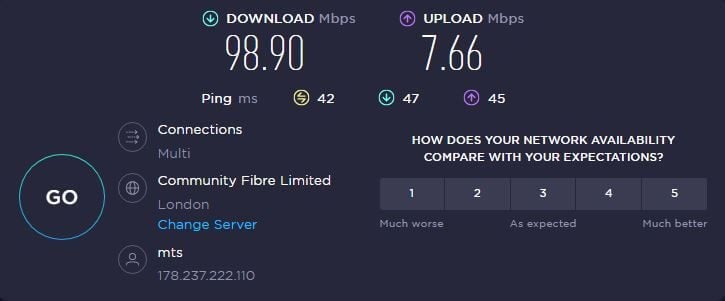
US:
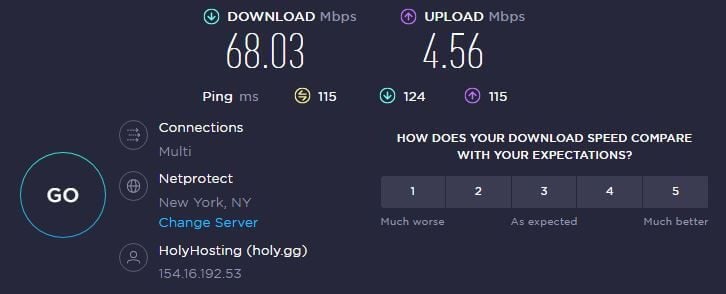
Australia:
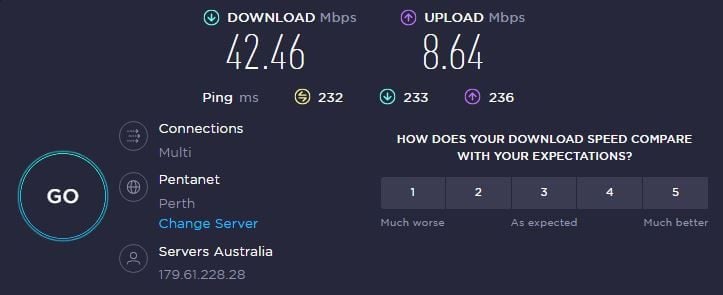
Japan:
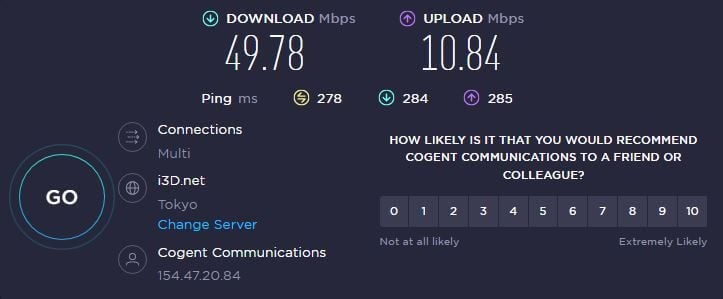
Who Wins?
The results show us a clear image of which provider is faster. Needless to say, ExpressVPN WINS this part of the comparison easily by being much faster in all four server locations, making it a better choice for streaming and browsing the web in general.
Torrenting & P2P: Are ExpressVPN and PIA P2P-Friendly?
When engaging in P2P activities or downloading torrents (which is a form of P2P activity), it’s vital to preserve your privacy with a VPN. Exposing your IP address can put you in trouble with the authorities and make you suspicious, even if you’re downloading copyright-free files.
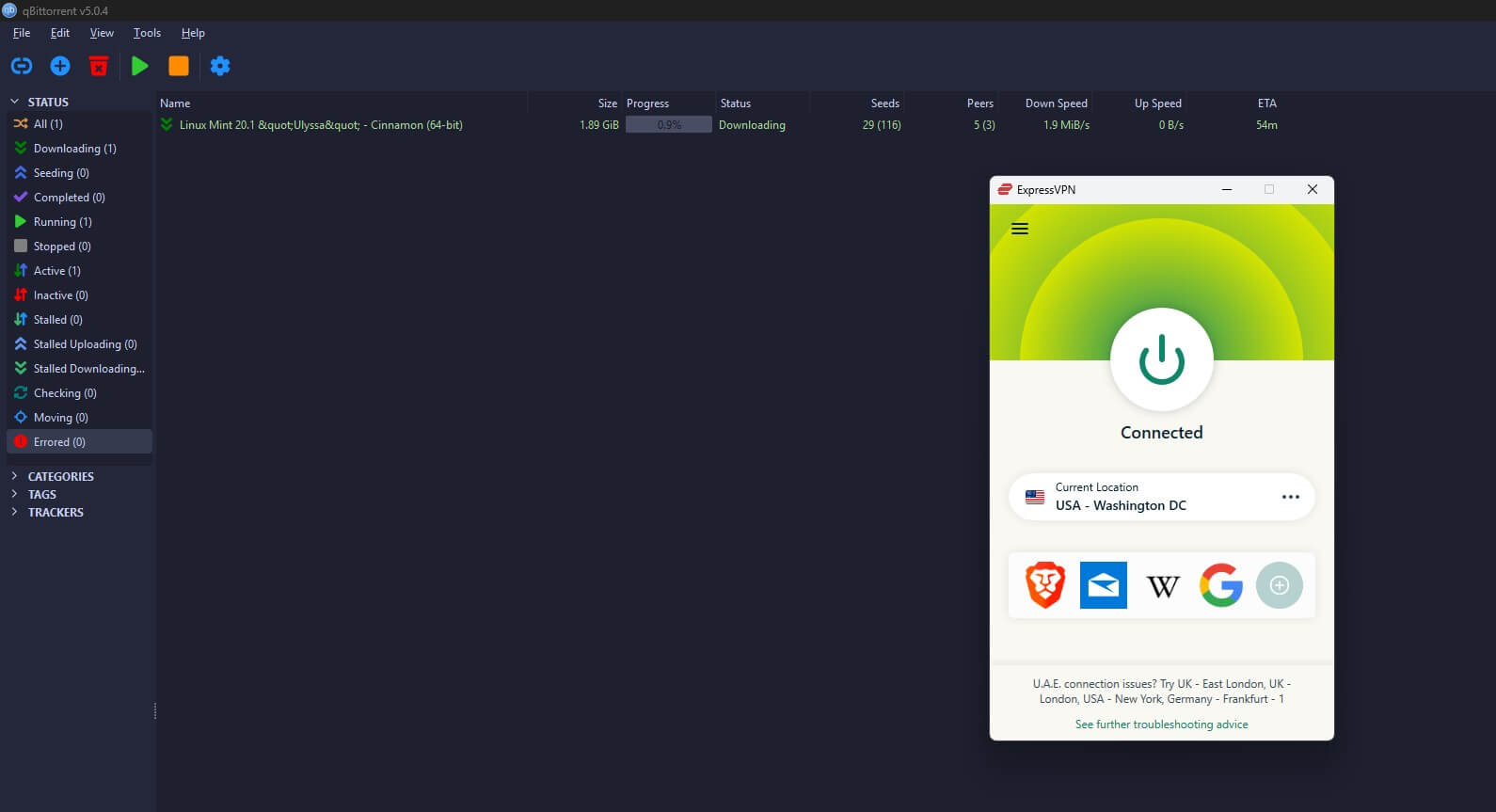
Moreover, torrent sites themselves aren’t safe, and they’re known for logging information like your IP address and geolocation. Above all, the VPN that you’re using must be FAST and provide great performance without a big speed reduction.
So how do these two providers compare in this category? We’d say pretty good. None of them have special P2P servers on the list, which means that the entire server network is torrent-friendly. This means you just have to connect to the closest one and start downloading torrents.
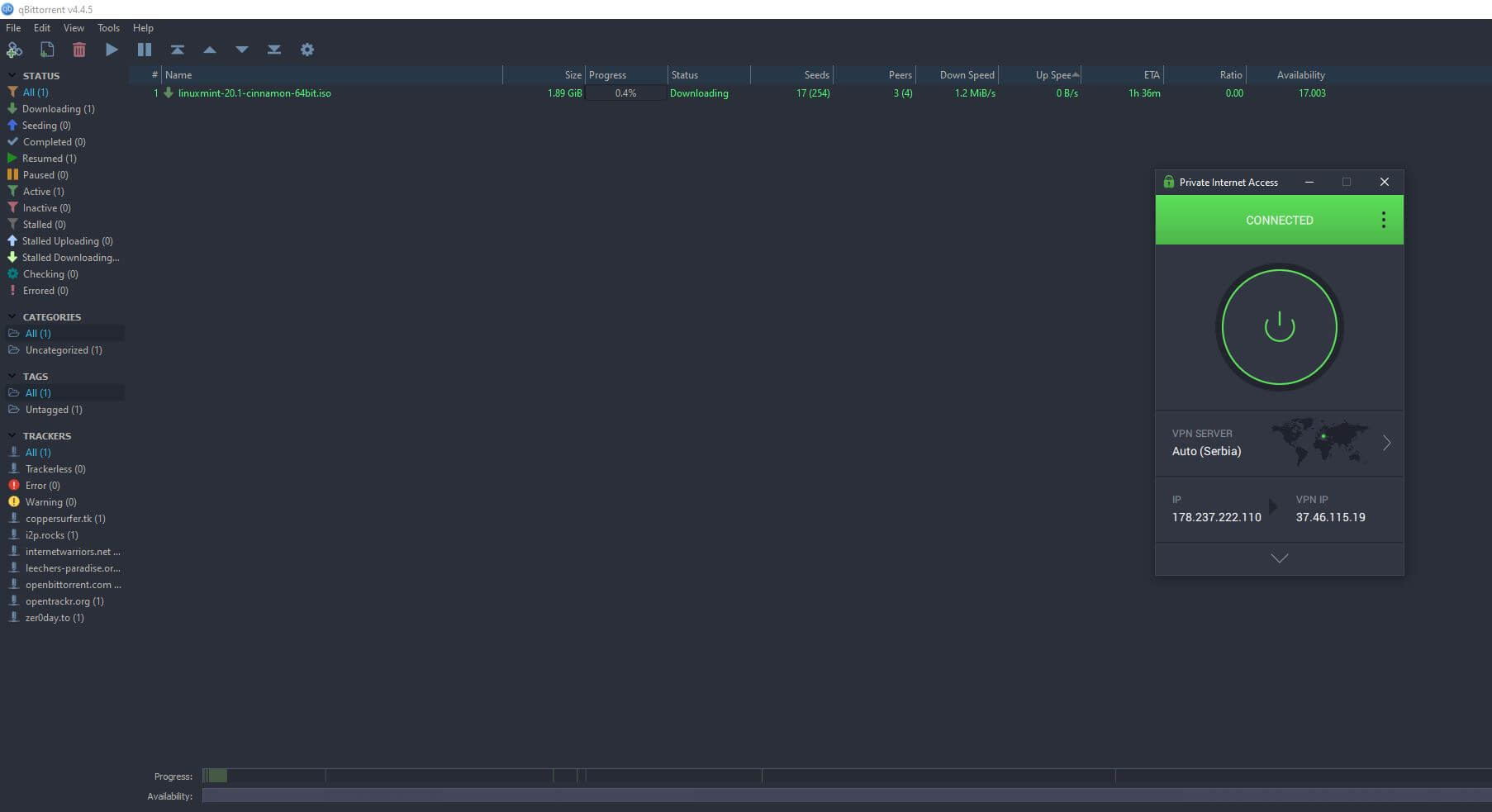
With ExpressVPN, we had no issues downloading Linux from 1337x. The same, of course, applies to PIA, which showed decent torrenting performance. Interestingly, when connecting to the closest server with PIA VPN, the speed reduction was barely noticeable, which, in this case, put it neck-to-neck with its rival.
You can try to remedy this problem by using port forwarding, but we don’t think that’s a great idea for your privacy. Port forwarding isn’t particularly safe and is oriented more toward making P2P activities faster. However, even this speed increase sometimes isn’t particularly noticeable.
Who Wins?
With everything in mind, we can say that this round ends in a TIE. Both providers allow for torrenting, and both of them offer top-grade performance for safe, secure, and fast P2P downloading/uploading.
Are ExpressVPN and PIA Working in China?
For years, people have been looking for the best VPN for China to be able to bypass the Great Firewall. In this country, internet freedom is nonexistent, and everything you can explore is controlled by the government, which blocks Google services and popular social media sites.
Unfortunately, the same applies to VPN services, as many of them are blocked in this country, which prevents people from using them. The good news is that there are still some great choices, one of which is ExpressVPN – in general, our beloved recommendation for this country.
Our acquaintances in the Chinese mainland had zero issues using it without tweaking any settings. With the protocol selection set to Automatic, ExpressVPN worked with no issues and allowed our friends to browse through the Instagram feed, watch YouTube videos, and unblock betting sites in China.
Private Internet Access has this obfuscation feature, which should obfuscate your traffic and make it seem like ordinary traffic. We’ve seen obfuscated servers with NordVPN, and they work pretty well. In PIA, obfuscation is basically useless in China.
So far, our friends have had no successful attempts to make it work in this country. Upon testing both WireGuard and OpenVPN with a different combination of parameters, obfuscation, and SOCKS5/Shadowsocks solutions, PIA VPN remained “stubborn” until the end.
Despite being a great provider of overall security and privacy, Private Internet Access failed to work in China, similarly to its sister company, CyberGhost. So far, ExpressVPN is the only provider that works in this country that’s under Kape’s ownership.
Who Wins?
Unlike the previous test, this one is pretty simple. ExpressVPN WINS this round because it’s great for bypassing censorship in China, and PIA VPN isn’t working at all in this country, making it pretty much a useless option for Chinese residents.
When it comes to using a VPN in China, things are obvious – more expensive providers do work better. An example of this would be CyberGhost, which costs almost as much as PIA but fails to jump over or slide under the Great Firewall.
ExpressVPN vs PIA Server Fleets: Which One Is Bigger?
People who use premium providers like NordVPN, ExpressVPN, and CyberGhost already know the importance of a vast server park. It not only prevents overcrowding and ensures decent performance, but it also lets you choose from millions of different IP addresses.
We’re happy to report that we’re talking about some of the biggest providers in this ExpressVPN vs PIA VPN comparison for 2026, so let’s check out how many servers they offer.
ExpressVPN (3,000+ servers in 105 countries)

ExpressVPN is nothing short of impressive. With 3,000+ servers in 105 countries and hundreds of locations globally, it is among the largest VPN providers on the planet. 3,000+ servers aren’t going to reinvent the wheel, but having in mind its 160+ locations, we can see its server distribution is par excellence.
Unlike NordVPN or some of its alternatives, this provider has no specialty servers. Instead, every server is great for all your needs, and the only thing you need to do is connect to one. We like this approach, as ExpressVPN is so advanced, yet it simplifies things, allowing even complete dummies to use it efficiently.
As said, the provider offers 10 Gbps servers, with the majority of the network consisting of physical servers. Virtual servers are available in countries where physical servers can’t be maintained, but that’s only a small portion that also works really well.
Overall, the server network is well-distributed, and apart from the US and the UK, you can find servers in Japan, Hong Kong, Europe, and even African countries like Egypt and Kenya.
PIA (30,000 servers in 91 countries)
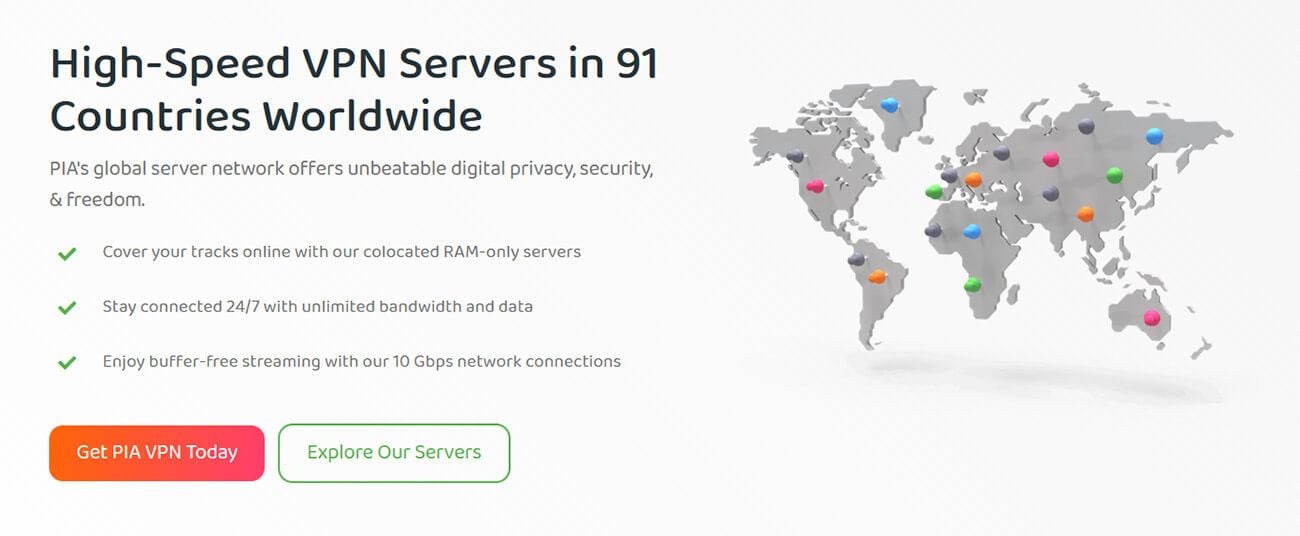
Private Internet Access has servers in 91 countries, 14 fewer than ExpressVPN. However, it offers around 30,000 servers across the planet, which is a mind-boggling number. So much so that I didn’t believe it at first. But hey – we asked the support agent and they confirmed it!
Right from the get-go, PIA is significantly larger than ExpressVPN. After all, it has ten times more servers, albeit in a smaller number of countries. That’s not a problem if you ask us because the server distribution is still top-notch, with 10 Gbps servers in place.
Although far from the fastest provider, Private Internet Access provides stable performance and has streaming-optimized servers in countries like Japan, Italy, and a few more. At least half of the server list consists of physical servers, but we were quite surprised to see a large number of virtual locations.
These virtual locations are in quite unusual locations. For example, you have virtual servers in Slovenia, Spain, Switzerland, Slovakia, and many more countries. In the US, aside from physical, you also see some virtual servers in Chicago and Atlanta. We guess that’s the way to have 30,000 servers.
Virtual servers are cheaper to maintain, which allows PIA to offer more of them, even more so than any other VPN. But still, 30,000 servers are 30,000 servers, and we can’t dispute this monolithic number.
Who Wins?
To conclude, Private Internet Access WINS this round, having ten times more servers (30,000) than ExpressVPN, which has “just” 3,000 servers in 105 countries. However, we don’t want to sound arrogant and say that ExpressVPN’s server park is small or unsatisfying.
With recent improvements regarding its network, it’s among the largest providers in terms of presence. Besides, PIA has 91, while this VPN has 105 countries on offer. But, as you can guess, 3,000+ servers can’t compete with ten times more of them.
Customer Support
Running into trouble with a VPN service is a major annoyance. You can’t connect, or something doesn’t work, and you’re left with your IP address exposed to hackers and your annoying ISP. If that happens, getting help quickly is crucial, and that is possible with helpful and responsive support.
Something like this will rarely happen with PIA and ExpressVPN. However, having 24/7 live chat support is always welcome, and both providers are going to give it to you with no issues. We found that both providers are extremely responsive, which is commendable.
In our experience, both of them take no more than twenty seconds to respond to your question, and many times, the support team agent tackled our question in a few seconds! Email support is another front where both providers shine.
ExpressVPN is particularly fast, as you’ll often get a useful response in about 15 to 30 minutes after sending an email. PIA VPN is a bit slower, but that’s negligible. One thing we like about ExpressVPN is its activity on social media.
For instance, it has a YouTube channel with useful tutorials and interesting videos about cybersecurity. While moderately active, compared to PIA, which doesn’t have a YouTube channel, it’s much better in this regard, as it responds to user comments as well.
To be honest, we have no issue with PIA not having a YouTube channel. It’s facultative, and while a nice addition, it’s not something we often consider when judging a VPN.
Who Wins?
Overall, we’d say that the customer support teams of both VPNs do an exceptionally good job. They’re not only fast and responsive but also very helpful and efficient, offering help through live chat and email 24 hours a day, seven days a week. Therefore, this round is a solid TIE.
Pricing Comparison: Which VPN Is More Affordable?
The final ExpressVPN vs Private Internet Access comparison, as always, is the one where we discuss pricing. This is where we see a massive difference between the two providers that can be seen as soon as you check the subscription plans of both of them.
ExpressVPN
Which one wants to go first? ExpressVPN volunteers – here’s how much it costs:

Looking at its pricing, we can’t say this is the cheapest provider you can get, but its biennial Basic plan is surely very affordable. You can get it with a 73% discount and four free months, making for a solid deal considering the meager monthly price of $3.49.
The Advanced plan is even better, at 67% and a price of $4.49 monthly. It includes more advanced features and larger discounts for AirCove routers. The Pro plan increases simultaneous connections to 14 and throws in a dedicated IP address at $8.99 monthly.
On top of that, the provider offers a 30-day money-back guarantee with no conditions, and it applies to all plans, not just the one in the middle. This means that you can even get a monthly plan at $13 or so and still get reimbursed if you don’t want to use it anymore.
We should also mention ExpressVPN’s 7-day free trial on iOS/Android. However, it does require a credit card, but at least you get to test out the provider for free for 7 days. This is something many users don’t know about, yet it’s pretty handy if you’re not sure whether or not you want to spend your money.
PIA VPN
Now, Private Internet Access is in a different realm. Its 6-month plan is cheaper, and the 2-year plan is a LOT more affordable! I mean, you can get it at just above $2.10 a month, which is insanely affordable, similar to CyberGhost, which nearly always costs identically to PIA.

Much like ExpressVPN, PIA offers a 30-day unconditional money-back guarantee for all plans, making this provider a much cheaper option. If you’re interested in another affordable VPN, you can also check our full review of Surfshark VPN, which is even cheaper than Private Internet Access!
Overall, PIA VPN is surely a dream come true for those with shallower pockets – or wallets. We don’t recommend its six-month plan. Instead, immediately opt for the biennial plan with two free months and spend around $57. That’s a silly price for 26 months – you’ll barely feel it.
Who Wins?
Being a much cheaper, more budget-friendly provider, Private Internet Access WINS this round. It’s significantly more affordable than ExpressVPN, and although not necessarily better, it’s surely going to be a choice for users who work with a shoestring budget.
Conclusion: ExpressVPN Wins!
Private Internet Access and its long-lasting experience helped it get a solid result in this PIA vs ExpressVPN duel. With the result of 7:6 for ExpressVPN, the provider from the British Virgin Islands takes the win and beats its sister company by a small margin.
ExpressVPN offers a better user experience, much faster speeds, better streaming capabilities, and the ability to bypass censorship in China. PIA held its ground in terms of security and privacy, but also customer support, where both providers show impressive results.
What’s more, PIA actually beats ExpressVPN when it comes to the size of the server network, and it offers its plans at much more wallet-friendly prices. The conclusion is that PIA isn’t better than ExpressVPN, but it doesn’t mean it should be demonized and scrutinized.
ExpressVPN isn’t very affordable compared to it, and it’s a provider for those who don’t mind the somewhat higher price and just want ultimate performance, whatever the cost. Private Internet Access is for those on a very tight budget with not much freedom to “stretch” further.
Although if you need an affordable provider, we recommend trying NordVPN or CyberGhost instead. We have a test of CyberGhost as well, so make sure you check it out. Its cost is similar to PIA, and it’s a better choice overall, particularly for streaming, where PIA has dropped the ball.