Selecting a new VPN is no easy feat. You must consider many factors, among which are security, privacy, performance, and price. If you’ve narrowed down your selection to Proton VPN or CyberGhost, you may be wondering which one to buy. We’re discussing two very safe and secure VPNs with many quality features.
Not only that, but CyberGhost and Proton VPN are fast, streaming-capable, and free of any logging. This makes the choice even harder. After all, you have two extraordinary VPNs at hand. Still, one must win in this duel. Today, we’re doing an in-depth Proton VPN vs CyberGhost comparison to discover a better provider.
The comparison won’t be short. We’ll surf through nine tests that will fully highlight the pros and cons of both VPNs. In the end, we’ll count the score and declare the winner. We recommend reading the entire CyberGhost vs Proton VPN analysis carefully to make an informed decision more easily.
CyberGhost vs Proton VPN: A Quick Overview
| Cyberghost VPN 🏆 | Proton VPN | |
| 💰 Starting price | $2.19 monthly | $2.49 monthly |
| 💸 Money-back guarantee | 45 days | 30 days |
| 🆓 Free version | No ❌ | Yes ✅ |
| 📺 Working with Netflix | Yes ✅ | Yes ✅ |
| 🔽 Torrenting allowance | Yes ✅ | Yes ✅ |
| 🔟 10 Gbps servers | Yes ✅ | Yes ✅ |
| 🥸 No-logging policy | Yes ✅ | Yes ✅ |
| 🌐 Jurisdiction | Romania | Switzerland |
| 📱 Simultaneous connections | 7 | 10 |
| 🛜 Protocols | WireGuard, IKEv2, OpenVPN | WireGuard, OpenVPN, IKEv2 |
| 💾 Servers | 12,000+ in 100 countries | 15,900+ in 125+ countries |
| 💯 Best for | Affordable price and torrenting | Privacy and security |
| ☎️ Customer support | 24/7 live chat, email, knowledge base, FAQs | 24/7 live chat, email, knowledge base, FAQs |
Proton VPN vs CyberGhost: Apps & Ease of Use
To start this fierce battle between CyberGhost VPN and Proton VPN, we’ll first need to discuss these VPNs’ apps and ease of use.
Device Compatibility & Simultaneous Connections
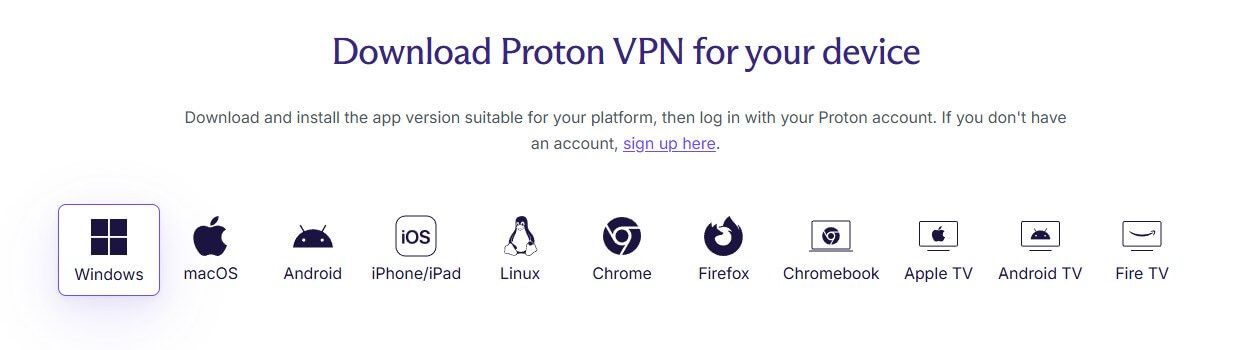
Compatibility-wise, both VPNs excel when talking about desktop and mobile platforms. This means CyberGhost and Proton VPN have apps for iOS, Android, Windows, macOS, and even Linux.
Proton VPN’s Linux app is GUI-based, so it’s more than excellent. CyberGhost, sadly, still relies on the terminal commands, which beginners might not particularly like. Compatibility with other devices and platforms is sublime on both sides, though.
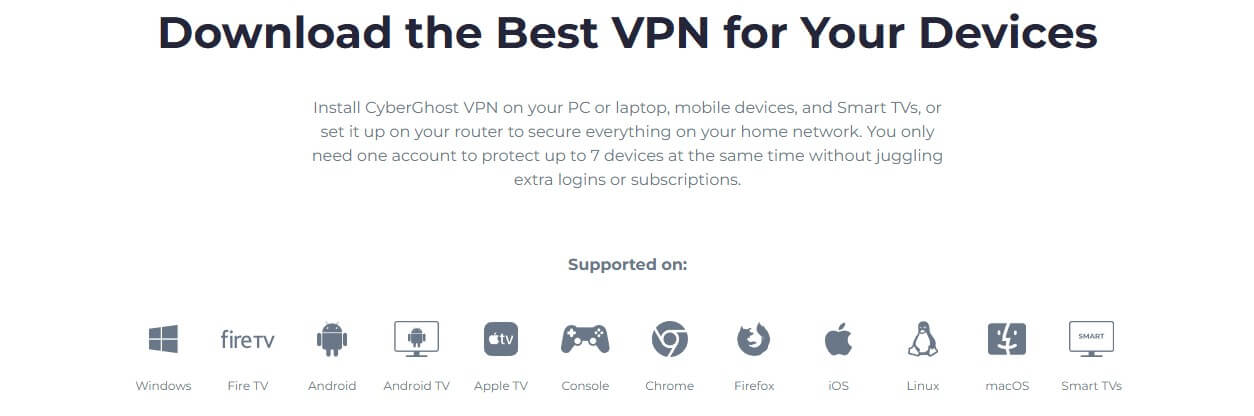
CyberGhost offers full router support and works on Fire TV, Apple TV, Android Smart TVs, Roku, Kodi, and even gaming consoles. Proton VPN’s router support is here too, so you can expect to be able to use it on a variety of platforms that don’t natively support VPNs. Both services also offer browser extensions.
For example, if you use a VPN on Microsoft Edge (the one from CyberGhost), you’ll enjoy a proxy-like experience rather than have a full-fledged VPN like ExpressVPN or NordVPN. Proton VPN’s extension is better, as it’s more like a full-on VPN. Conversely, Proton VPN lacks SmartDNS, which is strange at this price.
This means you won’t be able to set it up for streaming on, let’s say, the first gen of Fire TV or a gaming console. CyberGhost remedies this by introducing full SmartDNS support, offering DNS addresses in more than a few countries. However, it does offer seven simultaneous connections.
Proton VPN’s ten simultaneous connections are nothing to write home about either. But ten is larger than seven, so doing some simple math brings us to the fact that Proton VPN is advantageous here.
Proton VPN
The good news is that both CyberGhost and Proton VPN are very easy to use. As you can see, Proton VPN’s app looks stunning on our Windows computer. The red theme signifies you’re without VPN protection, but when you connect, it turns green, and the app gets this refreshing feel, which looks amazing.
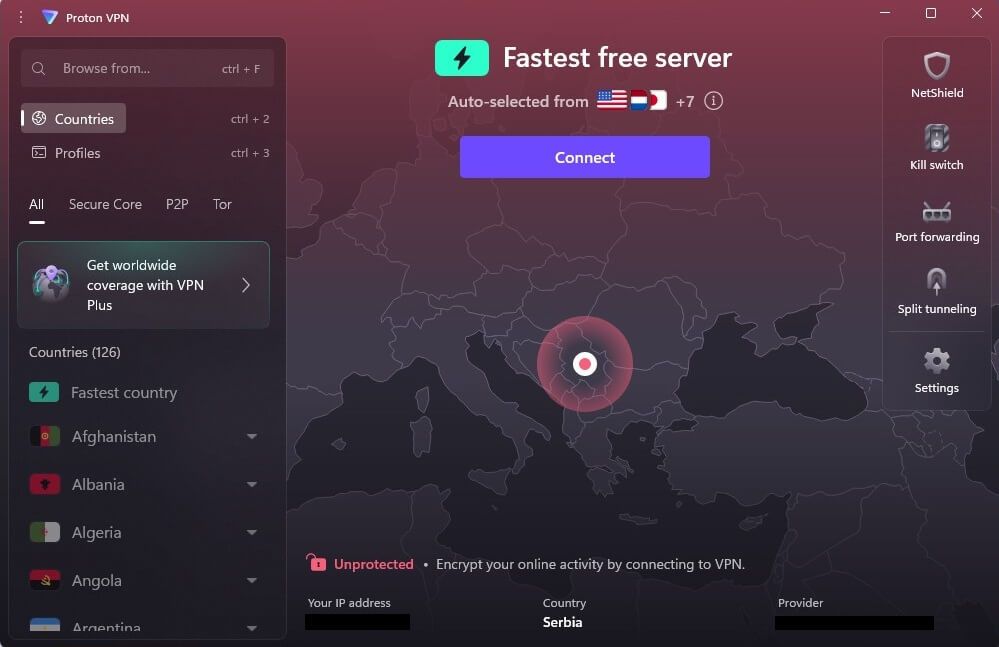
You’ll find major features on the right, and these include the kill switch, port forwarding, split tunneling, and NetShield (ad-blocker). Underneath is the Settings menu, where you can play around with protocols and other advanced settings. On the left side, you’ll locate the VPN servers, where you can connect with a click.
You’ll also notice different types of servers, including Secure Core, P2P, and Tor. Proton VPN allows you to make profiles where you’ll configure your own VPN settings for streaming, gaming, or torrenting. From there, you can connect with a click to the desired profile, based on the planned online activity.
The mobile app saw a massive refresh, as well. It made Proton VPN so much sleeker and more attractive. Simultaneously, its smoothness has improved, and the VPN now feels like a more expensive product.
CyberGhost
CyberGhost looks great on all desktop platforms. Granted, it’s a bit more complicated to use than Proton VPN, but nothing alarming. The left side is reserved for the server list or the server type you need. By choosing All Servers, you can open the full server list, double-click on the location you want, and connect to it

The home screen gives access to specialty servers for streaming, torrenting, dedicated IP, and NoSpy servers that we discussed in our CyberGhost review.
The middle portion of the app will show you the server list, while the right side is taken up by the connection button. When you connect, you’ll also see the protocol you’re using here, as well as a few other tidbits. Now, we also like the search bar in the top-left corner. It makes connecting to a server of your choice easier.
What we don’t like is that CyberGhost’s features are scattered around several menus. For example, Smart Rules is reserved for split tunneling and WiFi protection, while Privacy Settings is occupied by an ad blocker, DNS leak protection, and a kill switch.
The Gear icon lets you access the protocol selection, MTU size, and a few other VPN-related features. It’s a bit confusing, which can’t be said about its mobile apps. They’re much simpler, and all features are easier to access. Probably because there aren’t that many.
Outcome: Tie 🟰
The first round of our Proton VPN vs CyberGhost VPN duel is already intense. Proton VPN is slightly easier to use and offers more simultaneous connections. CyberGhost has better compatibility and even includes SmartDNS, which is easy to set up across many devices. In short, both VPNs score a point.
Security & Privacy: Which One Is Safer to Use?
Security and privacy are the two factors in which Proton VPN and CyberGhost show exceptional results. However, in this Proton VPN vs CyberGhost analysis, we must examine both services to see who has an edge.
Security Features
First, we’ll talk about their security features, but focus more on those that they share. You see, providers like CyberGhost and Proton VPN come with a basic set of features that include:
- AES-256 encryption. Also known as bank-grade encryption. The highest possible standard.
- A kill switch. This is great for keeping IP leaks at bay and making sure you don’t compromise your privacy if the VPN connection drops.
- Split tunneling. It lets you choose which apps and sites will be routed through the VPN tunnel and which won’t, which can be handy for local shopping sites or banking apps.
- IPv6/DNS leak prevention. It’s self-explanatory. A feature for preventing any form of leaks, be it IPv4 or IPv6. It works wonderfully in both VPNs.
- WireGuard, OpenVPN, and IKEv2 protocols. WireGuard is especially important here, as it’s the most modern protocol focused on privacy and top-notch performance.
One thing to note is that both providers have their, let’s say, proprietary features that we’ll discuss in a minute. For now, we should mention that both have RAM-based servers, which is relevant for preventing unwanted logging. Each server is wiped clean after it’s restarted, losing all data in the process.
Another feature worth mentioning is Private DNS. CyberGhost and Proton VPN use proprietary DNS servers to handle your DNS requests. It’s a far cry from free DNS services that frequently store your browsing history and divulge it to third parties for a bit of cash. The final feature they share is an ad blocker.
CyberGhost’s ad blocker blocks primarily ads, but also trackers and some malicious sites. Proton VPN came up with a fancy name, NetShield, but it essentially does the same, and in our tests, equally efficiently.
What Are the Differences?
In terms of differences, to be frank, there aren’t many of them. We’ll mention CyberGhost’s NoSpy servers. These servers are in Romania, which is CyberGhost’s jurisdiction. This tells us that CyberGhost controls and owns these servers instead of renting them. The privacy on these servers is better because of no third-party involvement.

Proton VPN has Secure Core servers, though. Secure Core servers function similarly to MultiHop. Once you connect to one Secure Core location, your traffic will pass through two servers. This makes you impossible to trace online and gives you protection against a plethora of cyberattacks.
Vital to point out is that Proton VPN owns these servers fully and they’re housed in Sweden, Switzerland, and Island, across underground data centers and former military bases. Another Proton VPN feature is Alternate Routing. This helps bypass censorship in some countries, but as you’ll see, it won’t function well in China.
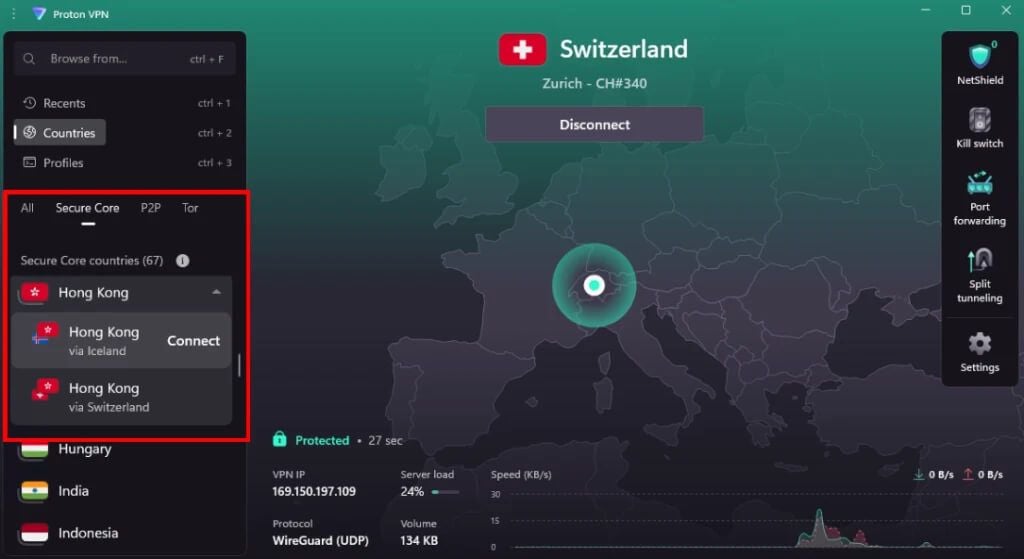
Proton VPN also comes with the Stealth VPN protocol on macOS, which doesn’t seem to work in China – more about that later in the CyberGhost vs Proton VPN analysis. Other features of Proton VPN and CyberGhost include full Tor over VPN compatibility and the option to use UDP and TCP variants of OpenVPN.
Essentially, they’re not very different in terms of features, despite offering a few unique security quirks that we’re glad to see.
Is There a No-Logs Policy?
To end this CyberGhost vs Proton VPN security comparison, we must review their privacy policies. The good thing is that both are free of logging, and you can expect the highest level of privacy. As said, CyberGhost’s HQ is in Romania, while Proton VPN resides in Switzerland.
Both countries are known for stern privacy laws. Romania is outside the data-collection alliances, and so is Switzerland, with the utmost respect for your privacy. As you can see below, CyberGhost indeed keeps no logs on its servers apart from a few mandatory bits of information.
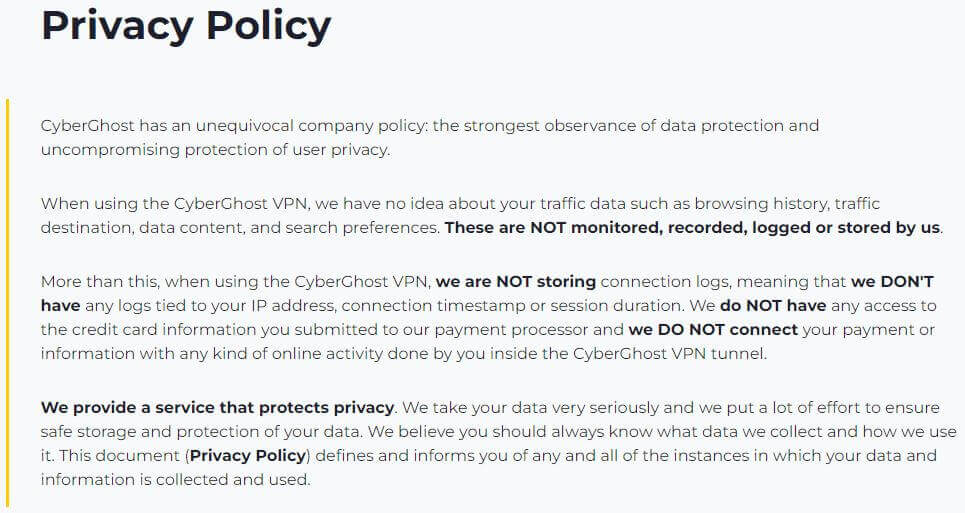
Data like your browsing history, DNS requests, IP address, timestamps, and others aren’t stored on its servers. This is further implied by a third-party audit from Deloitte. The company inspected CyberGhost recently, going over its full server infrastructure in a comprehensive audit.
Needless to say, it concluded that CyberGhost adheres to its promises. On top of that, it publishes transparency reports several times a year, adding to its trustworthiness.
Many people are wondering how safe Proton VPN is. Well, we’d be fools for saying it’s not. The excerpt from the FAQ says everything.
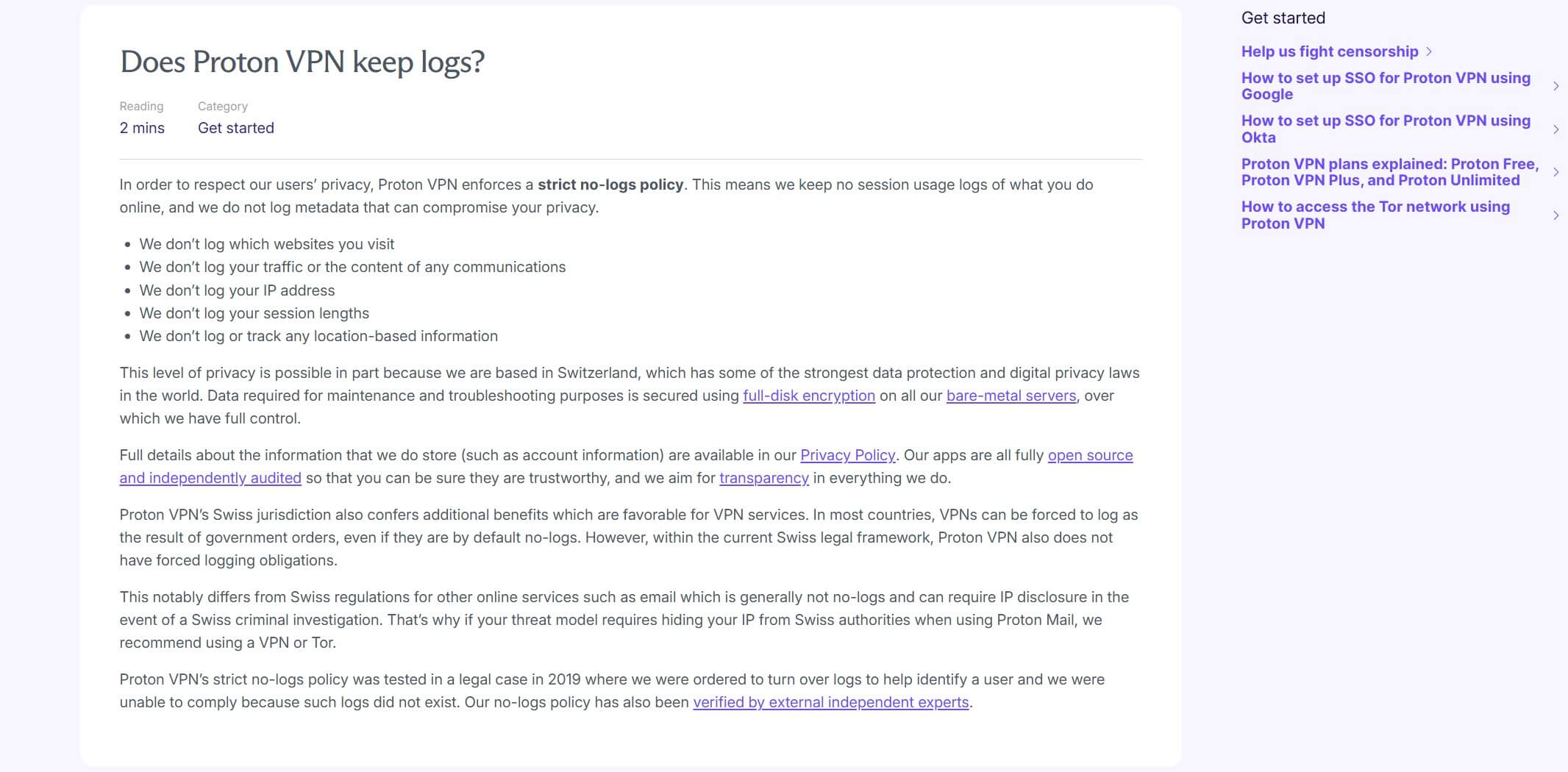
We can see that Proton VPN stores zero information that could compromise you. No IP addresses, session length, traffic destination, browsing history, or geolocation are stored on its bare-metal, RAM-only servers. Proton VPN excels in privacy and proves that through third-party audits.
The first audit was from SEC Consult, with the second and third audits taking place in 2022 and 2024, performed by Securitum, a leading European security auditor. All in all, we can digress by saying that none of the providers keep logs, which is a relief for those worried about their privacy.
Outcome: Tie 🟰
Having in mind everything we said, this round of our CyberGhost vs Proton VPN comparison is yet another tie. CyberGhost represents a staple of secure and safe VPNs. However, we can’t deny Proton VPN’s excellence and technical prowess, which make this VPN among the most advanced on the market.
CyberGhost vs Proton VPN Streaming Test
Moving on with this duel, we need to discuss streaming. If this is your #1 criterion, which VPN to buy – Proton VPN or CyberGhost? Again, these two are extraordinary for streaming, offering solid performance and thousands of servers.
Starting with Netflix, Proton VPN, and CyberGhost are almost equal. They work with around 10 libraries, including those from the US, Canada, Japan, the UK, and many European catalogs. CyberGhost offers special streaming servers for additional advantage. They’re optimized for many streaming services and TV channels.

For example, these servers let you watch MotoGP races live or stream the latest season of F1 anywhere. Another perk is that you can access platforms like Disney+, ABC, Hotstar, Prime Video, and others.
Proton VPN indeed works well and can unblock a wide gamut of services. However, we detected that Proton VPN sometimes won’t work with more demanding services like Hulu. This happens from time to time and is easily remedied by switching to another server or clearing your browser cache.
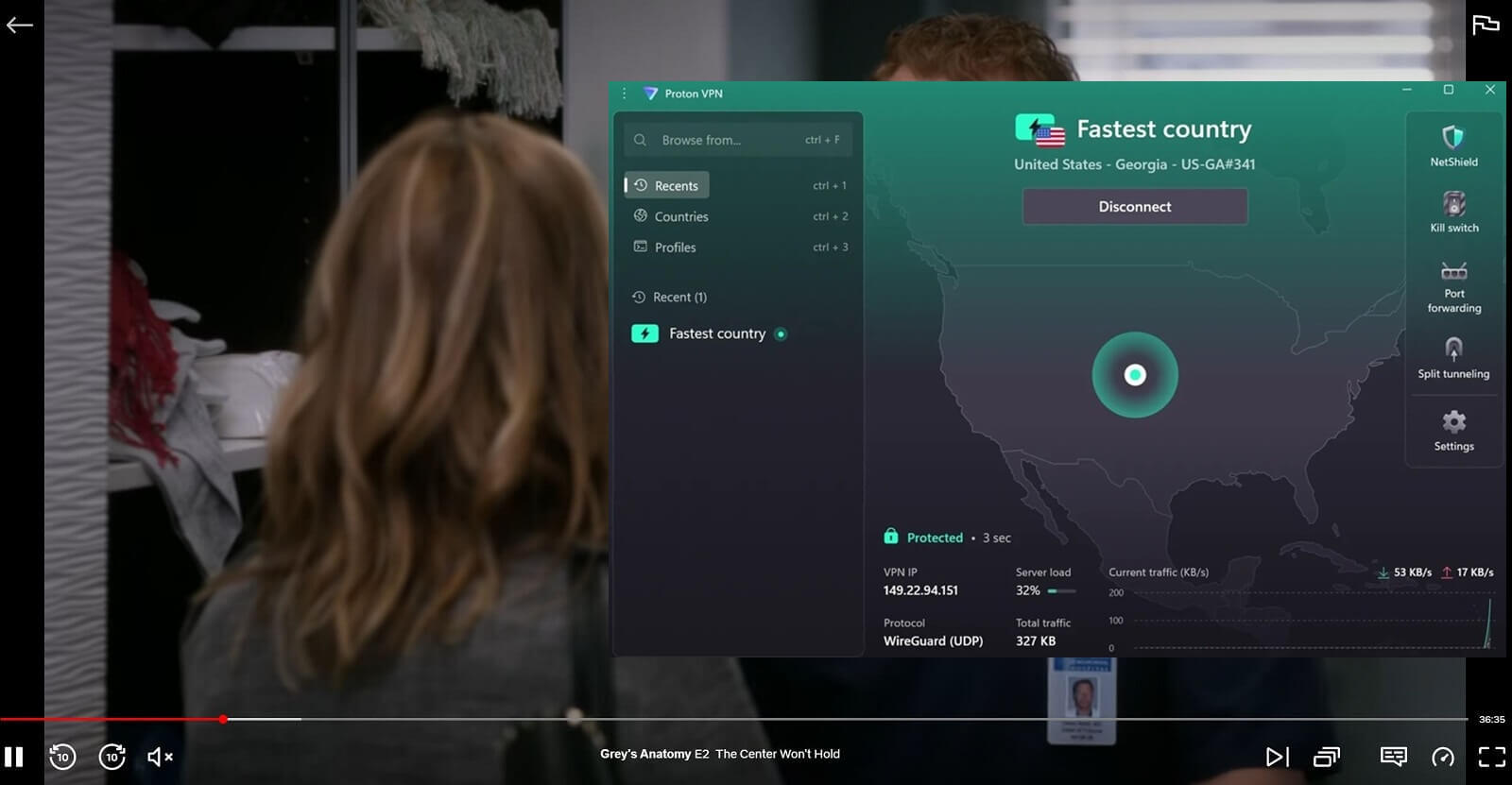
Still, the provider feels slightly less reliable in this regard, but not in a way that you should be alarmed or worried. Besides, Proton VPN also has a few dedicated streaming locations, alas, not as many as its rival. The provider is made more for privacy and security rather than entertainment.
We can, however, report that both showed decent streaming speeds. No lagging, buffering, or endless loading screens, even when using distant servers. Lastly, SmartDNS in CyberGhost makes streaming on every system possible. Proton VPN lacks this feature.
Outcome: CyberGhost Wins 🥇
In this part of the duel, CyberGhost displayed a more convincing streaming performance. It’s slightly better for unblocking, plus, it offers dedicated streaming locations and a tad faster speeds for this purpose. Not to mention its SmartDNS support, which Proton VPN lacks.
CyberGhost vs Proton VPN Speed Comparison
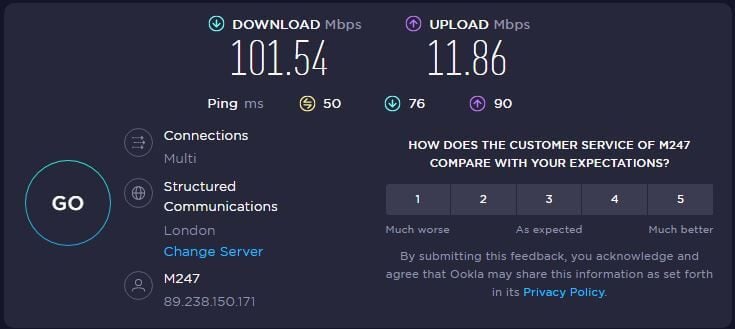
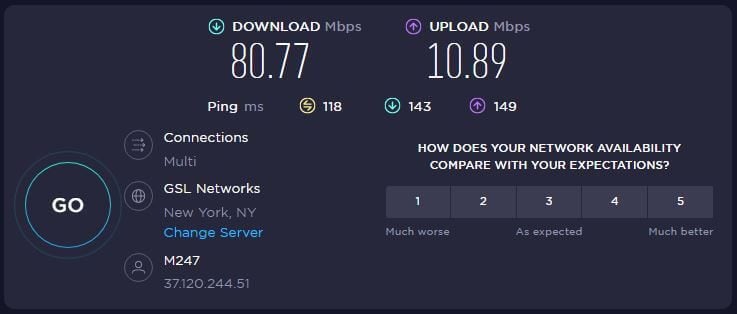
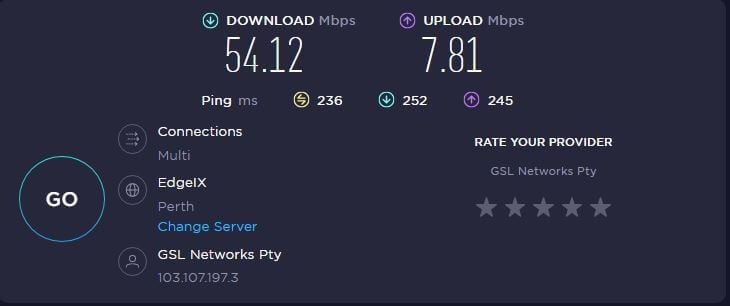
While we’re on the subject of speed and performance, let’s talk about it further. Our Proton VPN vs CyberGhost speed test will explain which VPN is faster. Before we move on to our test results, we first must properly set up the entire testing procedure. At the time of writing this comparison, we were in Europe.
When doing the speed test without using a VPN, our results looked like this:
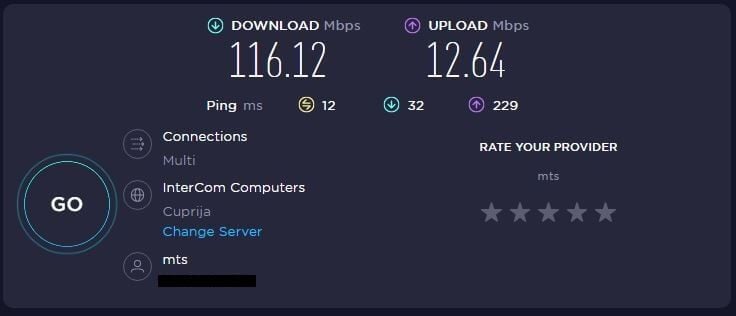
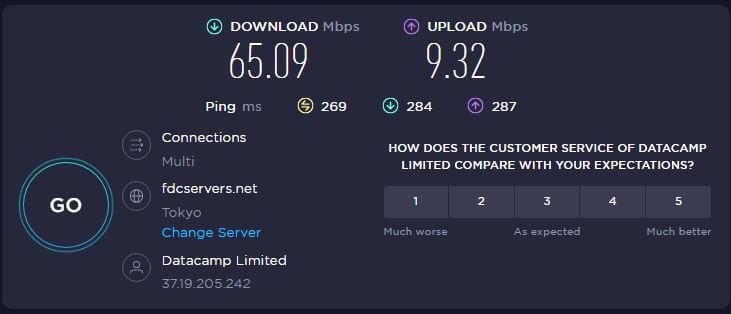
Roughly, our download speed is around 120 Mbps, with an upload speed of around 13 Mbps. Our ping is also quite low, at 12 ms. We tested both VPNs for three days in a row, three times a day, using four server locations in the UK, the US, Australia, and Japan. The protocol we used is most likely WireGuard.
We set both VPNs to Automatic, which means they selected the best protocol according to the server we were using. Since WireGuard is the fastest protocol (see our WireGuard vs OpenVPN comparison), we can, with certainty, say that these speeds are produced by that protocol. Now, let’s examine the speed test results.
CyberGhost
UK:
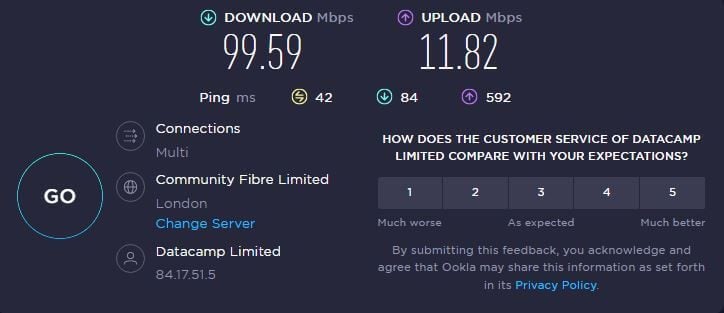
US:
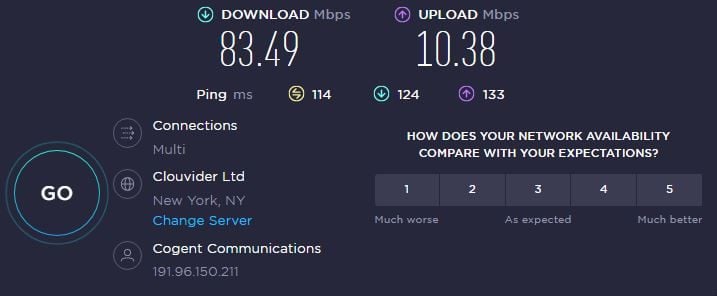
Australia:
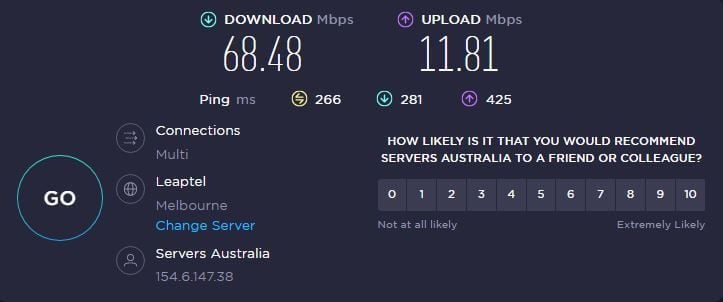
Japan:
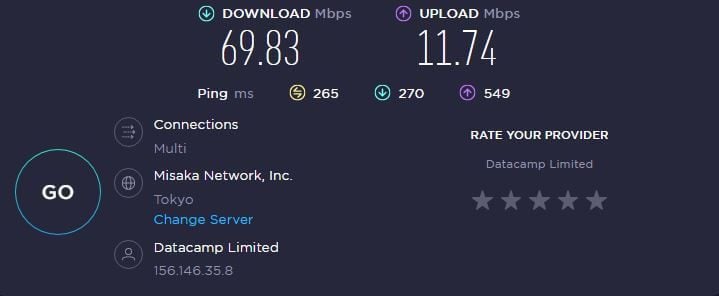
Proton VPN
UK:
US:
Australia:
Japan:
Outcome: CyberGhost Wins 🥇
CyberGhost takes this speed test round, and we’ll explain why. Proton VPN was faster on the UK server, but only a bit. The other three servers in the US, Australia, and Japan were a win for CyberGhost that displayed faster upload and download speeds than Proton VPN.
In terms of latency, it’s more or less similar. Albeit, we noticed that CyberGhost is slightly better here, with a tad lower latency on average. In real-world use, this VPN feels faster, which is most important, and this especially rings true on more distant servers.
Torrenting: Proton VPN or CyberGhost VPN?
P2P activities are safe and secure with encryption from a VPN. However, not every VPN is optimized for uTorrent, BitTorrent, and other clients. Don’t fret, though. For torrenting, it’s pretty much irrelevant which VPN you’ll choose, Proton VPN or CyberGhost. For one, both have dedicated P2P servers.
CyberGhost has them in almost every country that it offers, and they’re here to bring excellent performance and speeds for this purpose. Proton VPN’s servers, at least some, are considered optimized for P2P – you’ll see that in the app. The good thing is that regardless of the server in place, torrenting will work.
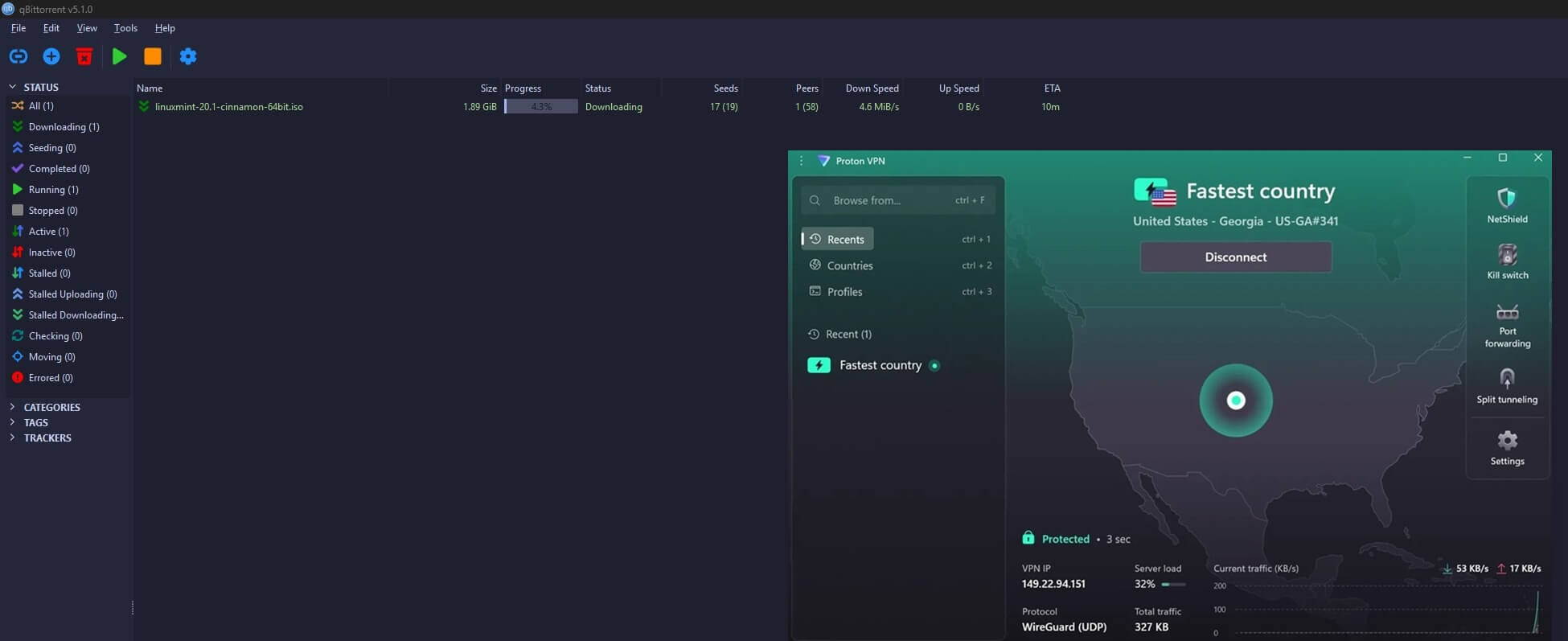
This is indicated by our screenshots below, both of which show Proton VPN and CyberGhost downloading Linux Mint through qBitTorrent.

Are there any differences? Not exactly.
If we compare their speeds, they’re neck and neck. Privacy and security-wise, it’s the same. Both stay away from any logging that could expose your torrenting activities and ruin your privacy. Proton VPN does have one feature that CyberGhost doesn’t – port forwarding. However, we don’t think this feature is necessary.
Yes, it can speed up your downloads, but you don’t need it if you’re using Proton VPN because the provider is already fast. It’s not the best solution for privacy because you’re trading it for a tad better performance.
Outcome: Tie 🟰
In this part of our CyberGhost vs Proton VPN duel, it’s easy to say it’s a tie. As we’ve learned, you’ll have zero issues with these providers. Both are P2P-capable, offering world-class performance and thousands of torrent-friendly servers in dozens of countries.
Bypassing Censorship
Obfuscation and obfuscated servers are crucial for those looking for a reliable VPN that works in China. Without these features, it’s impossible to slide under the Great Firewall’s radar and use the service normally. Let’s start with Proton VPN. As said, it does offer Stealth VPN and something called Alternate Routing.
The latter is available on all platforms and basically allows you to access the VPN when Proton VPN’s servers are blocked. What’s more, Proton VPN advertises this as a feature for bypassing censorship. Unfortunately, China is mentioned nowhere because the VPN won’t work in the country.
Don’t believe us? Well, here’s something we found on its official site:
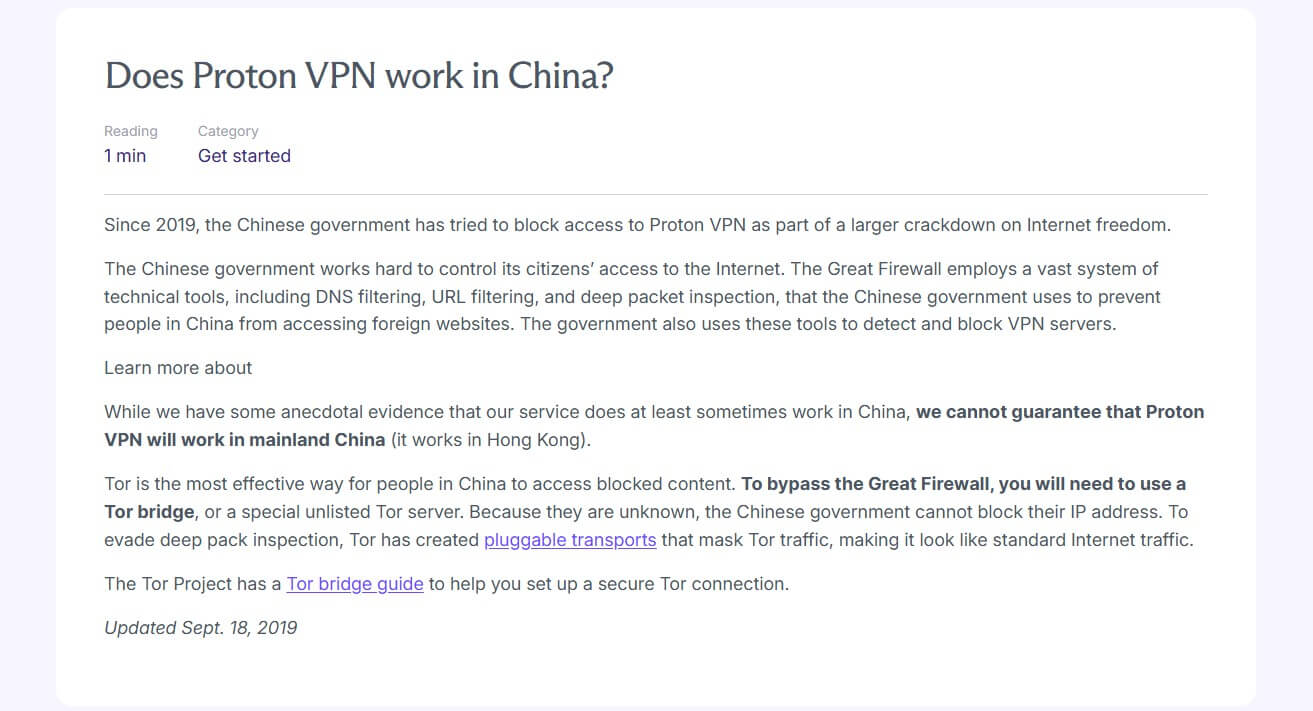
Proton openly admits to not working in the country; at least it cannot guarantee it. But what about the Stealth VPN protocol? Well, it also won’t work, and despite offering this protocol on macOS, users of this system shouldn’t have their hopes too high. CyberGhost is pretty much the same, as explained by this Reddit user.
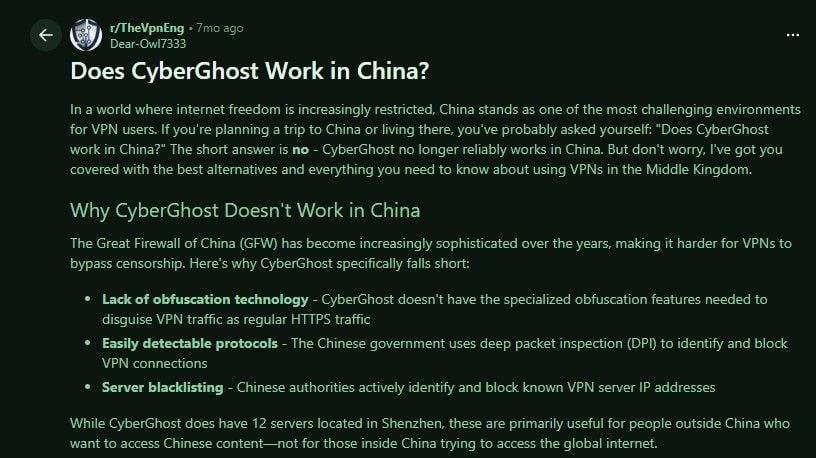
This VPN has no obfuscation, and by extension, won’t work in China. We tested CyberGhost at least a hundred times over the years, and it was a long time ago when it worked properly. Proton VPN stopped in 2019, while CyberGhost’s days of working in China ceased even before that.
If you’re packing your bags for China, we recommend avoiding these VPNs. Instead, NordVPN can be used in China, and its biennial Basic plan with three free months and a 73% discount should be your deal. Alternatively, you can also use ExpressVPN and Surfshark, as they’re also fairly reliable.
Outcome: Tie 🟰
This round of our CyberGhost vs Proton VPN analysis, once again, ends up in a tie. Neither of the VPNs works in China, rendering them useless. In other countries like the UAE, Qatar, and Turkey, these VPNs still work well. They’re censored locations that usually don’t pose a challenge even to lower-quality services.
Proton VPN vs CyberGhost VPN Server Fleets
Speaking about low-quality VPNs, CyberGhost and Proton VPN can’t be listed as such when discussing their server fleets. Both VPNs are jam-packed with server locations, but one is better. Which one – Proton VPN or CyberGhost VPN? Let’s answer this burning question by analyzing their server parks
Proton VPN (15,900+ servers in 126+ countries)
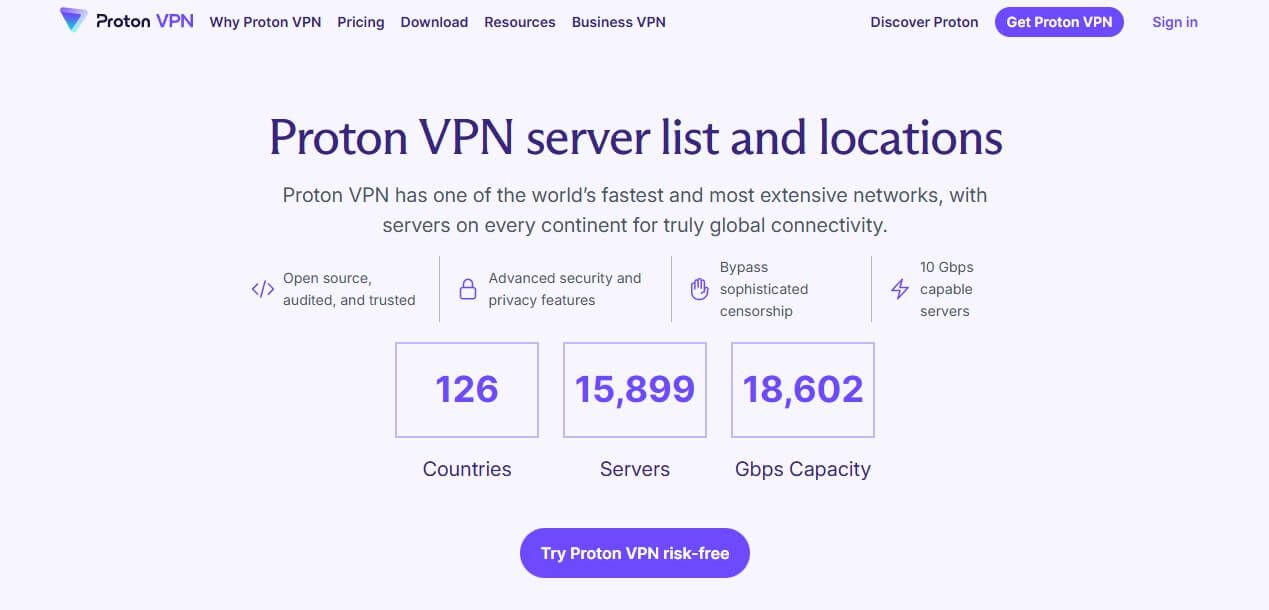
Proton VPN’s days of a small server network are behind us. In 2026, it had over 15,900 servers in over 125 countries. During this comparison, we mentioned plenty of specialty servers for torrenting, Tor over VPN, streaming, and Secure Core. That said, the server variety is all but unsatisfying. The server distribution is remarkable.
Proton VPN’s server network is mostly stationed in the US, but other popular locations are here. By that, we mean the UK, Canada, Japan, Australia, Europe, and some African countries. We like Proton VPN’s inclusion of virtual servers in countries where having physical servers is obstructed due to privacy-unfriendly laws.
Such servers are, for example, in India. Proton VPN has 10 Gbps servers based on RAM, so their quality is undeniable. One thing to note is that the provider has over a hundred free servers that can be used by free subscribers. Moreover, the service has a little over 110 Secure Core servers for more privacy.
CyberGhost (12,000+ servers in 100 countries)
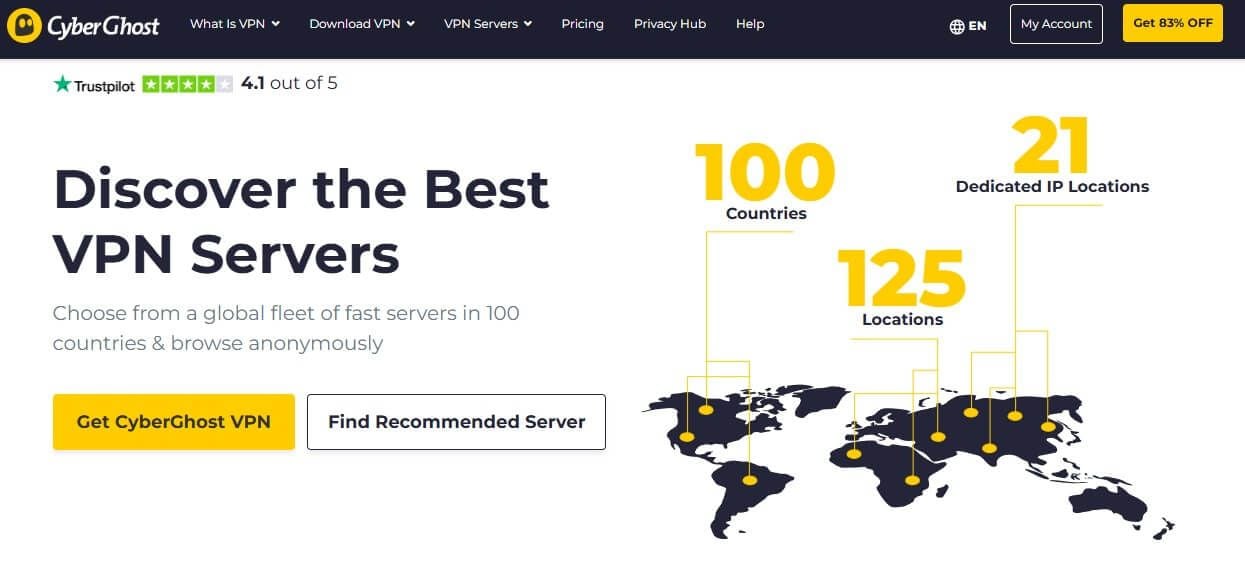
This gargantuan provider sports 12,000+ servers in 100 countries and 125 locations. These are massive numbers that trump even NordVPN and ExpressVPN, two better VPNs. Now, when compared to Proton VPN, CyberGhost may seem small. It has 12,000 versus 16,000 servers in the Swiss VPN.
Apart from servers for torrenting, CyberGhost offers servers optimized for streaming, gaming, and the aforementioned NoSpy servers. Like Proton VPN, the whole infrastructure is 10 Gbps, allowing for some of the fastest speeds around. Another benefit is that all servers are based on RAM. However, that’s not the point. The point is just how ever-present the VPN feels.
It has a combination of virtual and physical servers, allowing it to cover almost the entire globe. CyberGhost VPN has servers in the US, Canada, Europe, Asia, Africa, New Zealand, Australia, and many other countries. For instance, it has around 1,500+ in the US, and a few hundred servers in the UK, Canada, and Australia.
Outcome: Proton VPN Wins 🥇
While both VPNs have outstanding server networks, Proton VPN’s 16,000 or so servers virtually murder every CyberGhost’s chance to repent. It also offers more countries and server locations, with excellent server variety and distribution.
Customer Support: CyberGhost VPN or Proton VPN?
CyberGhost is known as one of the most user-friendly VPNs on the market. Its round-the-clock customer service is open 24/7 and available through live chat and email. Best of all, it’s quick to respond and won’t leave you waiting for long. We like that its support is available in English, German, and French.
Moreover, its email support is also impeccable, so oftentimes, your issue will be tackled in about ten to fifteen minutes this way. Not to mention numerous self-help articles and FAQs. CyberGhost has hundreds of how-to guides in addition to helpful Blog articles that you can read. Proton VPN’s support functions differently.
You won’t see the live chat widget when you go to its site. For free users and those who are yet to become subscribers, Proton VPN has email support only. Of course, you’ll have full access to FAQs, guides, and other nitpicks. However, live chat support is here too, but is only usable by those who pay for the VPN.
Paid users won’t mind having this support. It works pretty well and responds quickly to your questions. It’s a shame that Proton decided to lock it behind the paywall, as is the case with a few other providers we tested recently.
Outcome: CyberGhost Wins 🥇
On paper, both services have the same customer support means. But because the Romanian VPN doesn’t omit 24/7 live chat support for yet-to-become subscribers and is always here for you, CyberGhost wins this round against Proton VPN.
Proton VPN vs CyberGhost Pricing Comparison
As we approach the very end of this duel, we need to discuss the prices of CyberGhost VPN and Proton VPN. We think these will determine your final choice, as there are some stark differences.
Proton VPN
In our Proton VPN review, we criticized this VPN for being a bit expensive. In 2026, the Swiss provider managed to cut down its prices a bit and is now dangerously close to CyberGhost. How close, though?
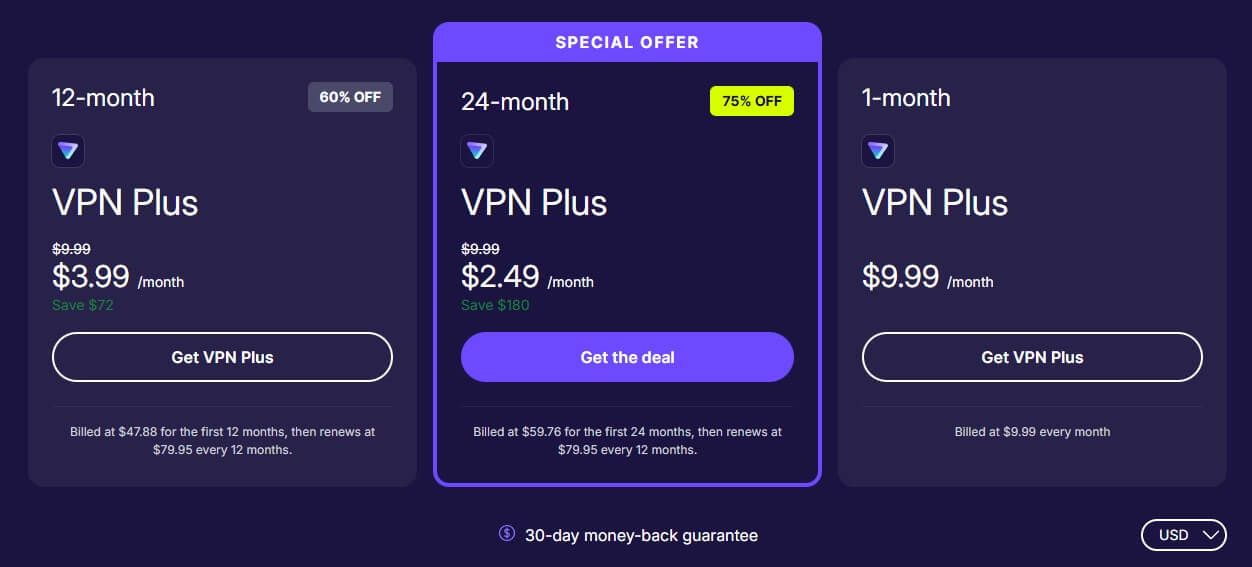
As you can see, the pricing structure is simple. The cheapest 2-year deal in the middle will cost you around $2.49 monthly for the first two years. The upfront price is under $60, but the plan renews at $79.95 annually, which is around $6.67 monthly. We also have an annual plan at around $3.99 monthly or $47.88 for the first year.
It renews at the same price. And finally, there’s the monthly plan at $9.99, which actually isn’t too expensive, as most monthly VPNs cost way over $13. All plans come with a 30-day money-back guarantee to ensure you can always get a refund if you’re unsatisfied. One more thing – Proton also offers a free VPN plan.
It has ten server locations, unlimited traffic, and 1 Gbps servers. On the other hand, it’s not optimized for streaming and torrenting and lacks features like NetShield, Secure Core, and many others. But let’s not pretend its free plan is bad. It’s, in all honesty, pretty good if we exclude the inability to choose the server location.
CyberGhost
CyberGhost has no free plans, unlike Proton VPN, although there’s a 24-hour free trial of its premium version. That isn’t an issue when you have a VPN this cheap. Look at its pricing and compare it to Proton VPN.

Remember the 2-year plan from Proton VPN? Well, the same plan but with three free months costs less. CyberGhost is $2.19 monthly for 26 months. You’ll spend about $57 for this period, and CyberGhost will renew at the same price, but annually. This makes the VPN noticeably cheaper in the long run.
CyberGhost lets you purchase some useful add-ons for a silly price. For instance, on Windows, you can get Antivirus and Security Updater for just $1.00 a month, while a single dedicated IP is $2.50 a month for the 2-year plan. Another big advantage is a 45-day refund policy for 6-month and 2-year plans.
While the monthly plan is subject to a 14-day refund policy, other plans give you much more freedom for testing premium plans compared to Proton VPN.
Outcome: CyberGhost Wins 🥇
Proton VPN has a free plan, but if you aim for one of these VPNs, you likely want a premium experience. In that case, CyberGhost is a more cost-effective option that costs less in the beginning and after a while.
Conclusion: CyberGhost Wins!
Okay, this was a tough battle, but only one can emerge victorious. A score of 8:5 marks a pretty strong win for CyberGhost, a VPN that takes the title to Romania and represents a far better choice than Proton VPN. What can we say? Proton VPN fought bravely but in the end, lost the match.
The takeaway is that both providers are extraordinary in their own ways. Proton VPN is one of the most impressive picks for security and privacy. Simultaneously, it offers a huge server network that surpasses even its pricier rivals. Proton VPN can boast about its free VPN plan, which very few high-caliber providers offer.
CyberGhost is excellent for streaming, torrenting, connection speed, and value for money. It’s a tad cheaper than Proton VPN, but it outperforms it in a few key aspects that ultimately decided today’s winner. Recently, we compared NordVPN to Proton VPN, and the latter was pretty close overall.
This speaks volumes about the Swiss provider and its countless improvements. Ultimately, it boils down to your preferences. You can at least test both for free for at least a day, then determine which VPN ticks all the right boxes for you. If you’d rather go for the winner, try CyberGhost risk-free on the button below.