Struggling to pick between CyberGhost and ExpressVPN? It’s as if we knew your struggles and decided to compare the two giants. This ExpressVPN vs CyberGhost comparison has all you need to know. However, before we begin, we must introduce them. CyberGhost is an affordable VPN with flexible plans.
Despite the price tag, it’s safe, secure, and reliable. ExpressVPN’s recent price change made the VPN more affordable. Simultaneously, ExpressVPN brought some amazing improvements to the table, making it more powerful than ever. During our testing, we chose ExpressVPN and ultimately found it to be better.
However, CyberGhost isn’t far off and, in many cases, gave ExpressVPN a run for its money. If you’re unsatisfied with the quick conclusion, read on. Our CyberGhost vs ExpressVPN duel is key to picking the right VPN.
ExpressVPN vs CyberGhost VPN: A Quick Overview
| ExpressVPN 🏆 | Cyberghost VPN | |
| 💰 Starting price | $3.49 monthly | $2.19 monthly |
| 💸 Money-back guarantee | 30 days | 45 days |
| 🆓 Free version | No ❌ | No ❌ |
| 📺 Working with Netflix | Yes ✅ | Yes ✅ |
| 🔽 Torrenting allowance | Yes ✅ | Yes ✅ |
| 🔟 10 Gbps servers | Yes ✅ | Yes ✅ |
| 🥸 No-logging policy | Yes ✅ | Yes ✅ |
| 🌐 Jurisdiction | British Virgin Islands | Romania |
| 📱 Simultaneous connections | 10 to 14 | 7 |
| 🛜 Protocols | Lightway, Lightway Turbo, OpenVPN | WireGuard, IKEv2, OpenVPN |
| 💾 Servers | 3,000+ in 105 countries | 12,000+ in 100 countries |
| 💯 Best for | Ease of use, speeds, and streaming | Affordable price and torrenting |
| ☎️ Customer support | 24/7 live chat, email, knowledge base, FAQs | 24/7 live chat, email, knowledge base, FAQs |
CyberGhost vs ExpressVPN: Apps & Ease of Use
Your first contact with a VPN provider starts with its applications. Both CyberGhost and ExpressVPN have a lot to offer in this aspect. Both providers offer native applications for all platforms. You can install them on Windows, iOS, Android, macOS, Linux, and platforms like Android TV, Fire TV Stick, and Samsung Smart TV.
In addition, both providers support routers, with ExpressVPN taking a slight advantage. It supports more router models, and its setup tutorials are good, so you’ll have an easier time setting up this VPN on a router. The cheaper provider had one advantage up until recently, but ExpressVPN eliminated it.
That is the number of simultaneous connections. We always criticized ExpressVPN for sticking to five connections, but now, in 2026, that number increased to ten, with 14 in the Pro plan. CyberGhost, on the other hand, has seven connections, which isn’t the best practice considering the standard of ten.
CyberGhost
Once you subscribe to CyberGhost, you can install its applications. We’ll analyze its Windows app since it resembles the app on macOS, and these two apps are used the most. The VPN looks sleek enough, with the server list in alphabetical order, a connection button to the right, and server types on the left.

CyberGhost even displays the server distance, which helps pick the nearest one to maximize the speed and stability. While we like its app overall, we dislike its slightly confusing design. You have to dig deeper to find different features, as they’re scattered across three separate menus. You’ll get used to that quickly.
The situation is a bit better on iOS and Android, where CyberGhost has a more streamlined design. We noticed that its VPN apps for iPhones were the best. They’re snappy and decently optimized. On Windows and macOS, CyberGhost’s connection times are slightly longer, but nothing that makes it feel weak.
ExpressVPN
On the other hand, we have ExpressVPN, which follows a completely different philosophy compared to CyberGhost. It’s extremely easy to use, it’s intuitive, and it takes very little to get used to its interface, which looks identical on all supported platforms. You’ll notice how good the VPN looks right away.

The connection button is right there, letting you connect to the fastest server in seconds. You can open the server list and use the search bar to find the right one. To access Settings, click the three horizontal lines. You’ll notice that ExpressVPN makes its protocol selection and the rest of the features easily accessible.
No digging through the menus to find what you need. Its iOS and Android apps tell us the same tale, as ExpressVPN keeps things simple, smooth, and maximally intuitive. During our ExpressVPN vs CyberGhost assessment, we noticed that the former’s connection times were shorter, making the VPN feel snappier.
Outcome: ExpressVPN Wins 🥇
ExpressVPN wins the first round. It offers slightly better router support, more simultaneous connections, and superior ease of use. It’s the best beginner-friendly VPN that combines simplicity with powerful features and outstanding compatibility.
Security & Privacy: Which One Is Safer to Use?
A mandatory part of our CyberGhost vs ExpressVPN comparison for 2026 is discussing security and privacy. Since we discuss some of the best VPNs your money can buy, you expect them to be pretty secure. We can’t say you’re wrong. They’re great, and here’s what we found in this comparison.
Shared Security Features
Keep in mind that these providers share the same parent company, Kape Technologies, which we highlighted in our review of ExpressVPN. This means they also share some of the features that we’ll discuss. Starting with encryption, both use 256-bit AES encryption, an automatic kill switch, and IP/DNSv6 leak protection.
In addition, both providers support OpenVPN, great if you prefer using it as a tried-and-tested solution for security and privacy.
Another thing worth pointing out is that both providers offer split tunneling and RAM servers. However, CyberGhost limits split tunneling to Android, while ExpressVPN supports it on all devices. CyberGhost and ExpressVPN also have proprietary DNS servers. This feature is also called PrivateDNS.
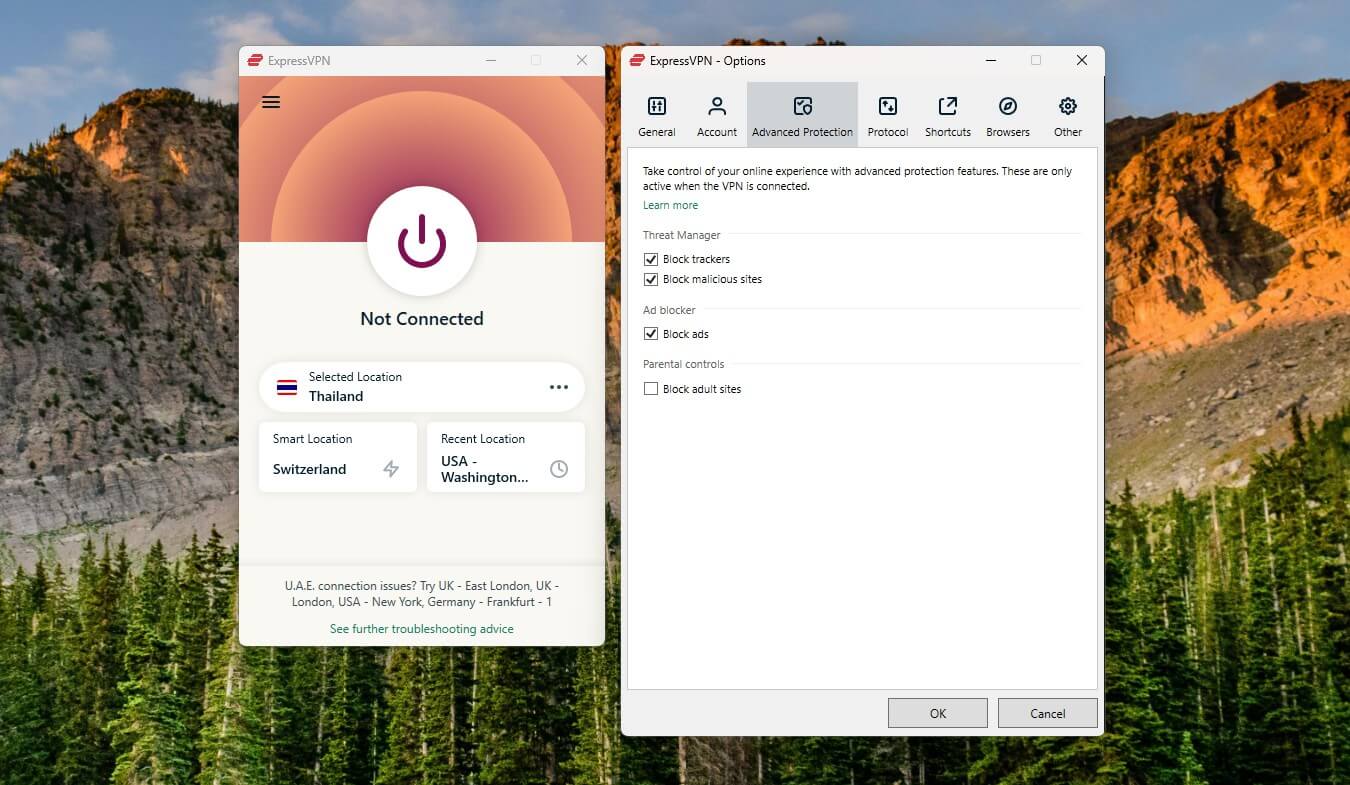
They use their DNS servers to handle your DNS requests instead of relying on free DNS services that usually keep logs of your online whereabouts. Moving on, the VPNs are similar when talking about extra features. Namely, both have an ad blocker that can block trackers and malicious sites.
What Are the Differences?
As you can see in this ExpressVPN vs CyberGhost VPN comparison, the providers share some basic features. However, if we talk about advanced functionalities, there’s much more to be said. Let’s start with CyberGhost.
CyberGhost
This provider offers additional protocols in the form of IKEv2 and WireGuard. WireGuard is currently among the fastest protocols, allowing CyberGhost to maintain excellent performance with stellar network stability. We already mentioned its ad blocker and found it helpful for getting rid of ads and pop-ups.
We criticized ExpressVPN for not having this feature, and in 2026, it was hard to do it because the provider finally improved. Now, it’s even better than CyberGhost because of Parental Control. This feature lets you block porn sites and adultery, in general, protecting your children from this nasty content.

CyberGhost doesn’t have this feature; instead, it relies on an ad blocker only.
This provider offers the so-called NoSpy servers. These servers are in Romania and are directly operated by CyberGhost, making sure you get the highest level of privacy. This is yet another security measure that we use a lot and have never had issues with. Finally, the VPN has optional antivirus software for $1 monthly.

It’s a crafty tool for clearing your Windows or Mac computer of nasties. While it’s paid extra, the dollar-a-month price is pretty much negligible. Bear in mind that its rival doesn’t offer anything similar.
ExpressVPN
ExpressVPN has seemingly no advanced features in its application. However, that cannot be farther from the truth. The VPN offers Lightway, a proprietary protocol that blends speed and security. The Turbo version of this protocol creates multiple tunnels to a server for faster speeds and more stable connections.
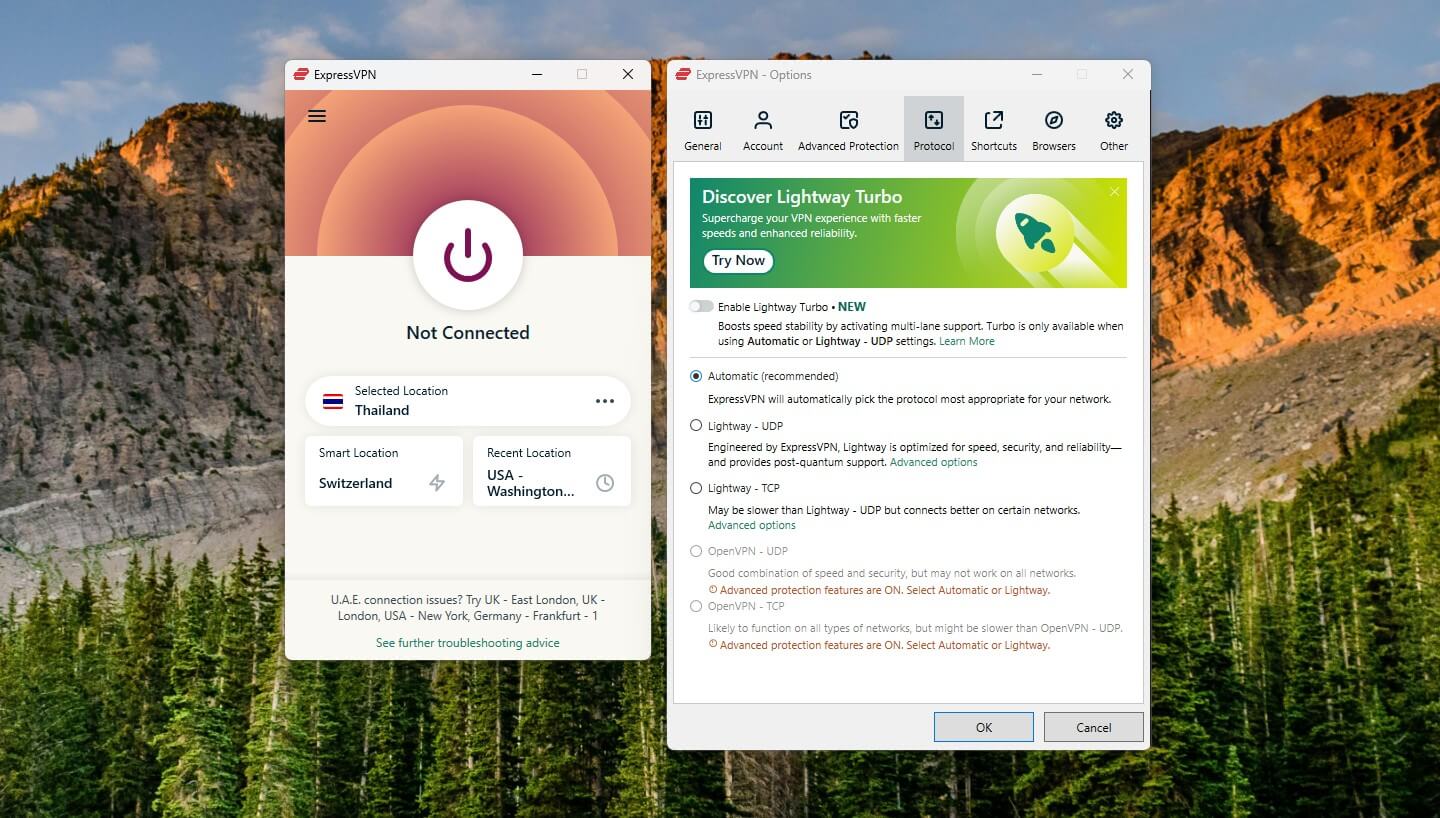
Instead of using a third-party DNS like Cloudflare or, God forbid, Google, it has an in-house solution. This is so much better in terms of privacy, as every bit of traffic goes through ExpressVPN’s no-log DNS, ensuring no one can track your online activities. Every subscription allows you to use ExpressVPN Keys.
It’s a password manager that you get for free. While not the best in the world, it’s driven by the provider’s excellent security to keep your passwords safe and sound. Another plus is the Identity Defender tool, which works primarily in the US and shields you against cyber-attacks, credit card theft, and other nasty things.
Overall, ExpressVPN is one of the fastest VPN services for browsing, streaming, torrenting, and much more, which doesn’t lack security. While we’d like to see Multi-hop and a few other tidbits, we must say that CyberGhost also doesn’t have them. Put simply, both VPNs shine in their own ways, security-wise.
Is There a No-Logs Policy?
With so many security features, our CyberGhost vs ExpressVPN comparison should be interesting when talking about logging practices. Well, it isn’t, as both providers are known for their stringent no-logging business models. Still, there are a few differences even in this case. Let’s start with CyberGhost.
The provider is based in Romania, a country outside the Five Eyes alliance, and one of the best privacy-friendly jurisdictions. With no data-retention laws, the provider is free to maintain a no-logging policy and store no compromising logs.
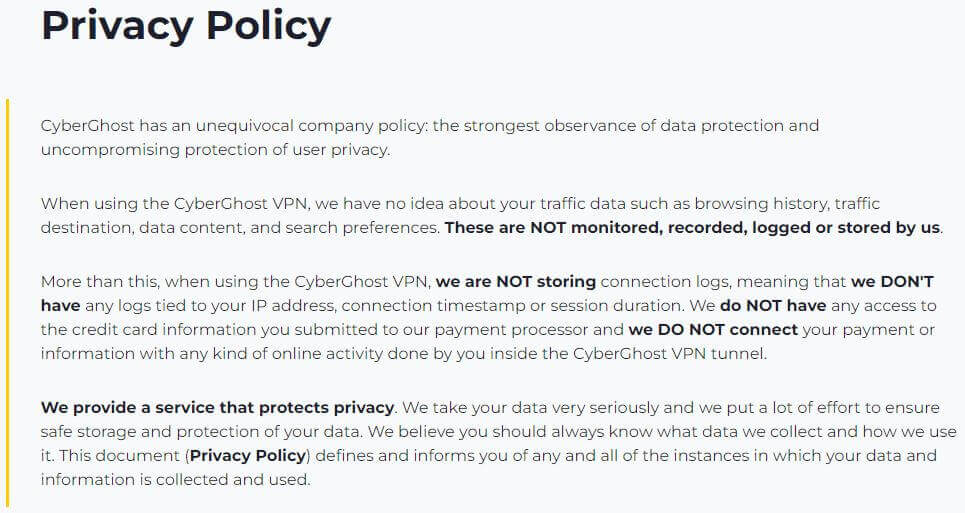
It stores no data regarding your IP addresses, DNS requests, browsing history, traffic metadata, geolocation, etc, etc. It does store information related to your email and payment method for activating your subscription, plus a few other unimportant tidbits for troubleshooting and maintenance.
Interestingly, it also has an audit from Deloitte, which puts it at a slight advantage because it has another solution in addition – transparency reports published every three months. This adds to the overall trustworthiness, as well as the fact that CyberGhost never leaked any data to the authorities.
The same can be said about ExpressVPN. This provider is based in the British Virgin Islands, an offshore, privacy-friendly location perfect for a VPN service. ExpressVPN maintains its no-logs policy, which received several independent security audits from PricewaterhouseCoopers, KPMG, and Cure53.
Much like CyberGhost, ExpressVPN stores zero sensitive logs, ensuring you browse the web anonymously. The information it stores is in an anonymized form and includes your app version, total amount of used bandwidth, and dates of connection to a VPN service. It stores no information on your browsing history.

Plus, it has no way of finding out how you used the Virtual Private Network. This is, unfortunately, proven in the investigation of the brutal murder of Andrei Karlov in Turkey. When the Turkish authorities seized ExpressVPN’s server, reportedly used to delete information about the assassin, they found nothing.
Outcome: Tie 🟰
The result is ultimately a tie, as both providers have many security features that make them some of the safest around. Their immaculate no-logs policies with several audits make them trustworthy and great for overall privacy and security.
CyberGhost vs ExpressVPN Streaming Test
If you need a VPN for streaming, you’re looking at some of the best providers in the business. This CyberGhost VPN vs ExpressVPN comparison will tell you everything you need to know about this aspect, so let’s see which provider is better in the streaming comparison.
Netflix Test
As always, we’ll start with Netflix since it’s the most popular streaming service. Many providers struggle to unblock Netflix libraries because of Netflix’s strong anti-VPN measures that still reign supreme. However, if you want to expand your horizons and unblock more libraries, should you consider these providers?
Our answer is YES, but ExpressVPN is a bit better since it can unblock a wider selection of libraries in general.
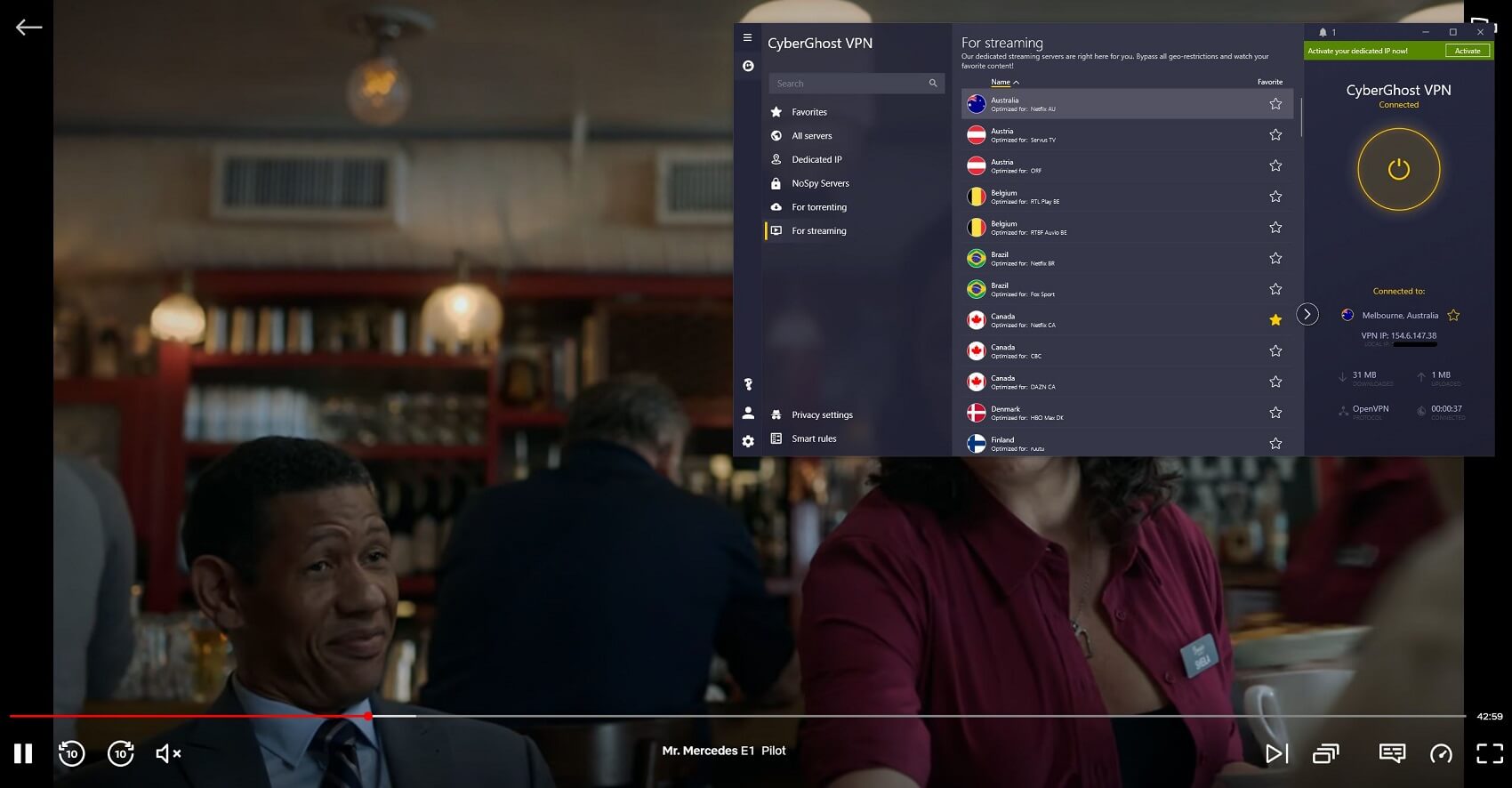
CyberGhost has dedicated streaming servers optimized for a few catalogs, but we’ll be honest – they don’t always work perfectly, especially when talking about more exotic libraries like Netflix Japan. ExpressVPN worked with all tested catalogs. It can unblock Netflix Australia, France, and many other catalogs – around 15.

CyberGhost doesn’t work with Netflix US and Japan, unfortunately, and the number of libraries it can unblock is way smaller. In our tests, it was around ten, which is good, but not as impressive as ExpressVPN.
Other Streaming Platforms
If you’re interested in streaming content on other platforms, both providers are solid for unblocking capabilities and performance. It’s vital to note that you’ll often need to use CyberGhost’s streaming servers when streaming. Its regular servers sometimes won’t unblock platforms, rectified by using the streaming server.

This happened when we tried to watch NBC using a regular server. It didn’t work until we switched to a streaming server for NBC. ExpressVPN, on the other hand, has no dedicated servers, meaning that all servers are capable of streaming. We find this to be an advantage in terms of ease of use.

But either way, when testing Hotstar, BBC iPlayer, Pluto TV, and other famous channels and streaming services, both providers displayed more than decent results.
Outcome: ExpressVPN Wins 🥇
Both providers are decent streaming VPNs, but ExpressVPN’s performance was more convincing. It’s better for unblocking Netflix libraries and other hard-to-access sites. For the price, CyberGhost performs well, but its streaming servers are an occasional letdown.
CyberGhost vs ExpressVPN Speed Tests: Which One Is Faster?
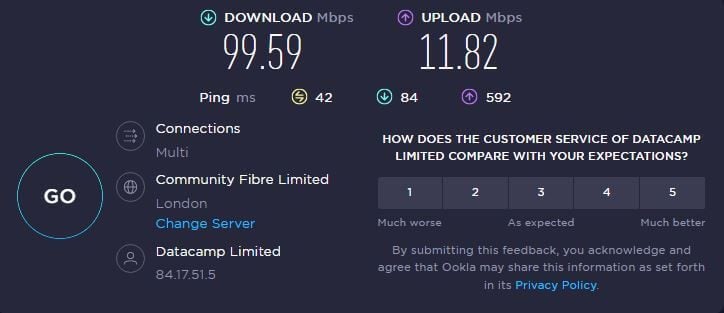
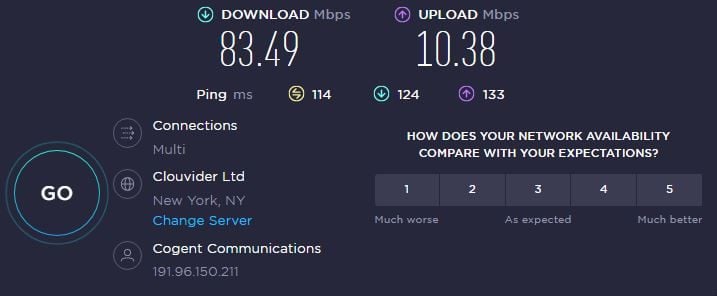
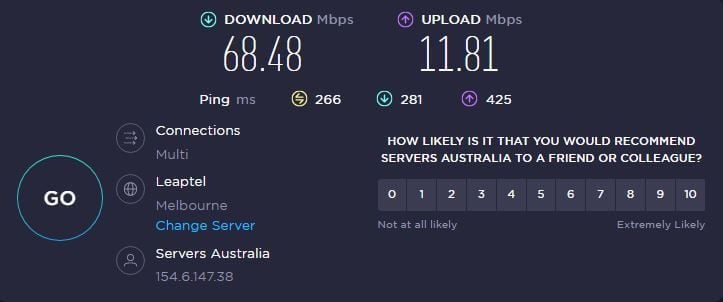
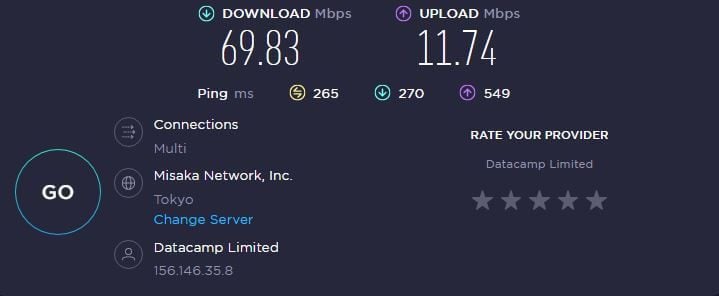
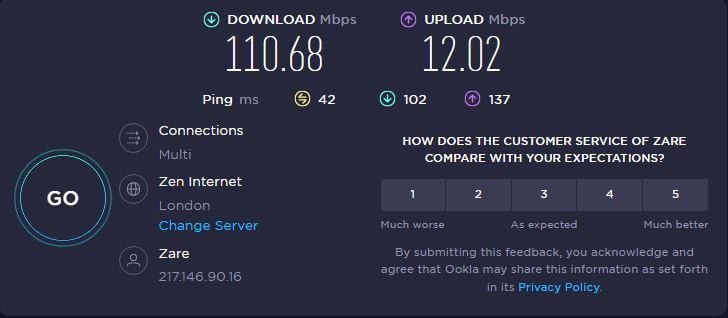
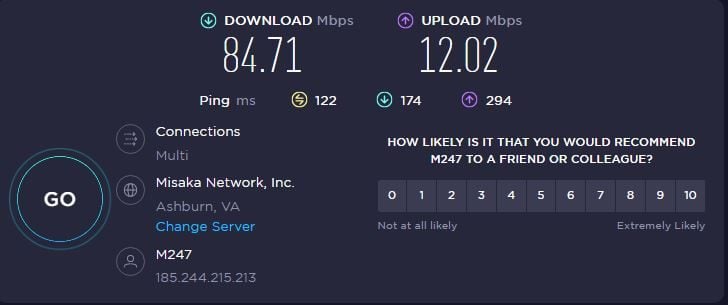
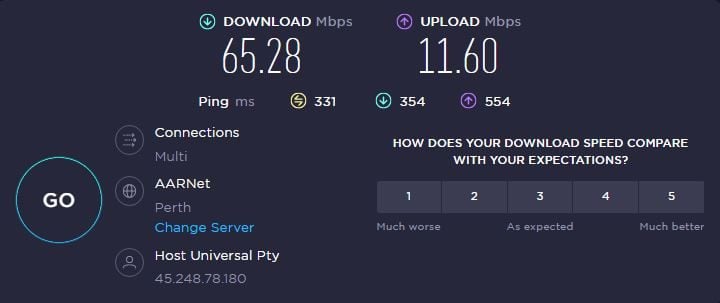
As said in this ExpressVPN vs CyberGhost comparison, both providers have great performance for all purposes, be it streaming, torrenting, or browsing the web. However, there are some differences in speeds. We’ll need to clarify how we tested these providers. First, we set the protocol selection to Automatic.
This makes the result authentic and shows how good each VPN is in terms of optimizing performance. After that, we tested each provider for three days in a row, three times a day, in the morning, in the evening, and at midnight with busy servers. We also used four server locations – the UK, the US, Australia, and Japan.
We were in Belgrade, and our native internet speeds looked like this:
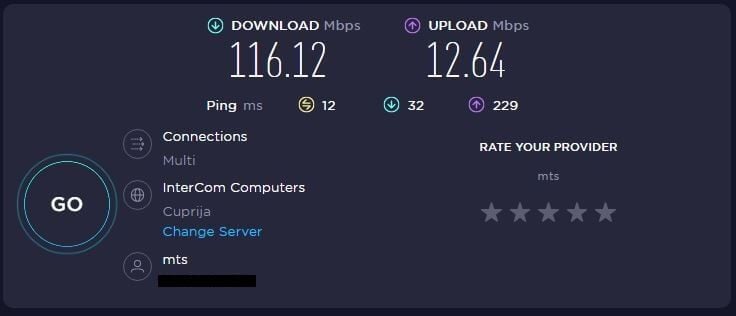
We don’t have the fastest internet, but that doesn’t matter in this case. We’re looking only at percentages that will also apply to your internet speed, whether slower or faster. With these parameters in place, we compiled the best results, so let’s see how well these providers performed.
CyberGhost
UK:
US:
Australia:
Japan:
ExpressVPN
UK:
US:
Australia:
Japan:
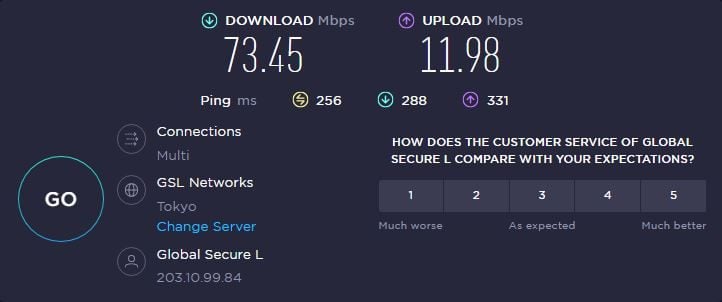
Outcome: ExpressVPN Wins 🥇
In this part of the comparison, ExpressVPN wins because it’s faster on three out of four tested locations. It only showed slightly slower speeds in Australia, while in the UK, the US, and Japan, ExpressVPN performed a bit better than CyberGhost.
Torrenting: Are CyberGhost and ExpressVPN P2P-Friendly?
If you’re looking for a VPN that you can use with BitTorrent or any other client, will these two satisfy your needs? Absolutely. As some of the best providers around, ExpressVPN and CyberGhost had P2P activities on their minds as well when designing their services.
ExpressVPN and its focus on privacy and security surely give you a lot to look forward to when talking about anonymous torrenting. Coupled with exceptional performance and speeds, you’re looking at perhaps one of the best torrenting experiences.
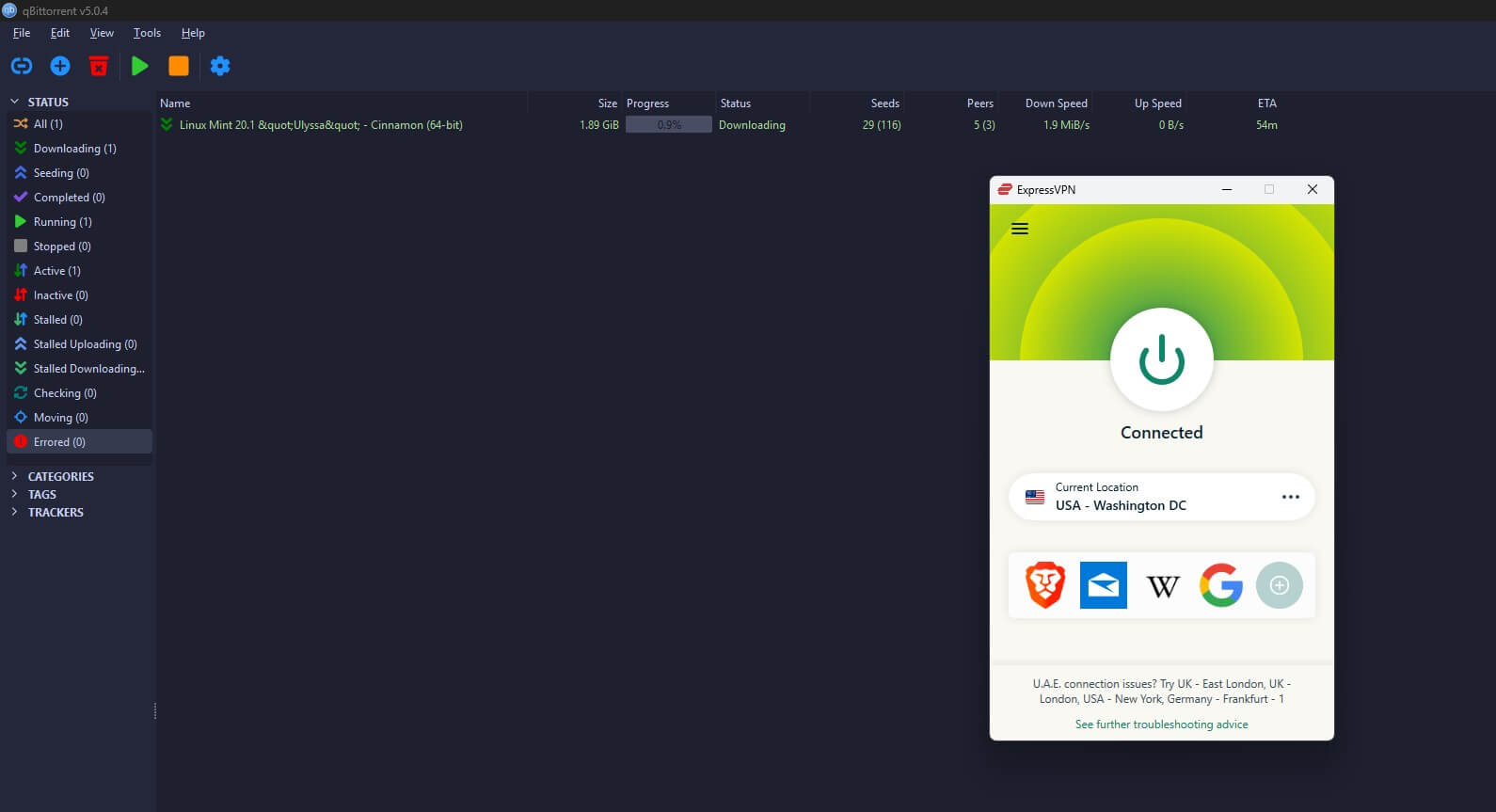
When using a few distant servers, you can expect awesome speeds, which make this provider so special. Not to mention that every server is compatible with torrenting, so you don’t need to adjust by selecting P2P servers or enabling special protocols. Use its Smart Location feature to get the fastest server.
After that, turn on your torrent client and start downloading. CyberGhost does offer P2P servers in conjunction with the streaming servers we talked about earlier in this comparison. However, it doesn’t force you to pick a P2P server from the list. You can connect to a random server and start torrenting right away.

When we were downloading Linux (a copyright-free file) using the qBittorrent client, we had zero issues with performance and instability. Everything was smooth and fast, making CyberGhost quite decent.
Outcome: Tie 🟰
This round of the CyberGhost vs ExpressVPN comparison is a tie. Both providers are capable of torrenting safely and anonymously, and both offer great performance. Pick whichever you like more, and you’ll be impressed.
Are CyberGhost and ExpressVPN Working in China?
Now, let’s talk about bypassing censorship in China. Many people are interested in the best VPN for Hong Kong, but it’s actually the China Mainland that’s far more alarming. This country imposes censorship on every part of the internet, and the Great Firewall of China now blocks over 10,000 sites and pages.
This block includes VPN services, rendering most of them useless for people living in this country. ExpressVPN has been known to work in this country for quite some time, and in 2026, we’re happy to report that nothing has changed. You don’t have to use special servers or protocols to make it work.
It will automatically apply obfuscation, letting you slide under the radar of the Chinese government and use the VPN to unblock your favorite platforms and sites. The only thing you need is to connect to a server, and after that, you’re free to browse the web at your will, with only occasional issues.
CyberGhost, despite offering advanced security features, lacks this obfuscation technology, which, even at this price, is a minus. When tested in China, CyberGhost showed poor results, as it didn’t manage to bypass the Great Firewall no matter what our testers did. It simply isn’t made for this.
Even if you ask its support team, they’ll openly tell you that the provider does not work in China. Sadly, due to frequent VPN bans in Turkey, CyberGhost also won’t be a reliable choice in this country, and we can say the same about Iran, which is even worse in this regard. Luckily, ExpressVPN is an adequate alternative.
Outcome: ExpressVPN Wins 🥇
While ExpressVPN also has occasional issues in China, it does work most of the time. The same goes for other censored regions. It’s better than CyberGhost for bypassing censorship overall, as CyberGhost doesn’t work in China at all, and lacks obfuscation that could be problematic in other countries.
ExpressVPN vs CyberGhost Server Locations
One of the biggest drawbacks of the best free VPNs is their inability to maintain a large server fleet. Their finances aren’t suitable for this because they earn no money through subscriptions. ExpressVPN and CyberGhost are well-established premium VPNs with millions of users combined.
CyberGhost (12,000+ servers in 100 countries)
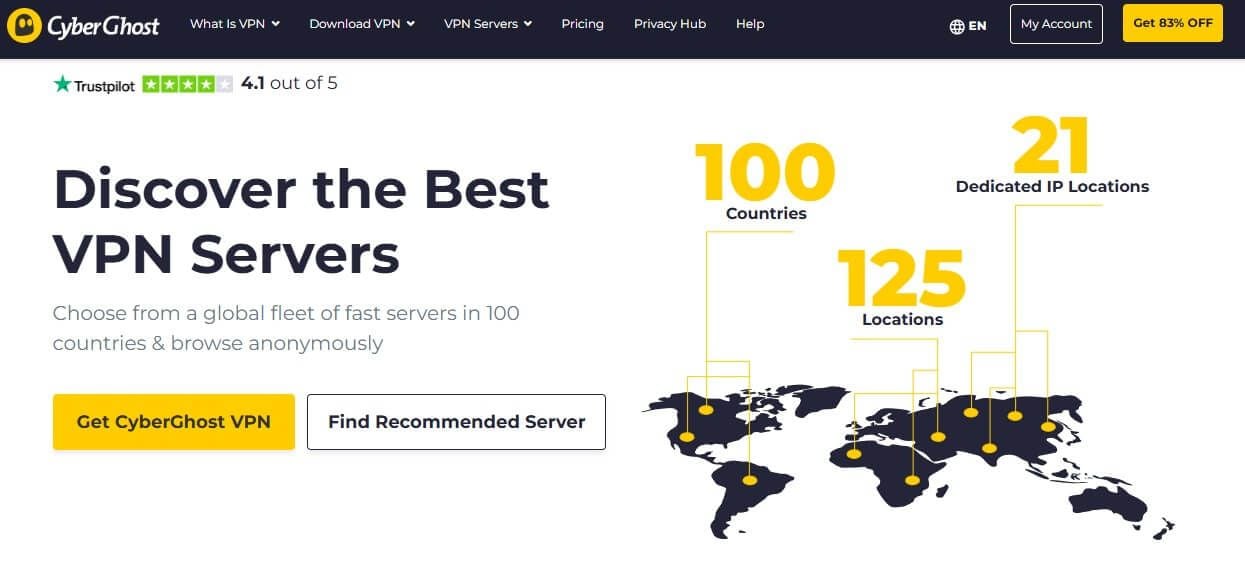
CyberGhost is, next to Private Internet Access, the largest provider on the planet. It comes with a whopping 12,000 servers in 100 countries, making it easy to find a server that isn’t overcrowded for the best performance. We also mentioned dedicated streaming and torrenting servers, which add to the variety.
In addition, there are NoSpy servers for maximizing your privacy, but the provider offers even Dedicated IP servers, with some of the lowest-priced dedicated IP addresses around. Regarding dedicated IP servers, you get 20+ locations. They include the US, the Netherlands, the UK, Singapore, and others.
Even better, CyberGhost has multiple locations in pretty much all of these countries. Aside from using a shared IP, you can get your own dedicated IP and enjoy its numerous benefits. The server distribution of CyberGhost is also something to behold. You get servers in each part of the globe.
There’s a stellar combination of physical and virtual servers. The provider has servers even in Africa, which some VPNs lack. In the US alone, it has over 1,500 servers, and European users get nearly 900 servers in the UK, so we have some pretty impressive numbers.
ExpressVPN (3,000 servers in 105 countries)

In this CyberGhost vs ExpressVPN comparison, the latter offers a significantly smaller server fleet. 3,000+ servers in 105 countries sure sound impressive, but when you have a juggernaut like CyberGhost, it pales in comparison in server numbers alone. This provider has dedicated IP addresses in more locations, but they’re pricier.
We already learned that its servers are versatile. The good thing is the server distribution. The provider has five more countries compared to its rival, and you get 160+ worldwide locations in total. In the US, it has 20+ locations, and you get tons of them in the UK, Germany, Australia, Canada, and other notable countries.
Much like CyberGhost, ExpressVPN uses some virtual servers as well since it’s impossible to have a physical infrastructure in every country. Thus, you’ll find virtual servers in India, for example. Unlike CyberGhost, this VPN doesn’t clearly state which server locations are virtual, and we don’t like that.
Important to mention is that both providers use 10 Gbps servers for the best performance, and since they’re based on RAM, they all provide the highest degree of privacy.
Outcome: CyberGhost Wins 🥇
CyberGhost’s larger server fleet makes it the winner of this round. ExpressVPN’s server fleet is far from small, and it offers ample dedicated IPs. However, CyberGhost also offers them, but with a greater server variety, number, and distribution.
Customer Support: CyberGhost vs ExpressVPN
Customer support isn’t vital when everything’s working fine and you’re enjoying the VPN. But as soon as things go south, you need someone to be your helping hand as soon as possible. First of all, these two providers rarely have any issues. We have used both for more than a decade and confidently say that.
Still, customer support of both providers in this CyberGhost vs ExpressVPN duel was on point. They offer 24/7 support through live chat with instant responses and, in the case of CyberGhost, in multiple languages (English, German, and French). We found both support teams to be very helpful.
Even their email support is surprisingly quick. After sending an email, we rarely had to wait for more than 15 minutes to get a response, even after sending an email at midnight on Sunday. Not to mention a help center that both VPNs have. There, you’ll find answers to all VPN-related questions, step-by-step guides, and more.
Outcome: Tie 🟰
This part of the comparison is a tie because both providers have exceptional support through live chat and email. Coupled with other support means like help centers and FAQs, these providers won’t disappoint you.
CyberGhost vs ExpressVPN Pricing Comparison
As we approach the end of our ExpressVPN vs CyberGhost duel, it’s time to talk about how much they cost. Here, we’ll have one clear winner, but let’s see which provider takes the throne, starting with CyberGhost.
CyberGhost

As you can see, the cheapest plan costs a bit over $2 a month, and at the time of writing this comparison, it’s a 2-year plan with two free months. Keep in mind that this is a current discount, and the selection of plans might change, but this provider usually won’t cost you more than $2.50 a month.
What’s more, the provider has a 45-day money-back guarantee, which we praised in my test and review of CyberGhost VPN. The monthly plan has a 14-day refund period, though, which isn’t bad and still lets you test this provider thoroughly. Another thing that might interest you is the optional security package.
For example, you can buy the Security Suite for Windows for $1 monthly, letting you use Antivirus and Security Updater. Even if you add this feature and buy a dedicated IP at $2.50 monthly, the price of this service won’t go up that much.
Either way, you get several payment methods here, which include credit/debit cards, PayPal, and Bitcoin, letting you purchase it anonymously. Do you think ExpressVPN will be cheaper? Let’s see.
ExpressVPN

This provider’s cheapest plan is the biennial Basic plan at 73% off and four free months for $3.49 monthly. You can also go for Advanced at $4.49. You get a 30-day money-back guarantee for all subscription plans, which is a great choice if you want to use ExpressVPN for free for 30 days.
ExpressVPN offers annual plans that CyberGhost doesn’t have. The Basic plan starts at only $4.99 monthly with three free months. You can see the rest below. Generally speaking, this VPN isn’t as expensive as it used to be. Remember that its previous cheapest price was for the annual plan, at $6.67 monthly.

Nowadays, ExpressVPN is much closer to NordVPN, but still pricier. So, while ExpressVPN is much cheaper, it still can’t get close to CyberGhost. This applies to both introductory and renewal offers.
Outcome: CyberGhost Wins 🥇
The final round goes to CyberGhost, an ultimately less expensive VPN. CyberGhost costs less, but as seen, it provides less, so it’s a fair exchange. Either way, if you seek the most cost-effective option, CyberGhost is excellent, and its price ideally aligns with what it offers.
Conclusion: ExpressVPN Wins!
At the end of our ExpressVPN vs CyberGhost comparison for 2026, it’s clear that the former is a better option. During our assessment, we couldn’t help but think about how much the red team was better. ExpressVPN’s overall performance is more convincing, especially its VPN speeds and streaming prowess.
However, the VPN also didn’t disappoint in compatibility, simultaneous connections, ease of use, and bypassing censorship. CyberGhost has its merits. It’s on par security- and privacy-wise, nearly as fast, decent for streaming, and with award-winning, multilingual customer support available 24/7.
CyberGhost is naturally cheaper, so by saving money and getting it, you’ll get less. Pay more and get more from ExpressVPN. The math is clear here, which makes it even easier to declare the overall winner. While CyberGhost is the best cheap VPN, ExpressVPN is the best overall VPN service and, by extension, our preferred pick.