AI tools like ChatGPT, Google AI Mode, and Perplexity have changed the way people find brands, products, and information online. Traditional SEO tools can’t tell you how you perform on these platforms. They track Google rankings, but they don’t show you whether AI tools are mentioning your brand, citing your content, or recommending your products.
That’s the gap the Semrush AI Visibility Toolkit addresses. In this review, we’ll cover what the toolkit includes, how each tool works, and whether it’s worth the investment for your business.
01net may earn a commission when a purchase is made via affiliate links.
What Is the Semrush AI Visibility Toolkit?
The Semrush AI Visibility Toolkit is a suite of tools designed to track, analyze, and improve your brand’s visibility across AI-powered search platforms like ChatGPT, Google AI Mode, Gemini, and Perplexity.
The toolkit monitors over 158 million relevant prompts globally and tracks when and how your brand appears in AI-generated responses. You can see your share of voice compared to competitors, analyze sentiment in brand mentions, and identify specific prompts where rivals appear but you don’t.
Unlike traditional SEO tools that focus on keyword rankings, the AI Visibility Toolkit shows you:
- How often AI platforms mention your brand
- Which prompts trigger brand mentions
- What sentiment AI tools express about your brand
- Which competitors dominate AI responses in your space
- Where content gaps exist that you can fill
Discover the AI Visibility Toolkit
Why This Matters
AI adoption is accelerating faster than most marketing teams realize.
ChatGPT now has 800 million weekly active users. And data from Semrush suggests that traffic from large language models (LLMs), the technology behind AI search tools, will overtake traffic from organic search in 2028.
This shift fundamentally changes where purchase decisions happen.
Someone researching project management software might ask ChatGPT “what’s the best project management tool for small teams with a budget of $200 per month” instead of Googling “best project management tools.”
A potential customer might use Perplexity to compare your product against competitors right within the AI search results, rather than visiting multiple review sites before visiting your pricing page.
If your brand doesn’t appear in these AI responses, you’re invisible during critical moments in the buyer’s journey—even if your “traditional” SEO efforts have been top notch.
The challenge is that AI visibility works differently than traditional search in several key ways:
- Speed of change: Changes in AI visibility can happen in days, not the months usually required for traditional SEO. Semrush tested the toolkit on their own brand and increased their AI share of voice from 13% to 32% in just one month.
- Competitive dynamics: Your AI competitors may differ from your search competitors. A brand with mediocre Google rankings can dominate AI responses if their content structure resonates with LLM training data.
- Context matters: It’s not just about being mentioned, it’s about being mentioned in the right context. How these AI tools talk about your brand can massively impact your conversion potential.
Who Should Use This Toolkit?
The Semrush AI Visibility Toolkit makes sense for:
- Brand managers and CMOs who need to understand how AI platforms portray their brand and measure visibility across all search surfaces,not just Google
- Content strategists creating content that needs to reach audiences wherever they’re searching, whether that’s traditional search engines or conversational AI tools
- Marketing teams at companies where AI recommendations directly impact revenue. If potential customers are asking ChatGPT or Perplexity for product recommendations in your category, you need to know if your brand appears (and how it’s presented in AI responses).
Next, we’ll go through the tools you get with the Semrush AI Visibility Toolkit, and how you can use them to understand and improve your own visibility.
AI Analysis Tools
The AI Visibility Toolkit includes several tools organized around three main objectives:
- Analyzing brands, competitors, and prompts
- Understanding your AI brand performance at a deep level
- Tracking your performance in AI search
Here’s what each tool does and how to use it.
Discover the AI Visibility Toolkit
Visibility Overview
The Visibility Overview lets you instantly understand any brand’s presence in AI tools. It aggregates important AI visibility metrics into a single view, including:
- AI Visibility Score: A 0-100 rating that measures a brand’s overall presence across AI platforms, factoring in mention frequency, topic coverage, and competitive positioning
- Monthly Audience: The total search volume of all topics where your brand is mentioned
- Mentions: The total number of prompts that trigger AI responses that mention your brand
- Cited Pages: How many of your website’s pages are cited in AI-generated answers
You can analyze brands across multiple platforms, including ChatGPT, Google AI Mode, and AI Overviews. Or you can analyze the brand’s presence across all of them at once.
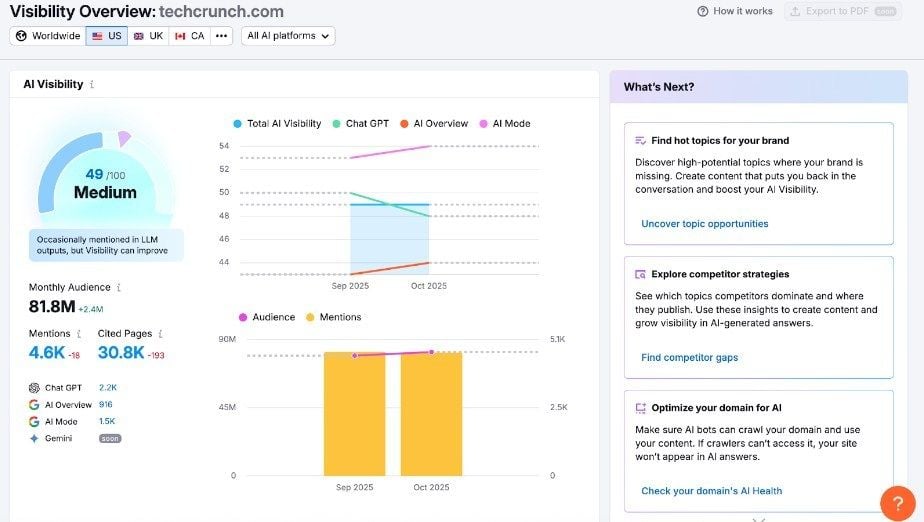
The dashboard also includes a “Topics & Sources” section that shows you:
- Your Performing Topics: Topics where your brand is already mentioned by AI tools
- Topic Opportunities: Topics where your competitors are mentioned, but your brand is missing
- Cited Sources: Domains that LLMs reference in their answers
- Source Opportunities: Sources where your competitors are cited, but your brand is missing
- Cited Pages: The pages on your website that AI tools cite in their answers
One of the most useful of these views is the “Topic Opportunities” tab. It shows where your competitors appear but you don’t. This is where you find content gaps.
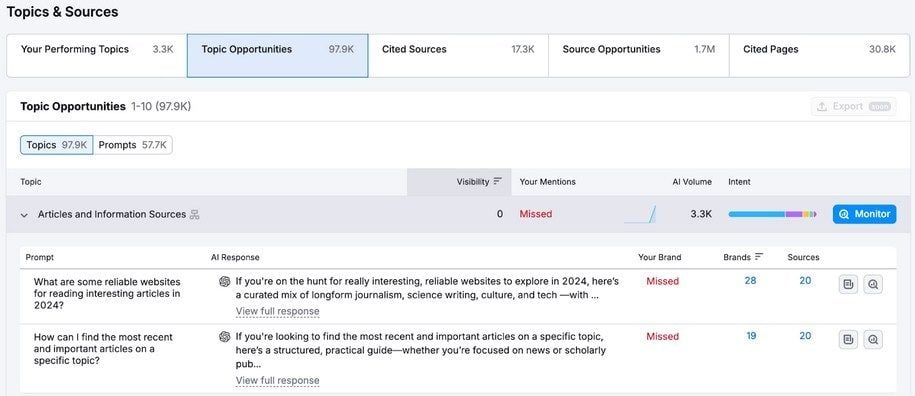
If your rivals all get mentioned in relevant prompts but you don’t, that’s a specific problem you need to address.
Why?
Because, if your competitors appear for the prompt, there’s a good chance you can too. But if you’re not yet appearing for it, it’s a missed opportunity to gain share of voice and appear in front of your target audience.
Check the AI Visibility of your website
So, focus on the prompts and topics in the “Topic Opportunities” tab first.
But another way to use this tool is to enter your competitor’s domain instead of your own. Then head to the “Cited Pages” tab to see all the pages on their site that AI tools are citing in their responses.
Clicking into any of the pages will show you the prompts they appear for. This can help you understand:
- Which pages on your rivals’ sites the AI tools find useful enough to cite
- Which prompts they’re citing your competitors for
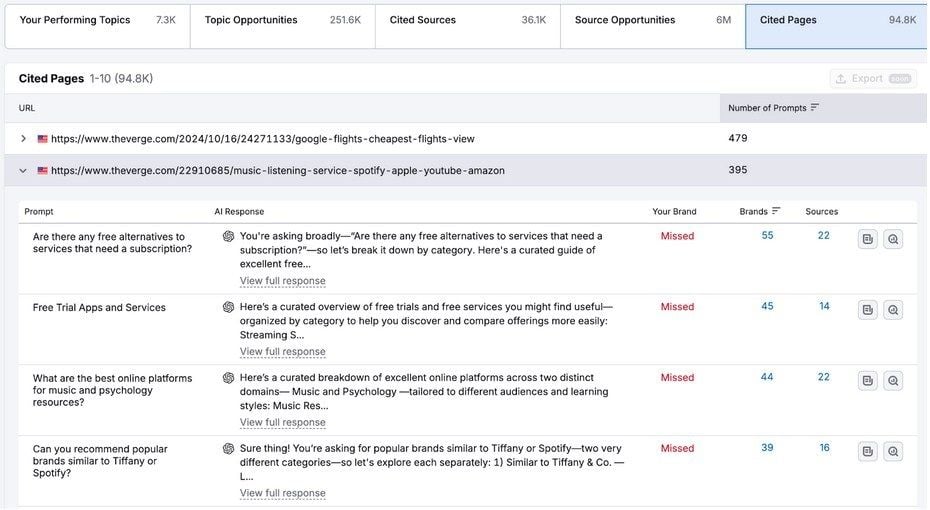
You can then analyze these pages to see what you can apply to your own site to improve your AI visibility.
Competitor Research
The Competitor Research dashboard lets you track up to four competitors simultaneously and see exactly how their AI visibility compares to yours.
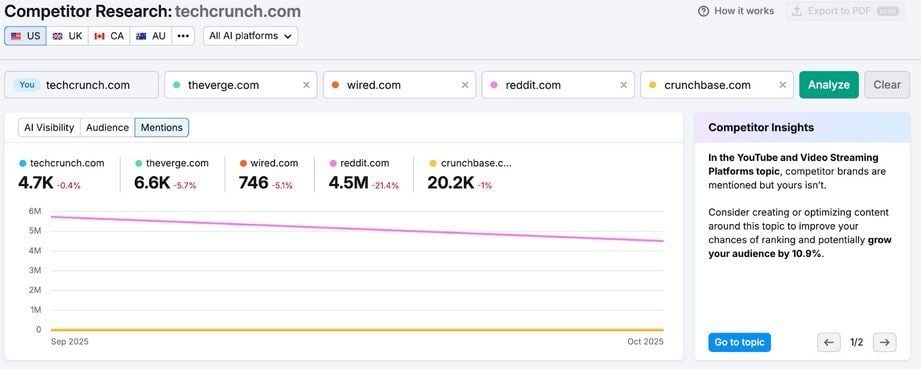
You enter competitor domains and the tool shows:
- Total mentions for each competitor across ChatGPT, Gemini, Perplexity, and Google AI Mode
- Which topics each competitor dominates
- Overlap in mentions (where you and competitors both appear)
But arguably the most valuable feature is the “Missing” tab. It gives you a list of specific prompts that trigger competitor mentions, but that your brand doesn’t appear for.
In other words: it shows you visibility gaps.
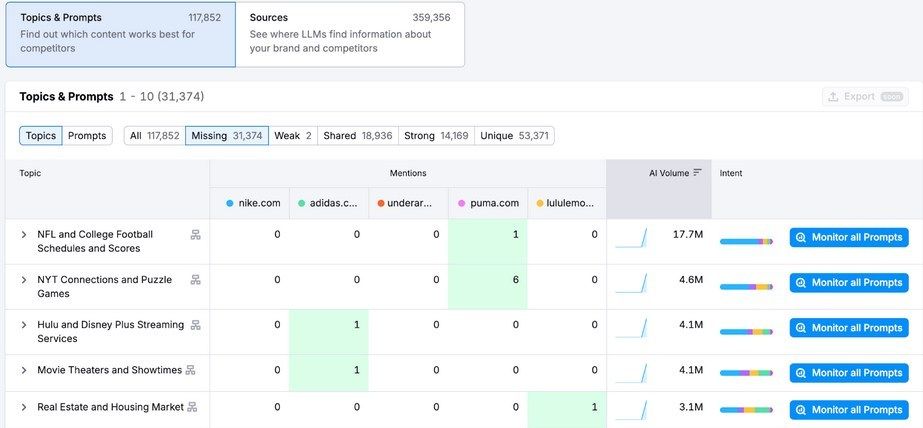
For example, if three competitors appear in response to “best email marketing tools for ecommerce” and you don’t, you know that’s a prompt you need to optimize your content and messaging for.
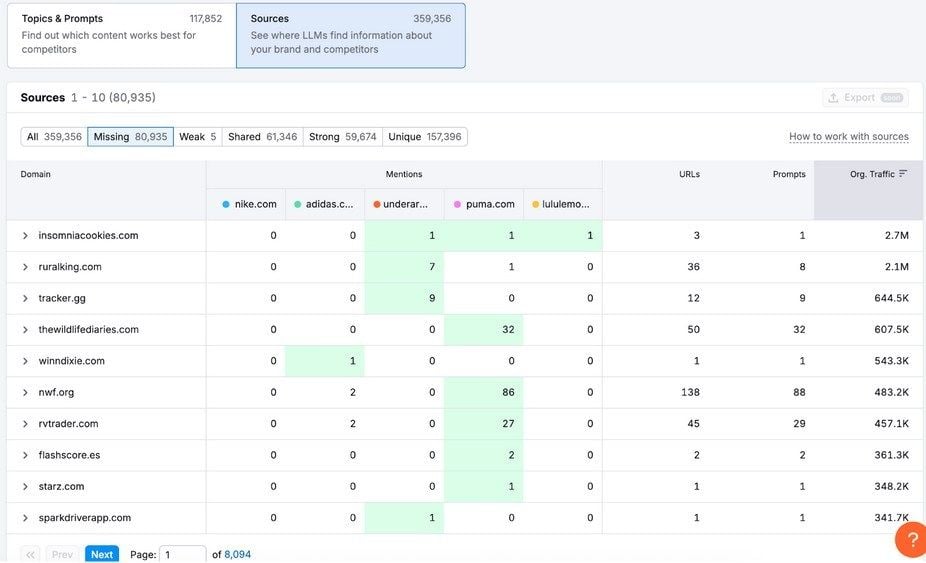
The tool also lets you perform a similar analysis but for sources. This gives you two useful types of insights:
- Which websites AI platforms cite: If your rivals are getting mentioned consistently by the same sites, these are sources you should also aim to get mentioned on
- The types of content the tools cite: If competitors consistently get cited from case study pages or comparison articles, that tells you that those content formats work
Prompt Research
The Prompt Research tool lets you search by keyword or topic to see:
- How often users ask questions related to your industry
- The split of the intent (goal) of those questions
- Top brands mentioned in responses to those prompts
- Authoritative sources that LLMs cite most frequently
You can click into the topics to see specific prompts people are asking AI tools. You’ll see the overall estimated AI search volume for each topic. For the specific prompts, you’ll also see the full response from the AI tool, how many brands were mentioned, and how many sources were cited.
By analyzing these prompts and responses, you can start to understand why certain brands are mentioned. Then, use what you learn to inform your own content and messaging to hopefully boost your AI visibility.
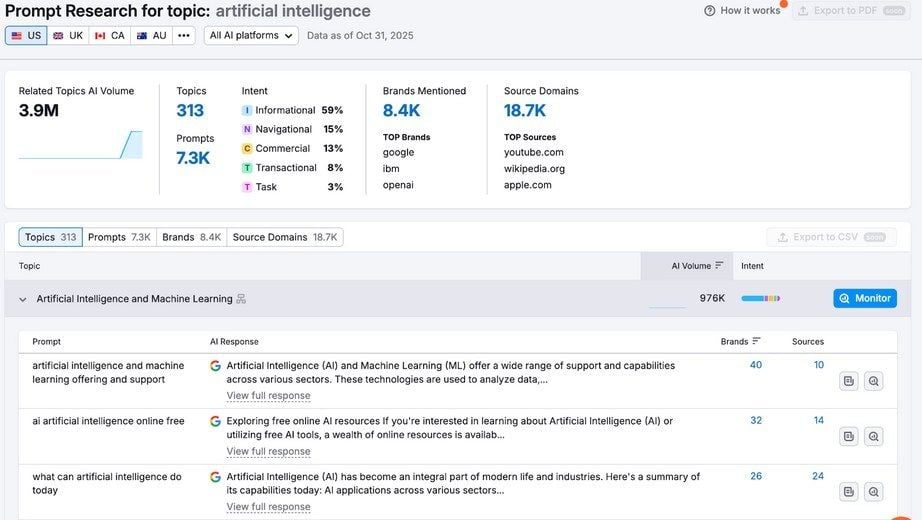
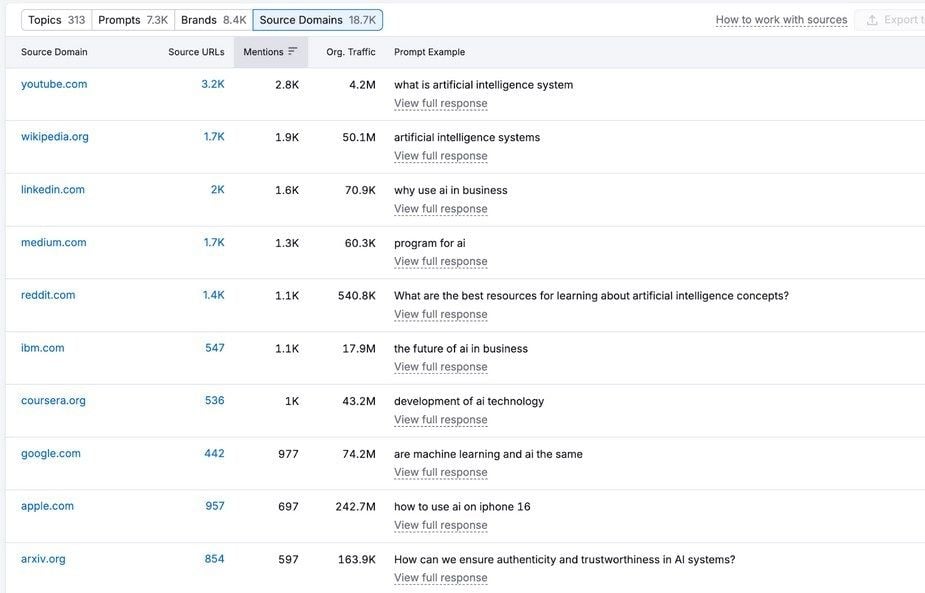
The “Source Domains” data is particularly useful. It reveals which websites AI platforms trust, indicating where to focus your link building and content distribution efforts. If you can get featured or mentioned on these source websites, you may be able to boost your own AI visibility as a result.
Brand Performance Tools
Once you understand where you appear, use the brand performance tools to help you analyze how AI platforms portray your brand.
Brand Performance
The Brand Performance dashboard gives you insights into how often your brand is mentioned and in what context.
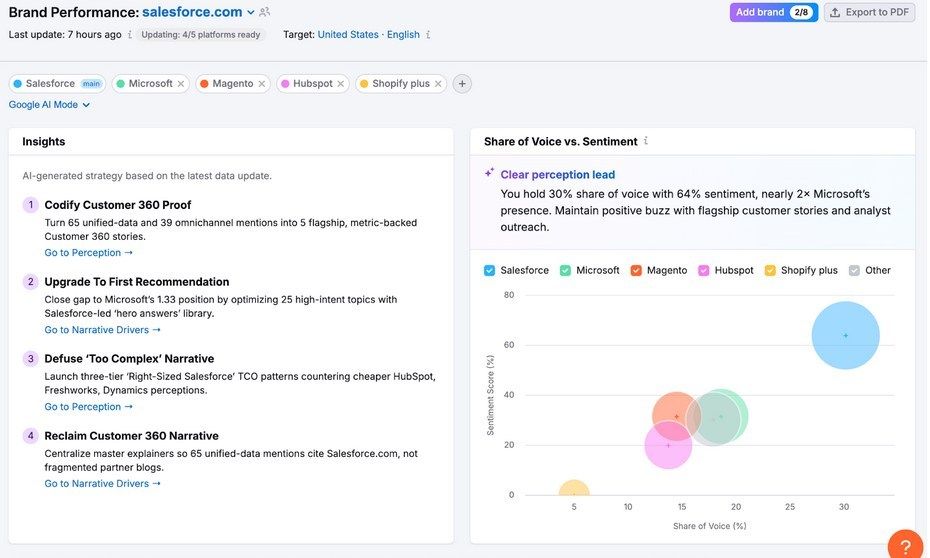
The tool tracks two critical metrics:
- Share of Voice: How often and how prominently your brand appears in AI responses
- Sentiment: The tool categorizes mentions as positive, negative, or neutral
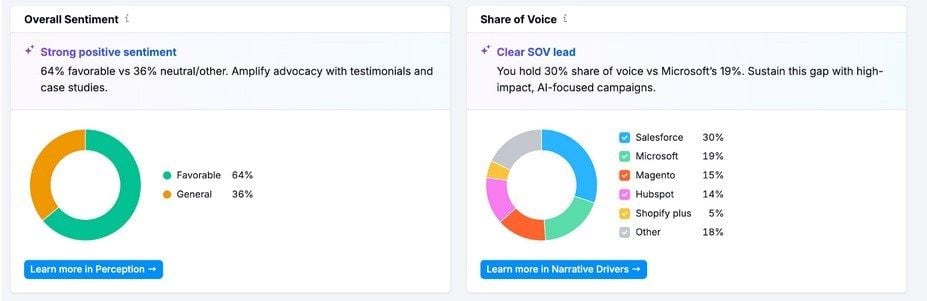
Sentiment matters because appearing in AI responses isn’t enough on its own. You need to be appearing in the right places for the right prompts, and in the right ways.
If ChatGPT mentions your brand primarily in negative contexts (e.g., expensive, complicated, poor customer service), and that’s where your target audience asks a lot of high-intent questions, those mentions will hurt more than help.
The tool also shows Key Business Drivers. These are factors that can influence your buyers’ decisions, and the tool measures how often your brand is mentioned in the context of these factors.
For an SEO tool, these factors might include mentions in the context of keyword research, competitor analysis, and backlink tracking. For a CRM, it might be pipeline management, contact organization, and email integration.
Using Salesforce as an example, you can see in the screenshot below that they’re mentioned more often than their rivals for prompts related to “unified customer data” and “integrated CRM ecosystem.”
But their rivals are mentioned more often in the context of “omnichannel commerce self service” and “partner channel enablement.”
These are factors Salesforce might want to address with their content or messaging.
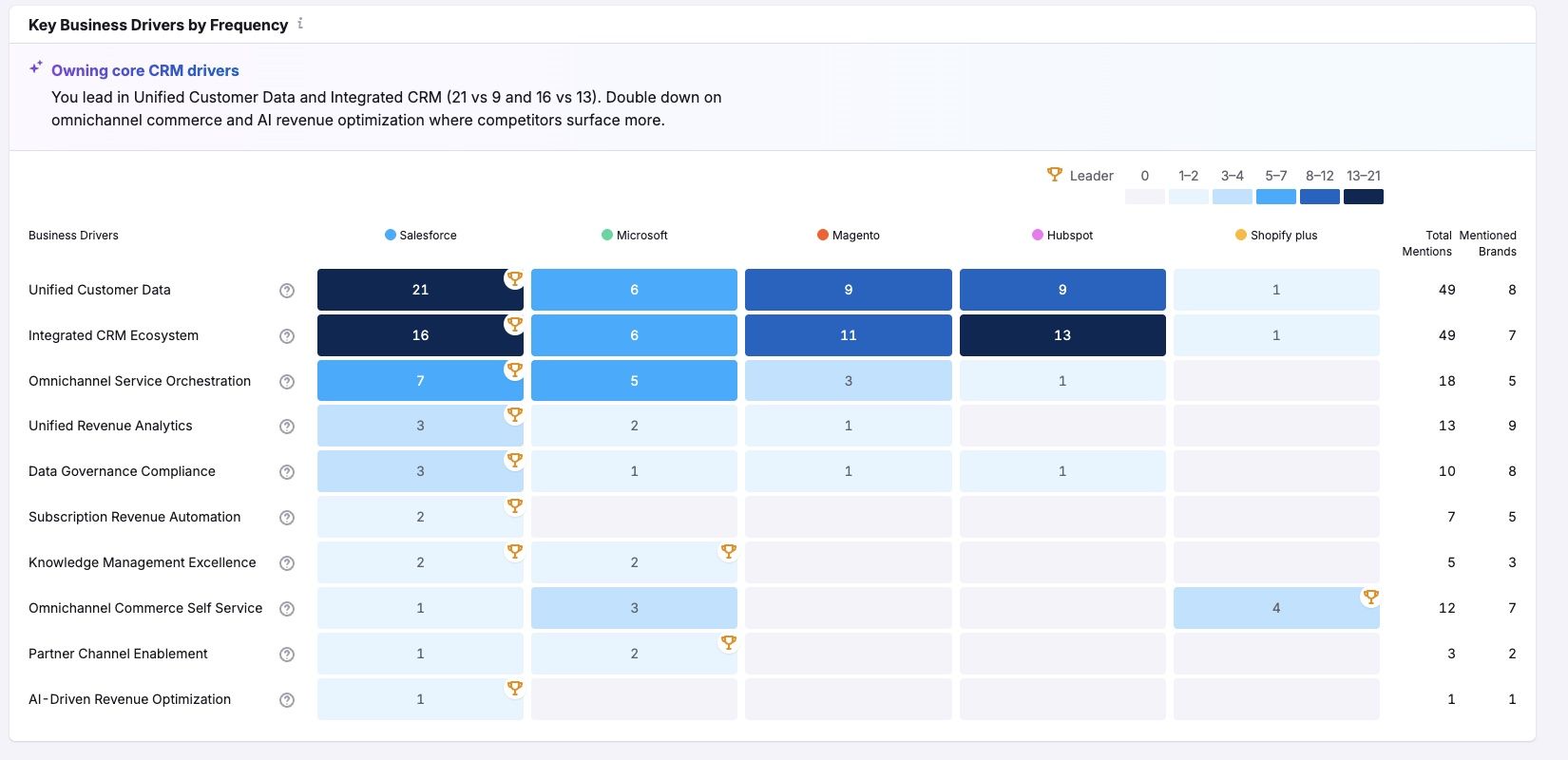
Business Drivers help you understand what AI platforms associate with your brand. If you want to be known for a specific capability but it doesn’t show up in your top drivers, your content isn’t communicating that positioning effectively, and you need to update it.
Perception
The Perception dashboard breaks down sentiment data further into actionable insights for your brand.
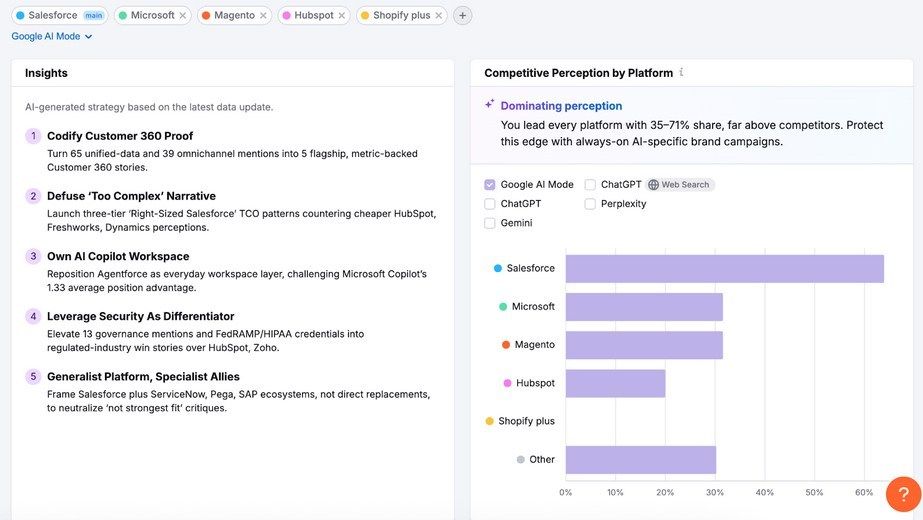
You can see a breakdown of your overall sentiment (whether it’s favorable or general). Next to that you’ll see a chart of your brand versus your competitors in terms of positive sentiment over time. This is useful for understanding how your brand is being portrayed by AI tools compared to your rivals.
In the example below, you can see Salesforce has maintained positive sentiment over time, while competitors like Microsoft and HubSpot have seen their sentiment rise and fall.
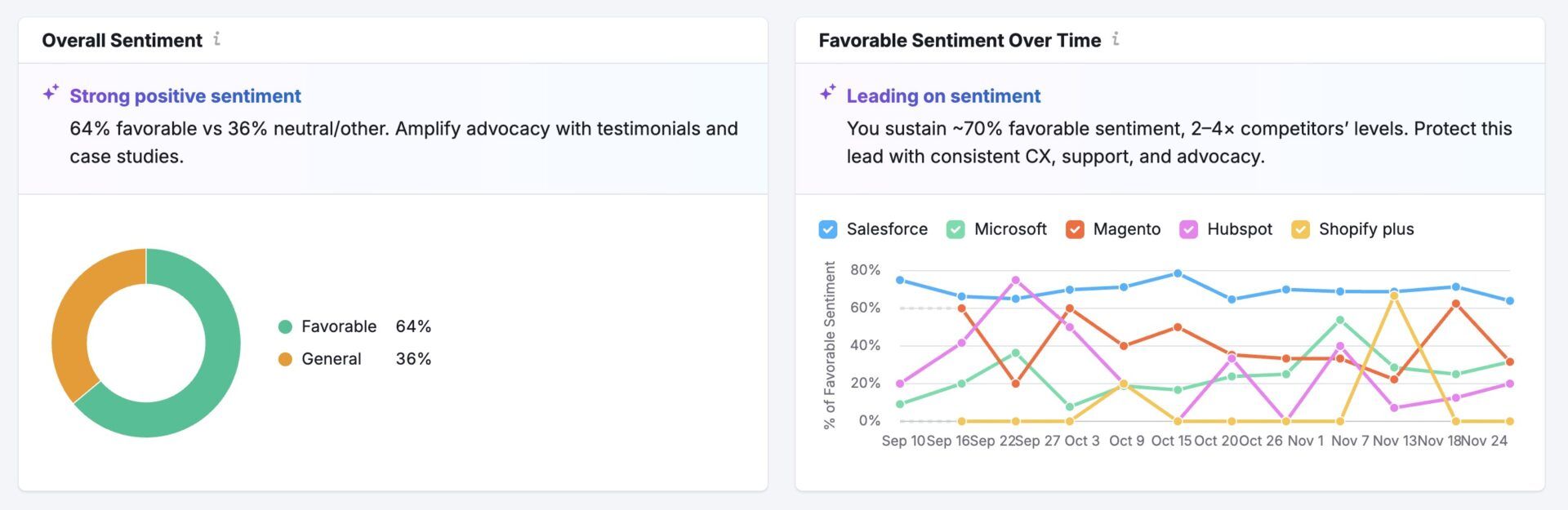
Below these charts, you’ll see a table with two lists:
- Brand Strength Factors: The positive attributes AI platforms associate with your brand. These are your competitive advantages in AI responses.
- Areas for Improvement: The negative attributes that appear in AI responses. This might include price concerns, usability issues, or missing features. Some of these require product changes, while others just need better or updated content to counter misconceptions.
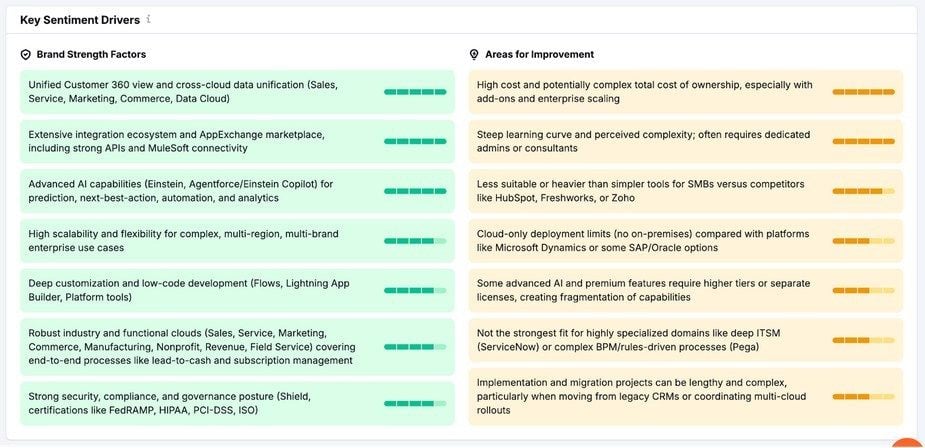
This data is super helpful for going beyond just improving your content (like traditional SEO tools can help with). Instead, you get data you can use to inform real business decisions, including those that affect your products and wider marketing efforts, decisions that can drive real business growth.
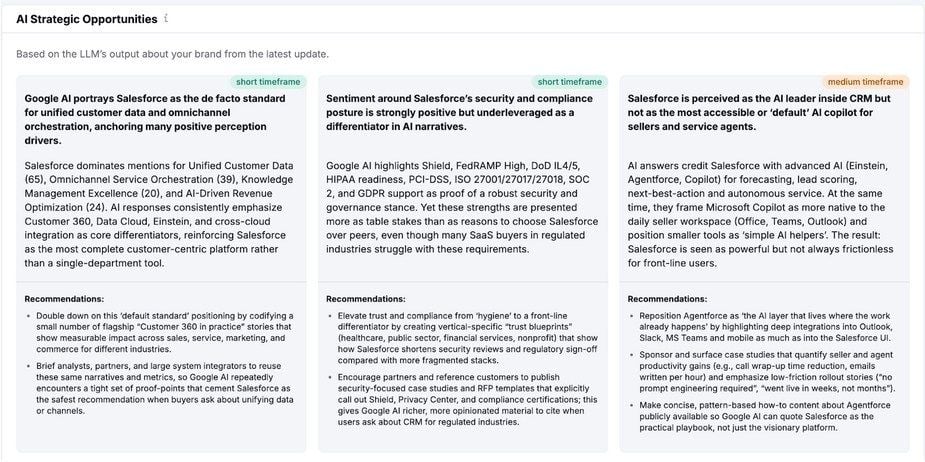
Plus, at the bottom of the page, you’ll see “AI Strategic Opportunities” that explain key insights about how AI tools perceive and portray your brand. You’ll then also get recommendations (and an estimated timeframe) to improve your visibility with these insights in mind.
Narrative Drivers
The Narrative Drivers tab gives you even more information about where you’re showing up and where you’re not.
First, you’ll see some AI-powered insights to improve your visibility, along with a graph showing your share of voice across major AI platforms like Google AI Mode and ChatGPT.
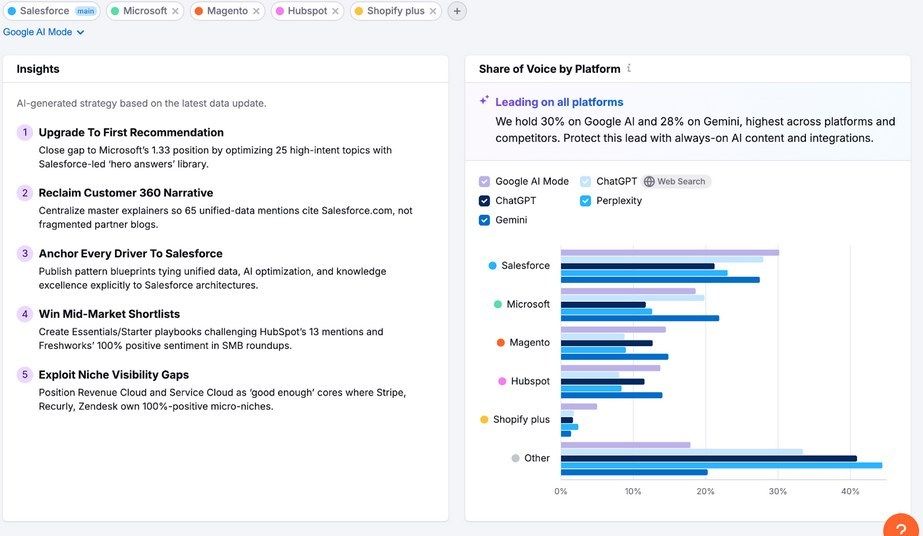
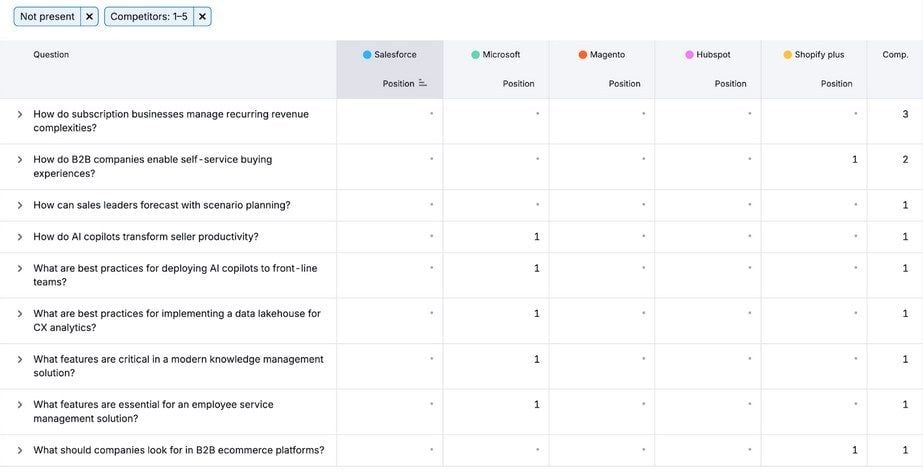
But further down, you’ll find another powerful tool for understanding where your rivals are showing up that you’re not. The “Breakdown by Question” section shows you all the questions you and your rivals appear for in your chosen AI tool.
But you can filter using the “Position” drop-down to show queries your brand is “Not present” for, and then choose a ranking position or range in the “Competitors” drop-down (e.g., 1-5). This will ensure you only see prompts that your rivals appear for that you don’t.
These are prompts you’ll want to create content for or optimize your existing content for to boost your chances of appearing for them.
Questions
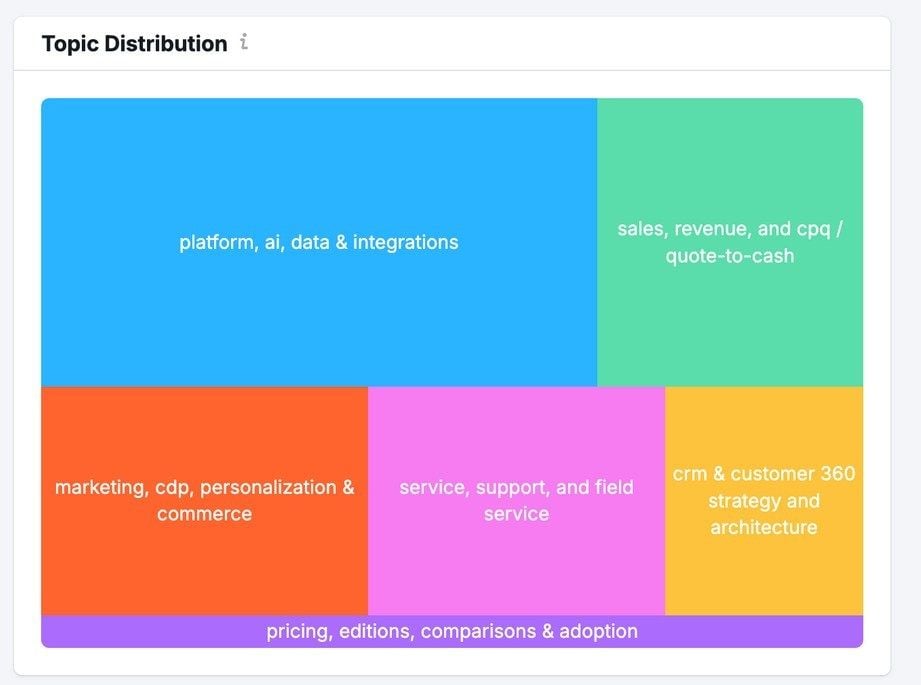
The Questions tab aggregates real user prompts grouped by theme and shows you which ones mention your brand. This is helpful for understanding what kinds of information, products, and services your target audience is looking for when they interact with AI tools.
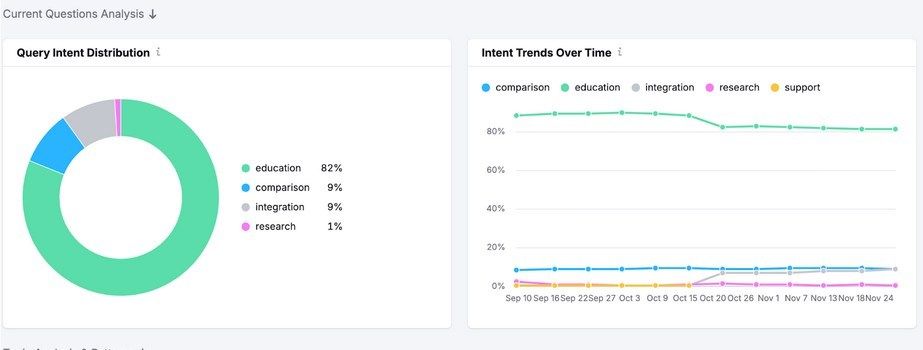
You’ll see a handy chart illustrating the distribution of the intent of your audience, along with how that intent has changed over time.
Further down, you’ll see examples of real user prompts grouped by query topic. This is useful as you don’t just see specific prompts (although that is useful). You also see what categories and topics you should be targeting with your AI visibility efforts.
This helps you move from individual prompt optimization to category-level strategy. Instead of trying to optimize for hundreds of specific questions, you can start by identifying the handful of thematic question groups that matter most. Then, create comprehensive content addressing each category.
Performance Tracking Tools
Beyond understanding your current AI visibility, the toolkit also includes two features that help you monitor ongoing performance and ensure your website remains accessible to AI platforms.
Site Audit
The Site Audit tool offers a specialized site health check that identifies technical issues preventing AI platforms from accessing your content.
The tool returns an AI Search Health score that summarizes your site’s readiness for AI platforms. This score considers:
- Crawler accessibility: These check whether AI bots can actually reach your pages. Some sites inadvertently block AI crawlers while allowing traditional search engines, creating an invisible barrier to AI visibility that they’re not aware of, since they still rank in Google.
- Structured data implementation: This check assesses whether you use schema markup that can help AI platforms understand your content. Proper structured data may make it easier for LLMs to extract and cite specific information.
- Llms.txt file presence: This emerging standard may help AI platforms understand your site structure and what content is most important. Note that it’s still unclear whether llms.txt files have any effect on AI visibility.
- Technical blockers: Issues like broken links and poor navigation setup might affect how AI platforms access and perceive the quality of your content.
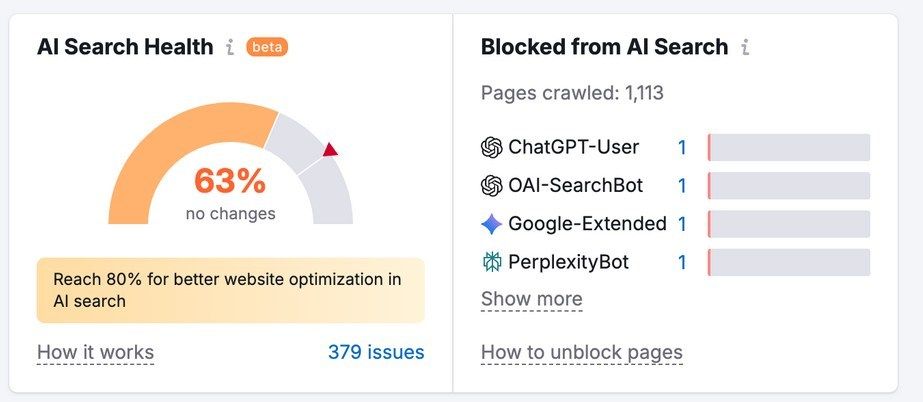
The audit checks whether eight different AI crawler bots can see your content:
- OpenAI crawlers: ChatGPT-User, OAI-SearchBot
- Google crawlers: Googlebot, Google-Extended (Gemini)
- Perplexity crawlers: Perplexity-User, PerplexityBot
- Anthropic crawlers: Claude-User, Claude-SearchBot
For each bot, the audit checks whether your robots.txt file blocks access to them. If AI crawlers can’t access your pages, your content won’t appear in their responses, regardless of how well you optimize it.
The audit also generates a prioritized list of errors that may be affecting your AI visibility, and you can click the “Why and how to fix it” button on any of them to learn how you can resolve the issue. This is super handy for website owners without much technical SEO experience.
Prompt Tracking
Prompt Tracking works like traditional rank tracking, but for AI search platforms. Instead of monitoring keyword positions in Google, you track how your brand performs for specific prompts in ChatGPT Search and Google AI Mode.
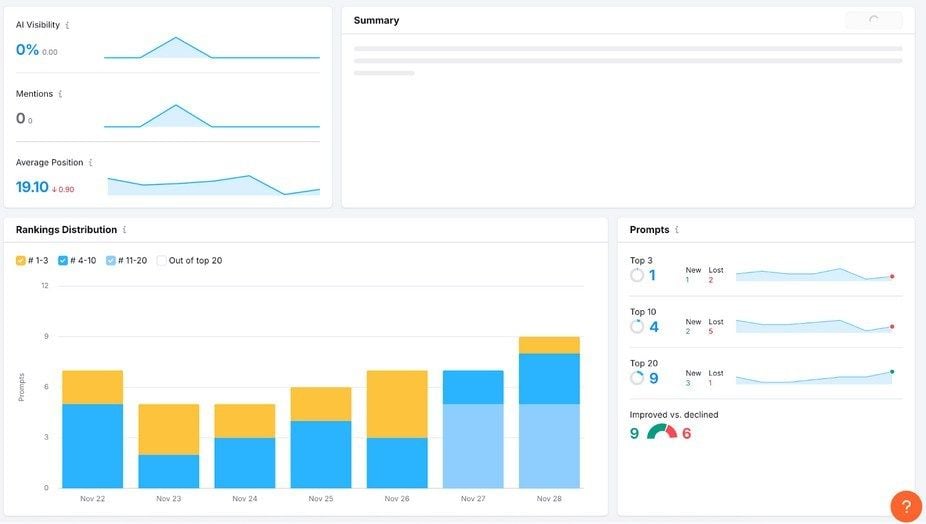
You select up to 25 prompts that matter most to your business and the tool monitors your visibility daily.
For each prompt, you see data like the topic volume, which is the estimated traffic the topic generates within the LLM you choose.
You’ll also see your ranking position, which indicates where your domain appears in the AI response. In ChatGPT Search, positions are ranked top to bottom in the citation area. In Google AI Mode, the response area itself counts as position 1, with citations numbered as positions 2, 3, and so on.
The interface mirrors Semrush’s traditional Position Tracking tool, making it familiar if you already use their SEO platform. You get daily updates on position changes, allowing you to respond quickly to visibility drops or capitalize on improvements.
AI Visibility Toolkit Pricing
The Semrush AI Visibility Toolkit is available in two forms: as a standalone subscription or bundled into Semrush One alongside their SEO tools.
Standalone Pricing: $99/Month/Domain
The individual AI Visibility Toolkit subscription gives you full access to all the tools we’ve discussed in this review. You can track your brand’s performance across ChatGPT, Google AI Mode, Gemini, and Perplexity; monitor your performance compared to your competitors; and access the complete prompt database.
Note: The per-domain payment structure means that if you manage multiple brands or clients, each one requires a separate subscription.
Bundled Pricing (Semrush One)
Semrush One combines the AI Visibility Toolkit with Semrush’s SEO Toolkit. You get keyword research, rank tracking, site audits, backlink analysis, and content optimization, alongside AI visibility tracking, in one subscription.
Check out all Semrush One plans
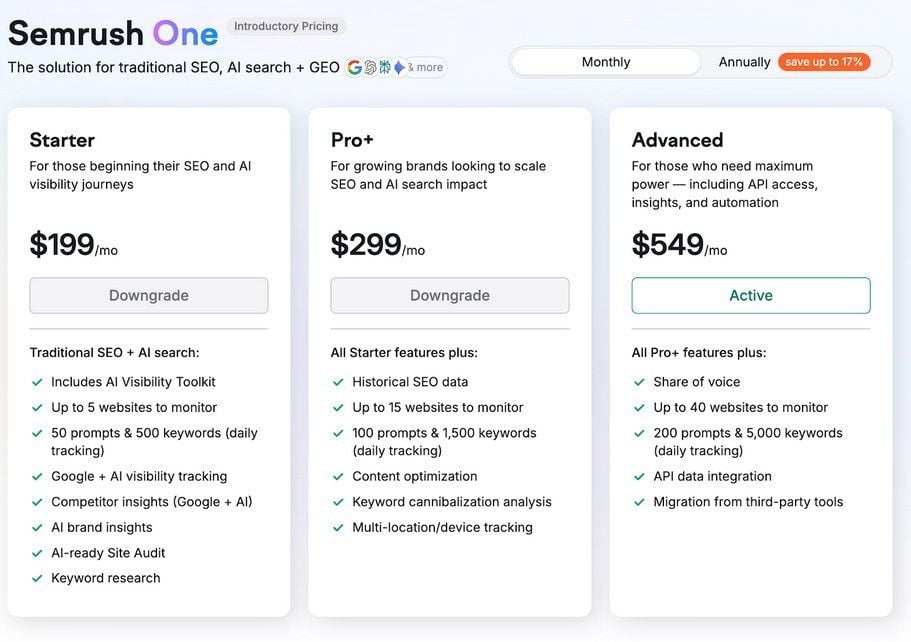
Three tiers are available:
Starter:
- $199/month (monthly billing) or $165.17/month (billed annually)
- 5 websites
- 50 AI prompts tracked
- 500 keywords for position tracking
- Basic AI visibility metrics
Pro+:
- $299/month (monthly billing) or $248.17/month (billed annually)
- 15 websites
- 100 AI prompts tracked
- 1,500 keywords for position tracking
- Historical data, content optimization tools, and cannibalization analysis
- Multi-location and multi-device tracking
Advanced:
- $549/month (monthly billing) or $455.67/month (billed annually)
- 40 websites
- 200 AI prompts tracked
- 5,000 keywords for position tracking
- API access and share of voice tracking
The Starter plan is best for individuals and small businesses. The Pro+ and Advanced plans suit larger businesses or those managing many client websites.
Boost Your Brand’s Presence with the AI Visibility Toolkit
Whether you appear in AI responses for prompts from your target audience is no longer a “nice to have.”
With AI tool use accelerating, and Google search results increasingly showing AI features like AI Overviews, AI optimization now needs to be part of your marketing strategy alongside SEO.
The Semrush AI Visibility Toolkit gives you the tools you need to monitor, understand, and improve your AI Visibility. Try it today!