Russia blocks the VPNs and the websites you’d use them to open. Roskomnadzor operates deep packet inspection hardware called TSPU inside every Russian ISP. By 2026, it had restricted 469 VPN services, and standard WireGuard and OpenVPN connections stopped passing the filters nationwide around the same time. A VPN without stealth technology will not connect here.
This is more aggressive than what you’ll meet in the UAE or most other censored countries, and it’s closing in on China. 4 VPNs for Russia still connect in September. Here’s how they compare, what each one uses to get through, and the setup rules that decide whether yours works.
Best VPN for Russia: Top 4 VPNs That Work in 2026
- Proton VPN: Best all-round VPN for Russia
- ExpressVPN: Easiest to run Russia VPN, obfuscation is automatic
- Surfshark: Cheapest VPN in Russia, with unlimited connections
- Private Internet Access: Most adjustable, with published config files
| Stealth Method | Servers / Countries | Devices | 2-Year Price | Russian Servers | |
|---|---|---|---|---|---|
| Proton VPN | Stealth, alternative routing | 20,000+ / 148 | 10 | $2.99/mo | 53 virtual, Moscow |
| ExpressVPN | Automatic obfuscation | 3,000+ / 113 | 10 to 14 | $2.99/mo | No |
| Surfshark | Camouflage, NoBorders | 4,500+ / 100 | Unlimited | $2.49/mo | No |
| Private Internet Access | Shadowsocks proxy | 26,000+ / 91 | Unlimited | $2.19/mo | No |
Read this before you buy. Reliability in Russia moves week to week as Roskomnadzor retunes its filtering. Treat any “this works” claim, including ours, as a snapshot and not a guarantee. Subscribe and install before you arrive, since Russian app stores have delisted the apps and the websites behind them frequently fail to load. Keep a second VPN installed as a fallback.
Compare the Best VPN for Russia: Top 4 Reviewed
1. Proton VPN: Best VPN in Russia Overall
Pros
- Highly resilient Stealth protocol
- Alternative routing reconnects promptly
- Swiss jurisdiction
- Virtual Russian VPN servers
- Low 2-year pricing
Cons
- Occasional speed drops
- Complicated app UI
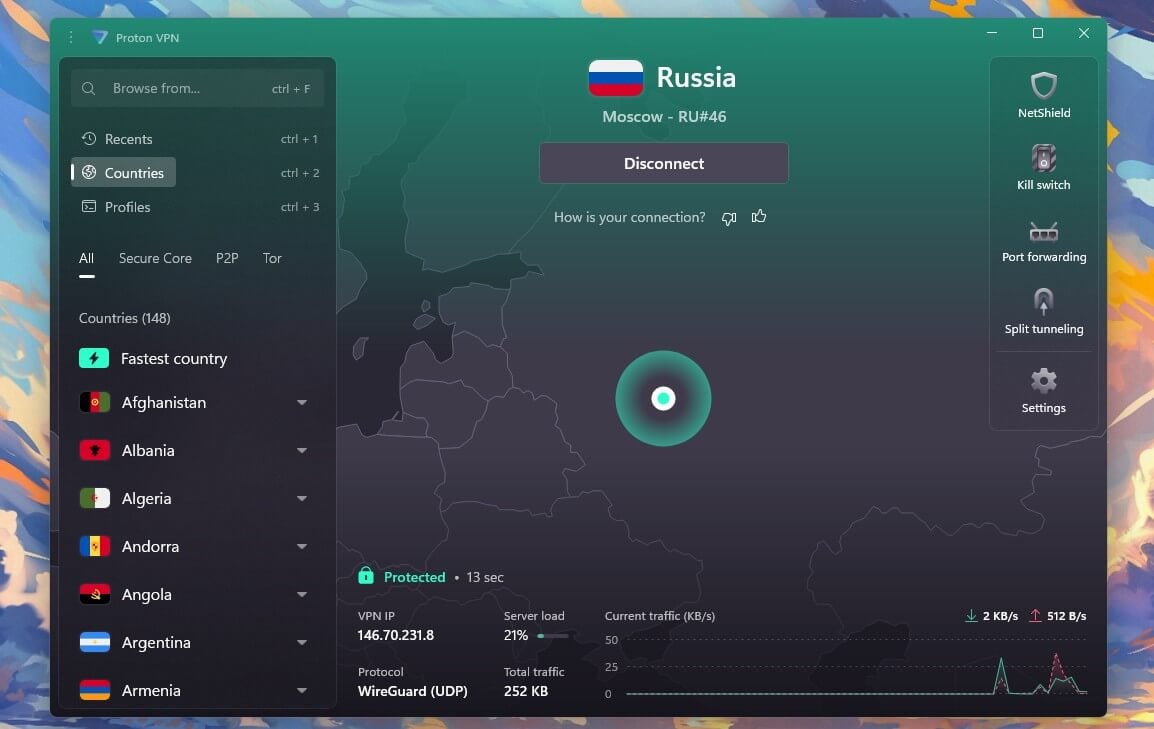
Proton VPN’s Stealth protocol tunnels traffic inside TLS so it reads as ordinary browsing. Independent testing of Russian conditions repeatedly places it among the most durable options available, alongside Mullvad. Alternative routing adds a second layer: when a path is blocked, the app reroutes instead of dropping. Switzerland is the structural advantage. Proton VPN operates outside the 5, 9, and 14 Eyes alliances under law with no data retention requirement, and its apps are open source and audited.
That distinction becomes important once the traffic is sensitive. The network is the largest here at 20,000+ servers in 148 countries, including 53 virtual Moscow locations that open domestic services from abroad. Secure Core sends you through a Proton-owned server before your exit point, and Tor over VPN is built in. You get 10 devices, NetShield for ads and malware, and port forwarding for torrents. The 2-year plan costs $2.99/mo, and every tier is refundable within 30 days.
2. ExpressVPN: Fast VPN Working in Russia

Pros
- Obfuscation is automatic
- Fast Lightway Turbo protocol
- Post-quantum protection by default
- Several no-log policy audits
- Up to 14 devices
Cons
- Expensive on renewal
- No server chaining
- No Russian servers
ExpressVPN applies obfuscation to every server without you touching a setting. There’s no toggle to find and nothing to get wrong, which counts when you’re troubleshooting a dead connection in an unfamiliar country. Lightway, its proprietary protocol rebuilt in Rust, is the fastest here and applies post-quantum protection by default. Server coverage extends to 214 locations. It’s reliable enough for streaming that Netflix US works from Russia without fuss.
Security covers AES-256, a kill switch, IPv6 leak protection, split tunneling, and RAM-only infrastructure. Independent auditors have checked its no-logs policy several times, KPMG included in 2025. Support is staffed 24/7, and the site has an onion address usable over Tor if the main domain is blocked. You get up to 14 connections, 80% off the 2-year plan plus 4 free months at $2.99/mo, and a 30-day guarantee.
3. Surfshark: Cheapest VPN That Works in Russia

Pros
- Unlimited simultaneous connections
- Lowest price here
- Camouflage mode and NoBorders
- Periodic IP rotation
Cons
- Not very beginner-friendly
- Dearer on renewal
Surfshark handles Russia VPN connections with 2 settings. Camouflage mode is the obfuscation layer, and NoBorders detects a restricted network and reorders your server list toward the locations still responding. Both features are present on Android and iOS as well as desktop. Unlimited simultaneous connections are the standout, covering an entire household on one subscription, and every plan includes it.
Its MultiHop chains 2 servers, and an IP Rotator cycles your IP address periodically to stay ahead of blocklists. Security includes AES-256, split tunneling, WireGuard, and a private DNS resolver, with a no-logs policy audited by Cure53 and Deloitte. Speed is the weak point against Proton VPN and ExpressVPN, and the kill switch has been inconsistent. The 2-year plan is the cheapest here at $2.49/mo, refundable for 30 days.
4. Private Internet Access: Most Adjustable VPN for Russia

Pros
- Shadowsocks obfuscation proxy
- Adjustable port and cipher
- OpenVPN config files published
- Subpoenas produced nothing
- Unlimited simultaneous connections
Cons
- Overwhelming for beginners
- Dated desktop interface
- US company registration
Pick PIA if you expect to troubleshoot. Shadowsocks goes in front of the tunnel as the obfuscation layer, and almost everything else is adjustable: the port, the protocol, and the encryption strength. Roskomnadzor filters protocols one at a time. Switching from WireGuard to OpenVPN on a different port is often the whole fix, and PIA lets you do it without leaving the app.
It also publishes OpenVPN configuration files, which keep the connection available when the app itself can’t be installed from a Russian store. Romania and Latvia are the closest useful exits. You can place a proxy in front of the VPN server; there’s no device limit, and subpoenas aimed at PIA have produced no usable records. The 2-year plan costs $2.19/mo, refundable for 30 days like the rest.
Why Use a VPN in Russia: Legitimate Reasons
- Censorship. Over 500 sites are unreachable, including X, TikTok, Instagram, Facebook, BBC News, and Euronews. A server abroad restores them. A VPN that already works in China is usually your best bet, since the filtering approach is similar.
- ISP visibility. Russian ISPs operate under legal obligations to monitor and report. Encryption removes what they can see, and stealth hides the VPN’s presence.
- Restricted content. Streaming platforms, betting sites, and foreign TV are all geo-blocked. A US server opens Netflix US; a Russian IP address works in reverse for Russian channels abroad.
- Public WiFi. Cafe and hotel networks are rarely secured. AES-256 encryption makes intercepted traffic unreadable.
- Torrenting. Copyright enforcement is aggressive, and torrent swarms expose your IP address to every peer in them. A no-logs P2P VPN keeps your downloads off your ISP’s record.
A Note for Journalists and Activists
A VPN hides your traffic from your ISP and gets you past network blocks. It does not make you anonymous to a determined state adversary, and it will not protect you from device seizure, account compromise, or from a party that already knows who you are. If you’re publishing sensitive material from inside Russia, a VPN is one layer of several and not a solution on its own.
Every VPN has limits, and treating one as full protection for high-risk work is how people get caught. Seek proper operational security guidance from an organization that specializes in it.
Best VPN to Use in Russia: Selection Methodology
- Stealth technology. Non-negotiable. Plain WireGuard and OpenVPN stopped passing Russian filters, so any service without obfuscation was excluded immediately. CyberGhost provides none, which is why it doesn’t appear here.
- Audited no-logs policy. Only government-approved VPNs operate legally in Russia, and approval requires handing over user data. Every service here refuses that and has the audit to back it.
- Security fundamentals. AES-256, a working kill switch, and leak protection.
- Speed under obfuscation. Stealth costs bandwidth. All 4 stay usable with it enabled.
- Manual configuration support. When an app won’t install or connect, config files are the fallback. All 4 publish them.
Free VPN for Russia: Does It Connect?
Mostly no, though not for the reason usually given. Several free tiers do obfuscate. Windscribe offers Stealth and WStunnel, which wrap OpenVPN in TLS and in a WebSocket, and its own documentation names Russia as the use case. Proton VPN applies Stealth across its whole range, free accounts included. Hide.me tunnels over SoftEther. What free tiers lack is the capacity to keep any of it working.
We tested Proton VPN Free, Hide.me, Windscribe and others over a 10-day trip. Proton VPN Free was the only one that stayed up across a full session. The others connected and then dropped, the usual outcome of a small server pool: the same handful of free IP addresses are on Roskomnadzor’s lists within weeks, and nothing rotates behind them. Data caps of 5 or 10 GB run out before the month does, and speeds under an obfuscated protocol make video pointless.
The bigger risk is logging. Names like Hola and Urban VPN make their money from logging sessions and reselling what they capture. In a country where ISPs already report to authorities, that puts a record of your circumvention attempts on a third party’s server. Paid plans here start at $2.49 a month, and every one includes a 30-day money-back guarantee, so testing one costs nothing if it doesn’t connect in your city.
Is Using a VPN in Russia Legal?
VPNs occupy a gray area. They aren’t banned as such, but only government-approved services are permitted, and approval means complying with data requests. Services that refuse are blocked, which is why the working list keeps shrinking. None of the 4 here cooperate with Russian authorities, and each has an audited no-logs policy. That’s why they work, and also why they’re blocked.
We aren’t legal experts, and enforcement can change faster than any article. Read the current law before you rely on a VPN in Russia, and treat nothing here as legal advice.
Summary: What’s the Best VPN to Use in Russia?
The same search covers 2 different jobs. Opening the outside internet from inside Russia takes obfuscation, and all 4 here have it: Stealth on Proton VPN, automatic scrambling on ExpressVPN, Camouflage mode on Surfshark, Shadowsocks on PIA. Opening Russian services from abroad takes a Moscow endpoint, and Proton VPN is the only one that kept any.
Proton VPN covers both jobs, and that puts it first. Swiss jurisdiction with open-source apps makes it the choice for sensitive work too. ExpressVPN has nothing to configure. PIA expects you to change the port and the protocol yourself. Surfshark costs the least. All 4 include a 30-day money-back guarantee, so a service that stops connecting in your city costs you nothing.
Frequently Asked Questions
🪆 What's the best VPN for Russia servers?
Proton VPN. Its paid plans include Moscow endpoints, the only ones among these 4, and the hardware is physically outside Russia. That removes the seizure risk that emptied the country of VPN servers in the first place.
🔞 How to bypass internet censorship in Russia?
With obfuscation. Connect using Stealth on Proton VPN, Camouflage mode on Surfshark, or Shadowsocks on PIA, and the tunnel reads as ordinary HTTPS traffic. ExpressVPN applies the same disguise to every connection automatically.
✅ Which VPN works in Russia?
Proton VPN, ExpressVPN, Surfshark, and Private Internet Access. Each disguises its traffic so TSPU hardware reads it as normal browsing. Services lacking obfuscation, CyberGhost included, get fingerprinted and blocked within a filtering cycle.
🌐 What are the most secure VPNs for Russia?
Proton VPN and Private Internet Access. Proton VPN works from Switzerland with open-source, independently audited apps, so its no-logging claim can be verified by anybody who wants to read the code. Private Internet Access has faced subpoenas and produced no usable records.
🐌 Do obfuscated connections slow a VPN down in Russia?
Yes. Wrapping the tunnel in TLS adds overhead, and stealth modes typically cost a fifth of the download speed a plain protocol would deliver.
✈️ Should a VPN be installed before traveling to Russia?
Yes. Russian app stores delisted around 100 VPN apps, and the websites behind them often fail to load from inside the country. Subscribing and installing in advance avoids both problems, and a second service on the device covers the first one failing.