
Omegle closed on November 8, 2023, after 14 years, and it isn’t coming back. The domain still shows its founder’s farewell letter, and any site using the Omegle name today is a copy trading on the search traffic. What the closure didn’t do is end the demand for talking to strangers, which scattered across a dozen successors. A VPN does three jobs on the platforms that replaced it: it hides the IP address other users can see, it opens sites a network blocks, and it restores access when an address ends up on a blocklist.
Using a VPN on a Random Chat Site in 2026
- Subscribe to NordVPN and choose a plan.
- Install the app on the device you chat from.
- Open the app and sign in.
- Connect to a server in a country where the site operates normally.
- Open the chat site and start a session with your own IP address hidden.
Why Omegle Shut Down
Founder Leif K-Brooks took the site offline in November 2023 and published a long farewell on the homepage. His stated reason was cost: the financial and personal burden of fighting misuse had grown past what he could sustain. Behind that sat years of lawsuits over harm to minors and steady regulatory pressure in the US.
The lesson the successors absorbed is that anonymity with no moderation eventually collapses under its own weight. The current generation advertises AI screening, human review, and report tools that Omegle never ran.
Best Omegle Alternatives in 2026
Six platforms account for most of the traffic that left Omegle. They differ in format, in whether an account is required, and in how seriously moderation is taken.
| Platform | Best for | Account required | Format |
|---|---|---|---|
| Chatroulette | The closest thing to classic Omegle | No | Browser video |
| OmeTV | Phones, with built-in translation | No | App and browser |
| Emerald Chat | Interest matching and text-first chat | Yes | Text and video |
| CamSurf | A cleaner, lighter interface | No | Browser and app |
| Chatrandom | Room browsing and filters | No | Browser and app |
| Shagle | Gender and country filtering | No | Browser video |
Chatroulette is the one to open first, since it kept the format Omegle invented: press start, meet someone, press next. It says it applies real-time AI screening with 24-hour human review. Those are the company’s claims about its own system. OmeTV is the pick on a phone, with translation built in for conversations across languages. Emerald Chat matches on interests instead of pure chance, and the account requirement thins out the bot traffic.
CamSurf has operated since 2015 and keeps the interface uncluttered, with a country filter that makes it useful for language practice. Chatrandom is closer to a set of rooms than a roulette. Shagle skews to an older crowd and leans adult, so it’s the one to avoid if that isn’t what you’re after. Every service here sets a minimum age of 18, and none of them is risk-free.
What a VPN Does on a Random Chat Site
Video chat connects your device directly to the other person’s, which means the stranger on the other end can read your IP address. That’s the same weakness Omegle had, and the successors inherited it. A VPN replaces your IP address with the server’s, so what the other user sees points to a data center. Network blocks are the second job. School and workplace administrators block these sites as a matter of routine, and several countries restrict them at the ISP level.
The encrypted tunnel a VPN creates keeps the destination out of view, so the block has nothing to act on. Session records are the third. These platforms log sessions against IP addresses whether or not you make an account, which ties what you typed to where you were. Using a VPN breaks that link at the source.
Best VPNs for Random Video Chat
1. NordVPN: Most IP Addresses per Country
Pros
- Large address pool per country
- Threat Protection blocks malicious links
- Two-server encryption option
- Traffic disguised as normal browsing
- No-log policy checked by auditors
- One-second server switching
Cons
- Paid subscription only
- Windows app drops now and then
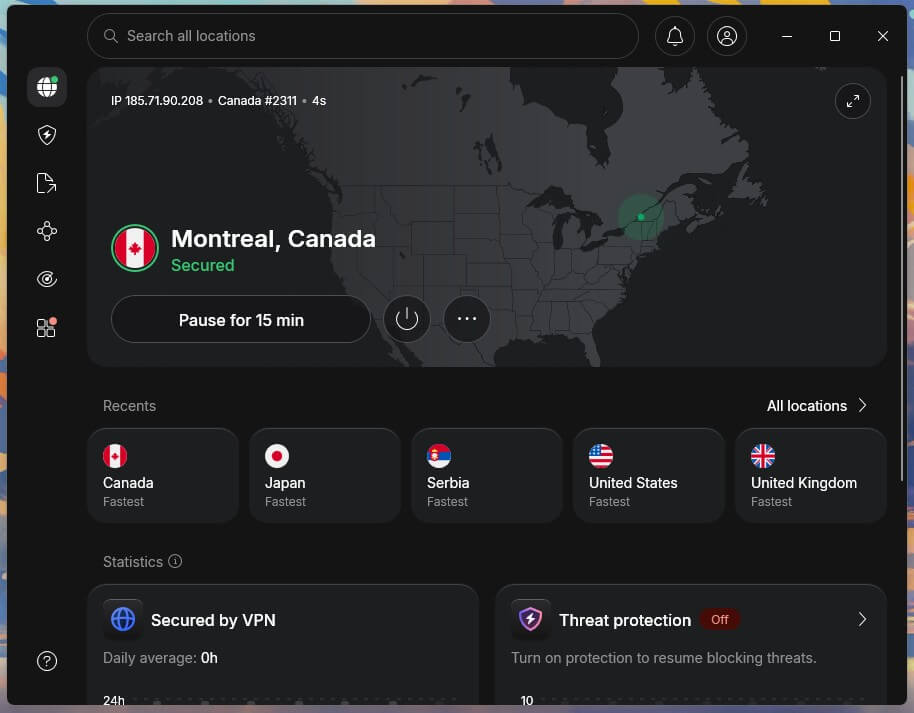
NordVPN heads this list. Its pool of IP addresses decides it: a network across 149 countries means thousands per location, so finding one a chat site hasn’t already flagged takes a few clicks. Switching servers inside the app takes a second, which is the operation you repeat most on these sites. Threat Protection blocks malicious links.
Enable it, because strangers paste URLs on these sites constantly. Double VPN chains two servers for a second round of encryption, and NordWhisper disguises the traffic where a workplace or university blocks VPN connections. Auditors have verified the no-log policy, and nothing is stored on disk, so a session leaves no trace on their side.
2. Proton VPN: Best for Anonymity
Pros
- Based outside EU retention rules
- App code published publicly
- Two-stage Secure Core exits
- DNS-level tracker filtering
- Free plan with unlimited data
Cons
- Short free country list
- Smart DNS not offered
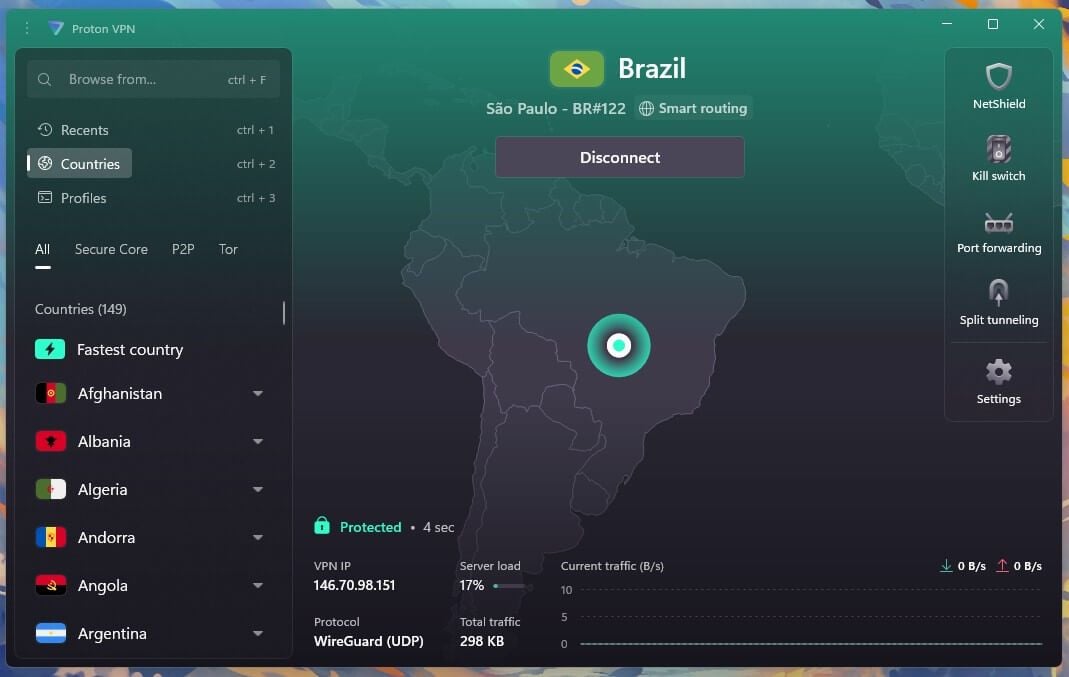
Proton VPN comes second on privacy grounds. The company answers to Swiss law, which leaves it clear of the EU retention regime, and it publishes the source for its apps, which makes the logging claim checkable. Secure Core puts a hardened relay in front of the exit server, so neither the site nor that server learns the origin.
Its network also spans 149 countries, so there are enough IP addresses for the same swapping routine. NetShield blocks ad and tracker domains before the browser requests them. The free tier doesn’t meter your usage, unusual at this standard, though it covers a short country list and you can’t choose where it connects, so a specific country means paying.
3. ExpressVPN: Best for Quick Server Swaps

Pros
- Simplest app to operate
- Lightway connects in seconds
- Obfuscation applied by default
- Nothing written to server disks
- Tracker connections cut off
Cons
- Monthly billing is expensive
- Minimal configuration menu
ExpressVPN earns third place on speed of use. Lightway reconnects in a few seconds, and on a site where you may cycle through several addresses before one works, that difference adds up across a session. The app itself is the plainest here: choose a location and connect. Every connection is obfuscated by default, which keeps it working where a campus network blocks VPN connections.
Its servers write nothing to disk, keeping data in RAM alone, and auditors have examined the no-log policy more than once. Threat Manager cuts tracker connections at the app level. Customization is thin, with settings stopping at the protocol and the kill switch. For this job, that’s enough.
4. CyberGhost: Best for Trying It Properly
Pros
- Longest refund period
- Low long-term pricing
- Self-owned NoSpy data center
- Quarterly transparency reports
- Ad and tracker blocking
Cons
- Device limit lower than rivals
- Obfuscation missing
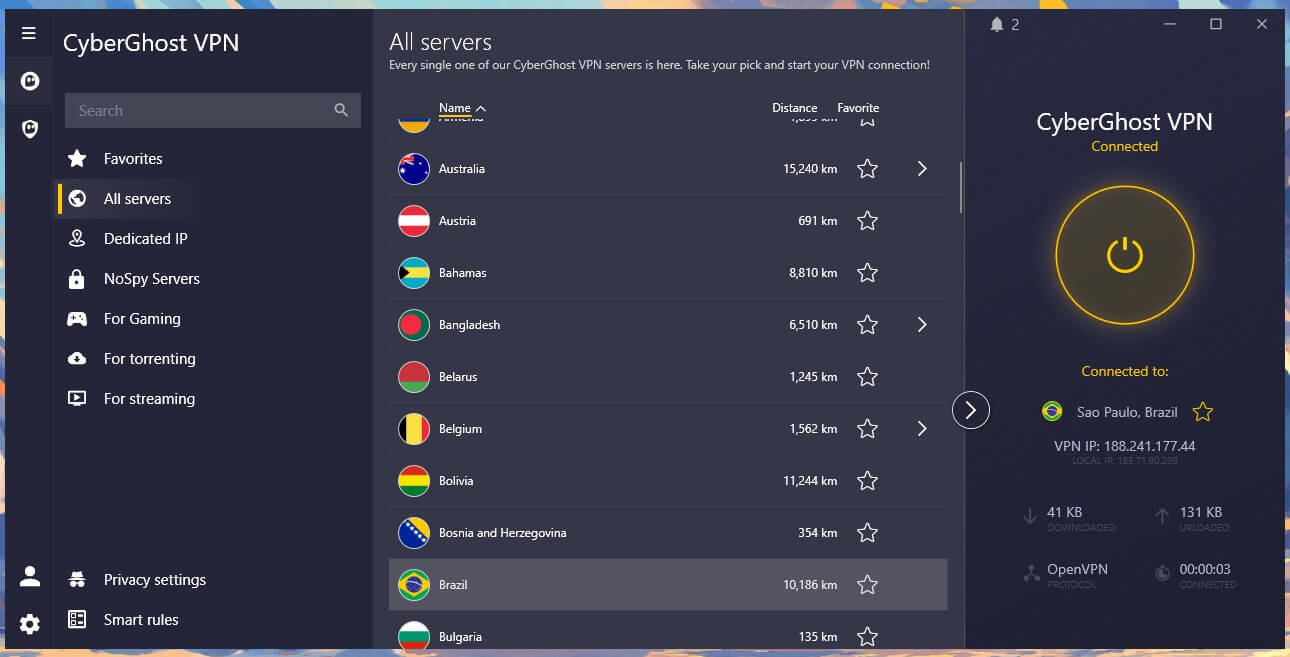
CyberGhost gives you the longest window to find out whether this works on your connection. Its 45-day money-back guarantee covers a month and a half of real use before you decide. That’s long enough to see how often a chat site blocks the IP addresses it assigns. Its server count is one of the largest in the industry, so the supply of IP addresses is deep in the same way.
Deloitte has reviewed its logging practices, and it publishes a transparency report every quarter. Its device allowance is the smallest here, at only seven. There’s no obfuscation, so a network actively filtering VPN traffic will catch it.
5. Surfshark: Best for a Shared Subscription
Pros
- No device limit at all
- Camouflage Mode for blocked networks
- Rotating IP option
- Deloitte-audited no-log policy
- Built-in ad blocker
Cons
- Higher monthly prices
- Antivirus not in Starter plan
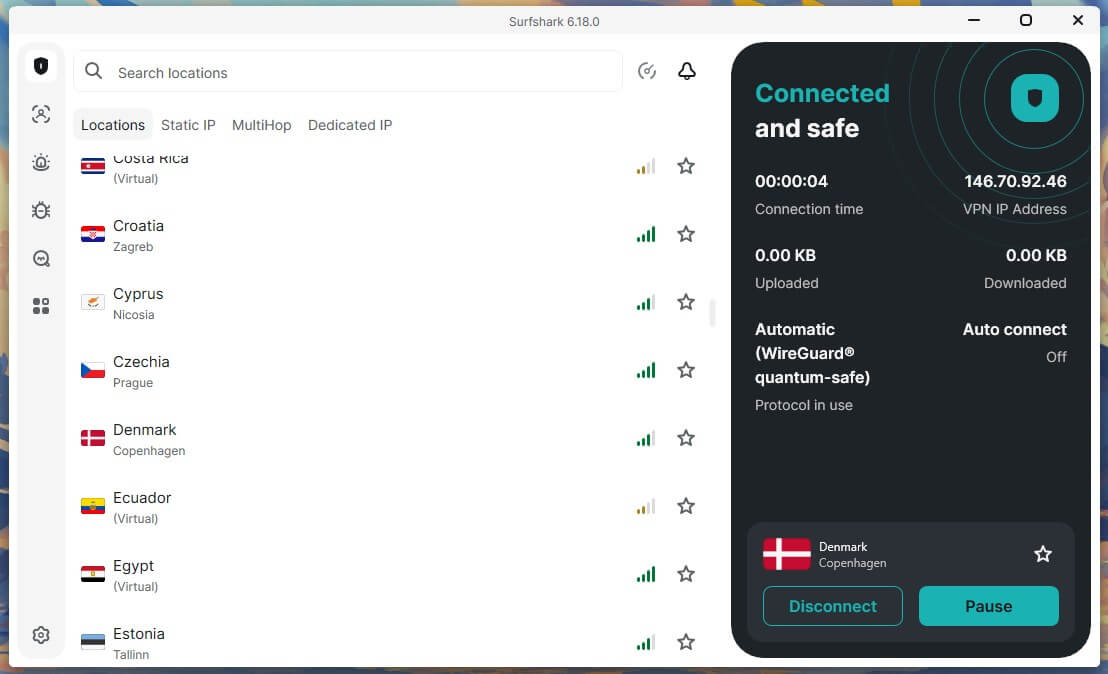
Surfshark places no cap on simultaneous connections, so a phone, a laptop, and the household’s other devices share one subscription. Its Rotating IP feature changes your address periodically during a session without dropping the connection, which is unusual and fits this use directly. Camouflage Mode is its obfuscation setting for networks configured to stop VPN connections.
Deloitte has signed off on its logging practices, and the ad blocker comes with the app at no extra cost. Month-to-month pricing is steep. The long plan costs far less per month, and antivirus is included only in One and One+ plans.
How Bans Work on Random Chat Sites
These platforms ban IP addresses instead of people. There’s no account to suspend on most of them, so the block attaches to the IP address your connection came from. That means the ban follows the network instead of the device. A phone, a laptop, and a game console on the same home connection are blocked together, and on a shared or university network it can catch hundreds of people who did nothing.
It also means a changed IP address removes it, which puts these sites in a permanent race with VPN address ranges. Bans for harassment or abusive behavior are the platform’s decision and its right, and nothing here is aimed at reversing one. The cases worth solving are the accidental ones: a dynamic address reassigned by your ISP, a shared connection, or a report made in bad faith. Our guide to getting unbanned from random chat covers the steps in detail.
Staying Safe on Random Video Chat
The moderation on the current platforms is better than Omegle’s, and none of them is safe in the way that word usually implies.
- Every service here is 18+. They state it in their terms, and it applies whether or not the site verifies it.
- Share no identifying details: full name, school or employer, neighborhood, social handles, or financial information.
- Assume you’re being recorded. Screen capture takes one keystroke and no platform can prevent it.
- Leave the moment a conversation turns coercive and use the report button on the way out.
- Keep the VPN connected so the person on the other end reads a data center address instead of your own.
Can a Free VPN Do This Job?
Rarely. A free plan operates a handful of servers, which means a small pool of addresses shared by an enormous number of users, and those are the first ranges a chat site blocklists. When the IP address you’re assigned is already flagged, a free plan has nothing else to offer. Data caps make it worse, since video chat consumes data quickly, and the paid apps we rank have none.
Security is the larger problem: Hotspot Shield, Hola VPN, and Betternet have been documented logging user activity, which defeats the point of connecting through one, as our free VPN comparison sets out. NordVPN and Proton VPN offer refunds within 30 days, and CyberGhost within 45, which is a better way to test one at no cost.
Verdict
Omegle is gone and staying gone. Chatroulette is the closest replacement for the classic format, OmeTV is the better phone experience, and Emerald Chat pairs you with people who picked the same topics. On the VPN side, NordVPN is our recommendation because the size of its address pool decides how quickly you find a working connection, and Threat Protection handles the links strangers send.
Proton VPN takes the privacy argument further, with Swiss law behind the company and published source code behind the apps. Whichever you install, keep it connected before you press start.
Omegle Alternatives FAQs
Is Omegle coming back?
No, Omegle is permanently closed. The shutdown was announced as final; nothing has launched under the same ownership since, and the sites trading on the name are unrelated.
What is the closest site to Omegle?
Chatroulette is the closest match. It keeps the same start-and-next video format, requires no account for basic use, and applies moderation that Omegle never had in place.
Are Omegle alternatives safe?
Safer than Omegle, though none is risk-free. Chatroulette and Emerald Chat run AI screening and human review, which reduces exposure to nudity and harassment without eliminating it.
Can other users see my IP address on video chat?
Yes, in most cases. A direct device-to-device link exposes your IP address to the stranger you're matched with, and a VPN substitutes the server's IP address for yours.
Why am I banned from a chat site I've never used?
The ban belongs to the IP address. A shared network, a university connection, or an IP address your ISP reassigned can arrive already blocked because of a previous user's behavior.
Is it legal to use a VPN for random chat?
Yes, VPNs are legal in most countries. The platforms set their own terms about ban evasion, and breaking those risks the loss of access, with no legal penalty attached.
