Are VPNs safe to use, or are they just another scam? To answer your question immediately, yes, VPN services are safe to use. However, not all providers are built the same, and there are exceptions to the rule. Sticking to tried-and-tested VPNs is the safest bet. Experiment a bit too much, and you’ll eventually regret it.
The rule of thumb is that premium (paid) services are mostly safe. They earn enough money by selling subscriptions, and it’s in their best interest to emphasize quality. The situation is murkier with free VPNs, where you’ll often find unsafe, borderline dangerous VPNs that we never advise using for whatever purpose.
This article will answer the question about the safety of VPN services, what makes them safe, and what doesn’t. We’ll also recommend the safest VPNs you can use to solidify your online privacy and anonymity.
Are VPNs Safe? How Do VPNs Function?
As alluded to previously, established VPN services are usually pretty safe. Besides, millions of users around the world use VPNs to safeguard their privacy and enjoy online anonymity. There’s a reason why VPNs are safe, and it lies in the way they work. This service allows you to connect to a remote server located somewhere else.
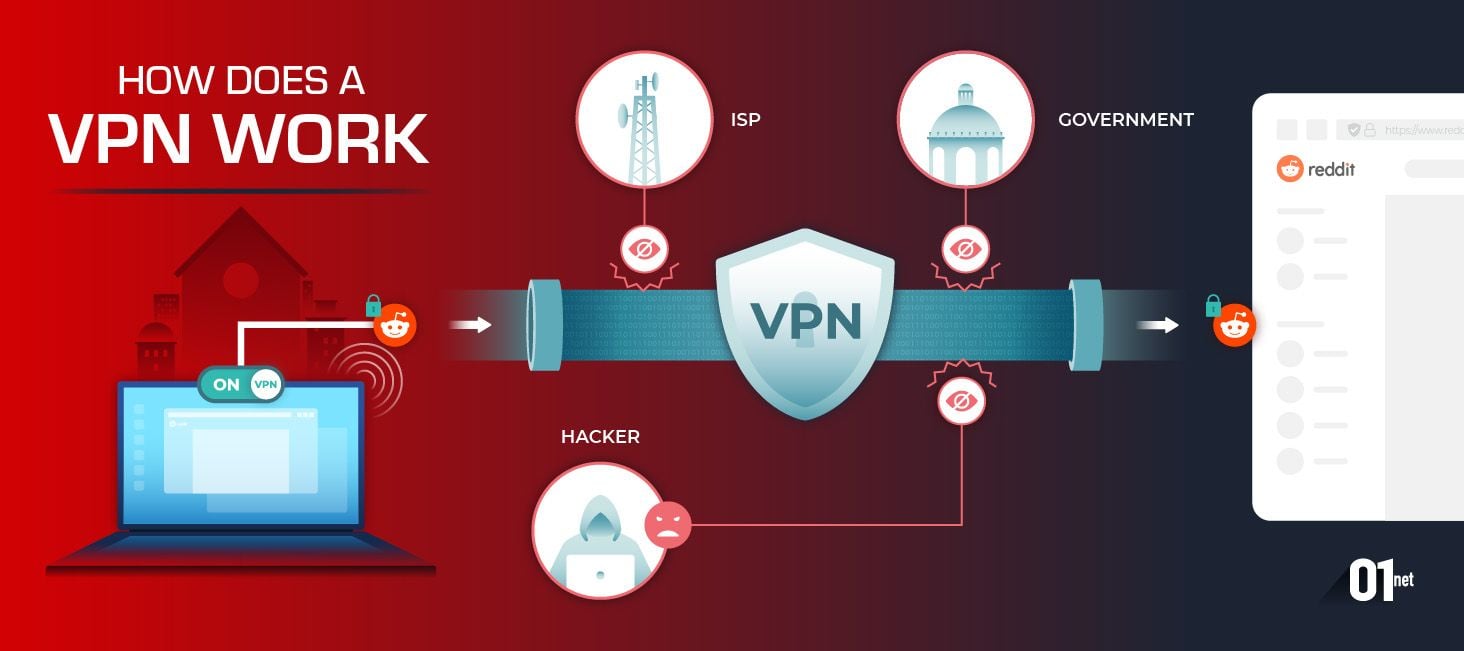
When you connect to it, your original IP address is hidden, and you’re assigned an IP address from that server. That’s basically the definition of a VPN and the way it works. By doing so, you route your traffic through a secure VPN tunnel, which encrypts your traffic and makes it untraceable by your ISP or even hackers.
This has an important benefit, which is top-to-bottom privacy, and another, anonymity, as no one can see what you’re doing online. We’re talking about safe VPNs like NordVPN, ExpressVPN, CyberGhost, and others.
If you stick to tried-and-tested providers, the VPNs are safe. Not only that, but the change of your IP address allows you to bypass geo-restrictions and unblock restricted sites. Other benefits include downloading torrents safely, getting on the dark web anonymously, and browsing the internet without tracking.
Are VPNs really safe then? As said, the answer is YES because of the aforementioned benefits that no other service will give you. At least not to this extent. Recently, we did a comparison between proxies and VPNs, so we highly recommend checking it out. Many people confuse these two, but in short, VPNs are significantly safer.
What Makes a VPN Safe?
A safe VPN is a service that you can fully trust to anonymize your online activities and protect your private data from snoopers. Not every service can be called safe, so let’s take a look at the features and functionalities that a safe VPN must have to deserve this distinguished title.
1. Strong Encryption & Newest Protocols
The first box that the provider must check is strong encryption. By that, we mean 256-bit AES or GCM encryption, the backbone of every quality VPN. This is the strongest encryption and is also used by government bodies. For example, the US military uses the same encryption to protect its confidential data.
It’s also used by banks that require cutting-edge security. VPNs use different protocols for encrypting your traffic and routing it through a secure tunnel. They include OpenVPN, IKEv2, WireGuard, Lightway Turbo, NordLynx, and older ones like IPSec, PPTP, and SSTP. For a VPN to be safe, it must have the latest protocols.
We recommend providers with the first five protocols we mentioned. To repeat, they include:
- OpenVPN (traditional VPN protocol)
- IKEv2 (reliable alternative to OpenVPN)
- WireGuard (lightweight protocol focused on speed)
- NordLynx (NordVPN’s unique protocol based on WireGuard)
- Lightway Turbo (ExpressVPN’s unique protocol for speed and security)
These protocols are still used in 2026, although OpenVPN and IKEv2 made space for more recent additions like WireGuard, NordLynx, and Lightway Turbo. Protocols like SSTP, PPTP, and IPSec are almost extinct breeds due to their unreliability and potential security issues that NordLynx, Lightway, and WireGuard don’t have.
2. Zero-Logging Policy (Privacy-Friendly Jurisdiction)
Another, maybe even more important factor is that the VPN is focused on privacy through the implementation of a no-logging business model. By that, we mean that it stores absolutely no logs of information that can be traced to you. This is usually the case with paid VPNs, although some free VPNs are also log-free.

No-log VPNs are usually based in privacy-friendly jurisdictions such as the British Virgin Islands, Panama, Bulgaria, Romania, Malaysia, and others. Privacy-unfriendly jurisdictions are the ones inside the 5/9/14 Eyes alliance, such as the US, the UK, Canada, Australia, and Western Europe.
Regardless, a no-log VPN must not store information like:
- Originating IP address
- DNS requests (also known as DNS queries)
- Location (approximate and precise)
- Connection logs
- Session information
- Browsing history
- Download history, etc.
Even better is when a safe VPN has a third-party audit on its privacy and security claims. This makes the service even more trustworthy and worth investing your money in. Adequate examples of audited providers are NordVPN, ExpressVPN, and CyberGhost, with at least one and up to twenty-plus audits.
3. Automatic Kill Switch
We always feel like the kill switch is a bit of an underrated feature, especially since it’s turned off by default in many services. However, that’s a cardinal mistake since losing the VPN connection means exposing your IP address to the public eye and losing your privacy in an instant.
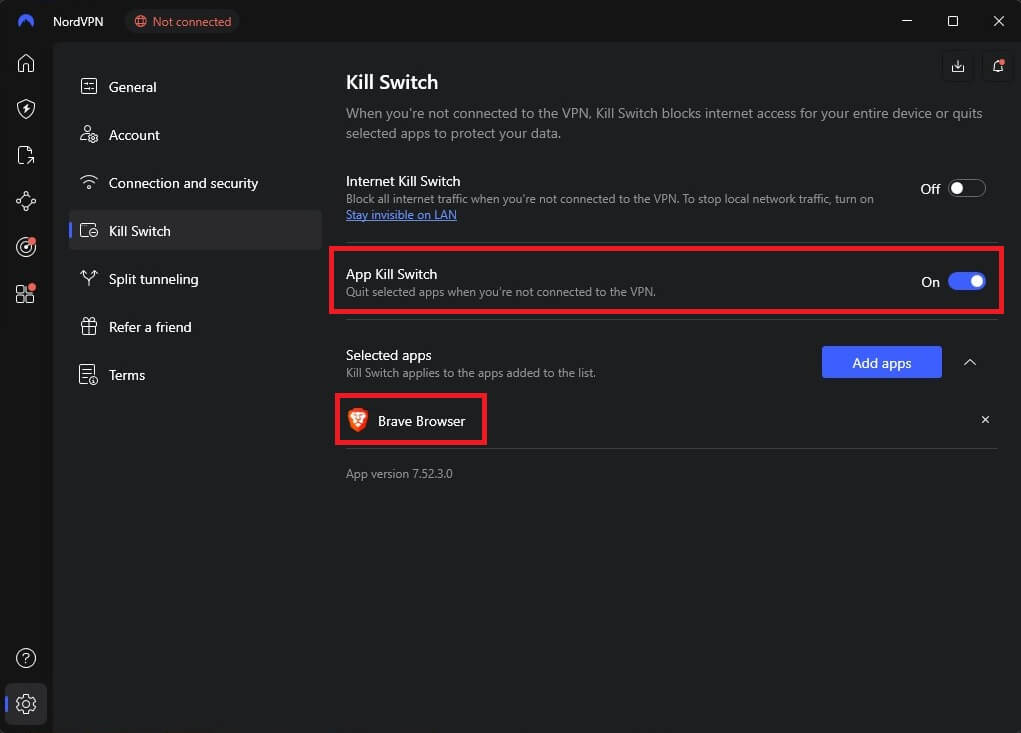
A kill switch will, in this case, immediately disable all traffic and put you in an offline mode until the reconnection attempt is successful. You’ll be cut out from the internet, but you’ll preserve your privacy, which is more important. Is a VPN safe without a kill switch, then? Absolutely not, and it never will be.
For us, a kill switch is a must, and thankfully, the majority of VPNs have it these days, except for a few free providers. We recently tested Turbo VPN, and this free service doesn’t have a kill switch. Coincidentally or not, it also displayed a few IP leaks, which could be linked to weaker encryption and the lack of crucial security features.
To learn more about this feature, feel free to read our article explaining how a Kill Switch VPN works.
4. Perfect Forward Secrecy (PFS)
Perfect Forward Secrecy, which we’ll call PFS, is a feature rarely discussed in the VPN world. VPNs use encryption, and in most cases, it’s AES-256 with some encryption keys. However, very few providers mention the reuse of encryption keys. Reusing encryption keys makes the service vulnerable to hackers who have decrypted them.
Next time a user is assigned that compromised key, a hacker or anyone else can track their activities and steal their data. PFS ensures that each connection gets a new, unique encryption key. Let’s say you connect to a VPN today at 1 pm. Then, you disconnect and connect again at 3 pm.
These connections will have different encryption keys, both of which are unique and never reused. As a result, even if the hacker compromises one of these keys, it won’t be used again, so it doesn’t matter. Of course, it’s extremely hard to compromise safe and secure VPNs, and in 99.99% of the cases, this won’t happen.
PFS is a feature found only in top-grade VPNs. Such providers are NordVPN, ExpressVPN, Surfshark, CyberGhost, and many more. Free providers or at least free versions of paid VPNs usually don’t offer it.
5. RAM-Based Servers
Last but not least, we should state the importance of RAM-based servers. You’ll see this feature only in top-of-the-line VPNs like NordVPN, ExpressVPN, CyberGhost, and Surfshark. RAM-based servers are crucial for privacy. Random Access Memory, or RAM, loses its data each time the power is cut off.
Hard disks used by low-tier providers won’t lose their data until it’s wiped manually or the disk has malfunctioned. Basing a server on RAM has the benefit of wiping every bit of information with each restart. When the server restarts, all data is lost, so there’s nothing to get from the server.
The authorities can request the provider to hand out its server data, but upon inspection, they’ll see that the servers are empty since no data can be found. Servers based on hard disks store information for months, so if the server is compromised, the authorities, hackers, or anyone else will be able to read this data.
In short, for a VPN to be safe and secure, it should have RAM-based servers or, at the very least, another security measure that makes hard-drive-based servers safer. A good example is Proton VPN, which doesn’t use RAM servers, instead employing full-disk encryption to achieve virtually the same effect.
Why Free VPNs Are Not Safe to Use? ❌
Every feature we mentioned previously is a characteristic of cutting-edge, premium VPN services. But what about free services? Why are free VPNs not safe? We think you can already guess the answer, but let us give you a few answers anyway, just to make sure you understand everything well.
The Lack of Security Features
Unlike paid providers, free VPNs won’t offer the full roster of features. Many times, they’re using weaker encryption coupled with the lack of a kill switch, no IP leak protection, and other advanced features. As such, they’re prone to IP and DNS leaks that will compromise your privacy. down the road.
Furthermore, RAM-based servers are the feature that free VPNs are missing, which, as stated, is a game-changer in some VPNs. We should also mention the VPN protocols. Free services don’t have enough resources to upgrade their security, so they stick to older protocols just to make the service work.
There’s an interesting study done by the University of Berkeley and New South Wales in which they studied free VPNs for Android. The study showed that 18% don’t encrypt their traffic, while a whopping 84% of free services are leaking your private data. Sounds alarming? We believe it does.
Keep in mind that not all free services behave this way. Exceptions include Proton VPN and Hide.me, although Windscribe and PrivadoVPN are also great. Here, we mostly refer to the so-called really free VPNs that offer unlimited data and everything else on a silver platter, but still keep tabs on you in the background.
Intrusive Logging Practices
Since they don’t earn money through subscriptions, free providers often collect your sensitive data and sell it to third parties for additional revenue. This is the case with many free providers that offer unlimited data and somewhat decent performance, such as Hola VPN (you know this one for sure).
You’re not paying it with your money but with data like browsing history, IP address, DNS requests, geolocation, connection timestamps, and other revealing bits. Even free VPNs with limited data and slow speeds tend to do this. Aside from Hola VPN, we can mention Urban VPN and at least a dozen more.
Paid VPNs are safe because they already make money from subscriptions, and as such, they don’t need to collect and sell your data – you’re already paying for a service with money.
Frequent IP and DNS Leaks
As said, free VPN providers won’t protect your connection properly, which leads to problems with data leaking. We’ve seen this more than a few times, especially with low-quality free services that have questionable security. The image below shows you Turbo VPN and the leak test we did in a recent review.
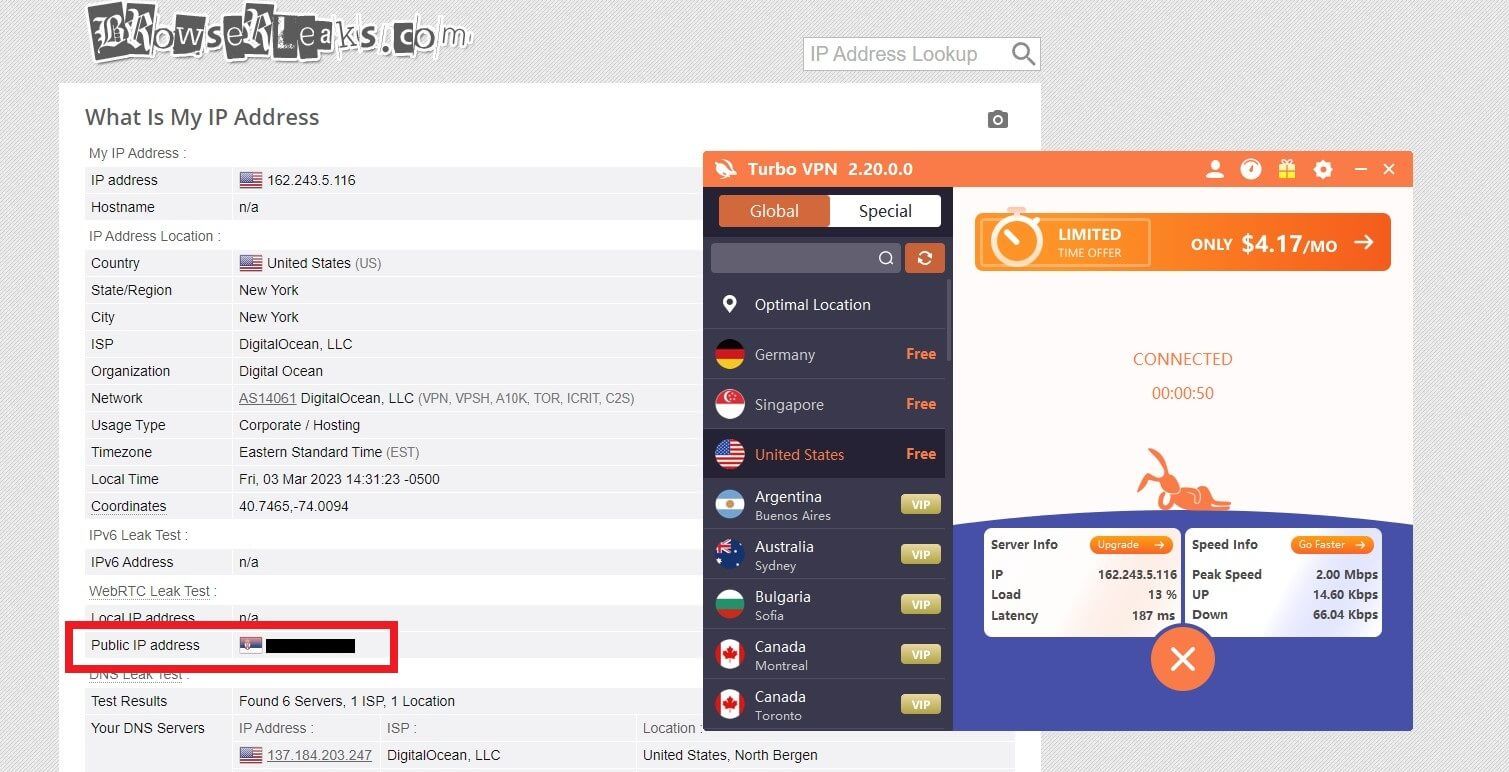
Despite having a US IP address, you can see a leak with a Serbian IP (our native IP), indicating that our connection isn’t as secure as it should be. Paid providers like NordVPN, ExpressVPN, and CyberGhost show no signs of leaking, which is why they’re safe and secure, and free providers aren’t.
VPN Limitations That You Should Know About
While VPNs are 100% safe to use, there are certain limitations that we’d like to address:
- Malware protection – VPNs aren’t designed to detect and remove viruses and malware. They provide online privacy and let you browse the web anonymously. The removal of viruses and malware is done by antivirus software; albeit, some VPNs have anti-malware included as a part of the standard subscription or as a bonus feature (NordVPN, CyberGhost, Private Internet Access)
- Phishing protection – If you’re using a VPN and you expect to be protected from phishing or any similar cyber threat, you need to reevaluate your thoughts. While some VPNs will block malicious domains, most won’t, so you still need to be careful about which sites you visit and which personal data you’re leaving.
- Third-party account tracking – Account tracking can’t be prevented with a VPN. Using your Facebook account to connect to various sites still leaves you vulnerable to Facebook’s tracking. Even if you use a VPN, Facebook will be able to access your account information and track your activities on every site you associate with your Facebook account.
Some Safe VPN Services We Recommend
One thing we promised is to discuss the VPN providers that are completely safe to use with no issues regarding privacy, data leaking, or anything remotely close. So, here are our three favorite options:
- NordVPN. This Panamanian provider has many security audits on its no-logging policy, plus other features like bank-grade encryption and Double VPN. NordVPN has obfuscated servers, NordLynx protocol, a kill switch, RAM-based servers, and malware protection. All this comes at an affordable price for 2 years with a 30-day refund policy, making testing it out risk-free.
- ExpressVPN. It has bank-grade encryption and a certified no-logging policy, offering superb online protection. People enjoy ExpressVPN’s kill switch and the Lightway Turbo protocol, which brings excellent performance. It’s our #2 VPN in 2026, and you can get its biennial Basic plan with a 73% discount and four free months backed by a 30-day money-back guarantee for some big savings.
- CyberGhost. CyberGhost has 256-bit encryption, RAM-based servers, and more than 100 server locations. Its WireGuard support is excellent, and the provider includes an ad-blocker, a kill switch, split tunneling, and IPv6 leak protection. There are also transparency reports and a no-logging policy, all at a low price for a 2-year plan that comes with a large 45-day money-back guarantee.
Can VPNs be Hacked?
One more thing to address before concluding this guide is whether VPNs can be hacked. Yes, they can, but this practice is extremely rare. The best providers use bank-grade encryption, which is usually ChaCha20 or the aforementioned AES-256. These ciphers are the best on the market, and in theory, they can’t be hacked.
If we take AES-256 encryption as an example, its 256-bit keys mean 2^256 combinations, a number so high that we don’t want to waste time writing it. If you have a calculator, do the math. In practice, this means that even all of the world’s supercomputers wouldn’t be able to break the encryption and decrypt your data.
Not even the most skilled CIA-level hackers. NO ONE.
In this regard, VPNs can’t be hacked, so you can rest assured your data is safe and secure once you connect to a server. However, a VPN like NordVPN has been hacked in another way. NordVPN’s security breach in 2018 is well known at this point, but it was minor. The security breach influenced only one server in Finland.
However, the rest of the infrastructure was untouched. NordVPN wasn’t the one to blame, but the security of the data center, which wasn’t under direct ownership of NordVPN but rather belonged to one of the external ISPs. All VPNs rent data centers from third-party providers. The minority of the network is self-owned.
Immediately after, the company performed an audit and fixed its vulnerabilities, ensuring everything was under control. In short, your VPN connection can’t be hacked, but data centers that hold VPN servers can – although this is very, very rare and unheard of in the past few years.
Bottom Line: Are VPNs Safe in 2026?
Are VPNs really safe to use? Well, having in mind everything we said, the answer for those too lazy to read the entire article is positive. Sticking to premium VPNs is the best way to go, as their focus on privacy and security will be of the utmost importance. Recently, we talked about how to get a NordVPN free trial for 30 days.
The same trick applies to premium services like ExpressVPN or CyberGhost. We suggest avoiding 100% free services if you’re looking for a safe VPN that won’t compromise your privacy. Services like this are limited security-wise, and they’re prone to data leaking, which won’t do you any good.